CBN, one of Indonesia’s leading Information and Communications Technology providers, continues to enhance its customer experience by combining technology with human expertise. As customer outreach volumes fluctuated throughout the month, the company sought a more scalable way to support outbound communications while ensuring customers continue to receive timely information and easy access to its customer service team.
Working with AI Rudder, CBN implemented AI-powered voice automation to support selected outbound communications, specifically for payment reminders and customer satisfaction surveys. The solution complements CBN’s existing customer operations, allowing human agents to focus on handling more complex customer needs and interactions.
Today, the AI-assisted solution helps process between 150,000 and 200,000 customer records each month, supporting more consistent outreach while maintaining a seamless customer experience.
At a glance
Customer
CBN
PT Cyberindo Aditama
Industry
Information & Communications Technology (ICT)
Location
Indonesia
Key challenges
Fluctuating outbound communication volumes each month.
Maintaining consistent customer outreach without continually scaling operational resources.
Enabling customer service teams to focus on higher-value customer interactions.
AI Rudder solution
AI Voicebot
Supporting Better Customer Communications
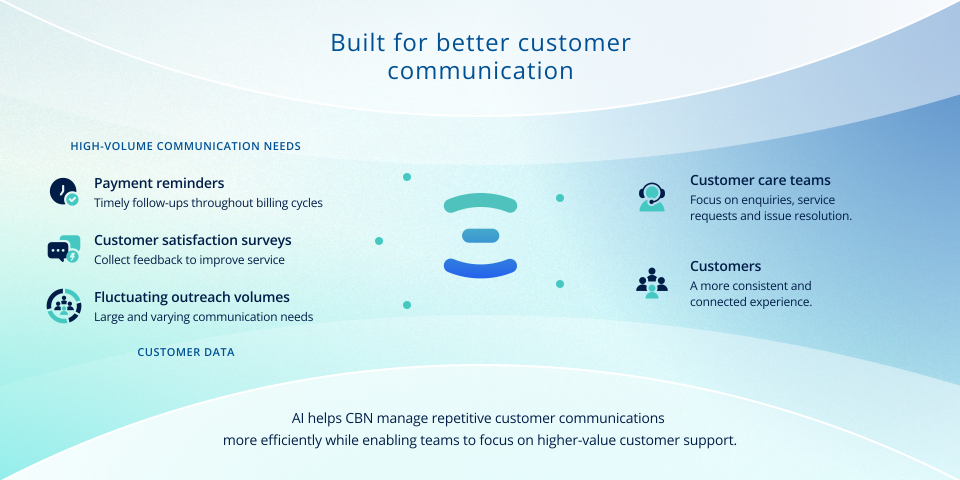
As one of Indonesia’s leading ICT companies, CBN delivers a broad portfolio of digital solutions for businesses, while also serving residential customers through CBN Fiber. Alongside delivering reliable digital services, CBN continuously enhances its customer experience through proactive communications, including payment reminders and customer satisfaction surveys, which help strengthen customer relationships and support continuous service improvement.
As outreach volumes vary throughout each billing cycle, managing large-scale outbound communications using manual processes alone became increasingly challenging. CBN wanted a solution that could help handle repetitive outbound activities more efficiently while allowing its customer care teams to dedicate more time to customer inquiries, service requests, and issue resolution.
Recognising the need for a more flexible approach, AI was introduced to support CBN’s customer service operations.
A new chapter in customer outreach
CBN partnered with AI Rudder to introduce AI Voicebot technology into two outbound communication processes: payment reminder calls and customer satisfaction surveys. This allows CBN to manage changing outbound workloads more efficiently without relying solely on manual calling, creating a more scalable approach to day-to-day customer outreach.
The AI Voicebot automates routine outbound calls for payment reminders, helping CBN consistently reach customers at scale. In parallel, InfoChecker Voicebot conducts automated customer satisfaction surveys, providing an additional channel for customers to share feedback following their service experience.
The AI Voicebot automates routine outbound calls for payment reminders, helping CBN consistently reach customers at scale. In parallel, InfoChecker Voicebot conducts automated customer satisfaction surveys, providing an additional channel for customers to share feedback following their service experience.
Following the implementation, CBN achieved an average 27% connection rate across its collection activities, with 6–10% of connected customers completing the intended collection outcome. More consistent outbound coverage has enabled the company to reach a larger share of customers despite fluctuations in monthly outreach volumes.
Today, CBN has established a more structured approach to managing collections and customer satisfaction surveys. Automation helps ensure that routine communications are delivered consistently while customer service representatives remain available to provide personalized assistance whenever customers require further support.
Improving Efficiency While Keeping Customers at the Center
Automated customer satisfaction surveys have also provided CBN with a more consistent way to gather customer feedback, helping teams better understand customer sentiment and identify opportunities to improve the overall service experience.
By combining AI-powered automation with human expertise, CBN has established a more scalable customer communication model that supports operational efficiency without compromising service quality. Manual workloads and operational costs have been reduced by 50–70%, while overall productivity has improved by 100–200%. These gains allow customer care teams to focus their time on interactions where empathy, problem-solving, and personalized assistance create the greatest value for customers.
As customer expectations continue to evolve, CBN remains committed to leveraging technology responsibly by using AI where it can improve efficiency while ensuring customers continue to have convenient access to knowledgeable customer service representatives whenever they need assistance.
“As CBN continues to expand its portfolio of digital solutions, delivering an excellent customer experience remains one of our highest priorities. Working with AI Rudder helps us manage routine outbound communications more efficiently, allowing our teams to focus on personalized support where it matters most.”
Dedi Handoko, Commerce Director CBN
Telecommunications is a fiercely competitive industry where proactive customer engagement is crucial for driving revenue. Telcos regularly run massive outbound telemarketing campaigns to promote plan upgrades, launch new products, and execute win-back programs for churned customers. However, executing these campaigns at scale presents a significant operational challenge.
Relying solely on human agents for high-volume outbound calling is expensive, inefficient, and difficult to scale quickly. Agents spend countless hours dialing numbers, leaving voicemails, and dealing with unanswered calls, leading to low productivity and high burnout. Enter AI-powered telemarketing: a transformative approach that allows telecom companies to scale their outbound campaigns exponentially without the need to continuously expand their call center headcount.
The Challenge of Scaling Outbound Telemarketing in Telecom
Traditional outbound telemarketing in the telecom sector is fraught with inefficiencies. The sheer volume of customers that need to be contacted for a new promotion or upgrade offer requires a massive workforce. Human agents are limited by the number of calls they can make in a shift, and their productivity is heavily impacted by low connection rates.
When agents finally do connect with a customer, the interaction is often brief and transactional, yet it consumes valuable time that could be spent on more complex, high-value sales conversations. Furthermore, scaling up human teams for seasonal campaigns or major product launches involves significant recruitment, training, and infrastructure costs, making it difficult for telcos to remain agile and responsive to market opportunities.
What AI Voice Agents Can Do for Telecom Outbound Campaigns
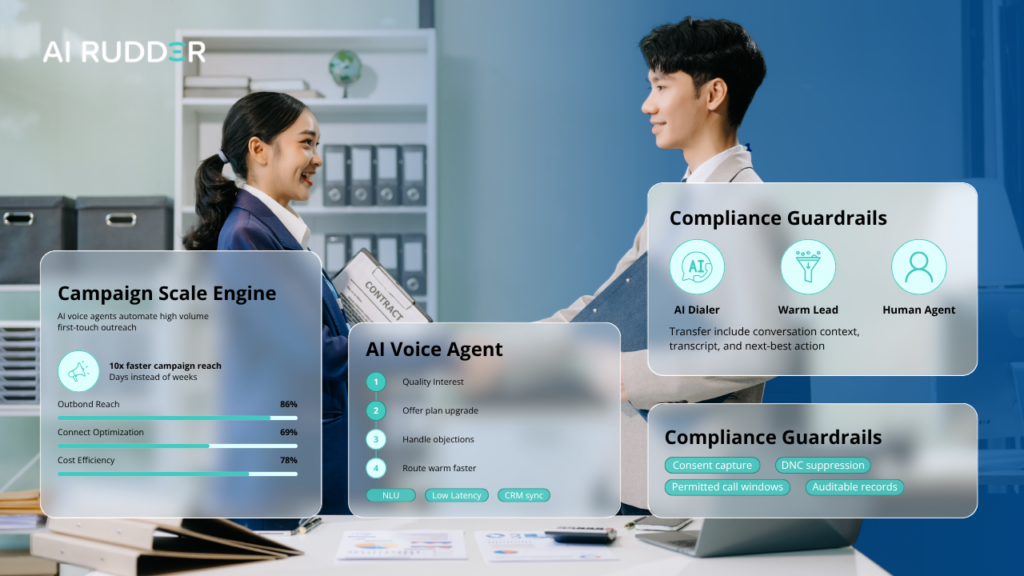
AI voice agents are revolutionizing outbound telemarketing by automating the initial, high-volume stages of customer outreach. These intelligent systems can dial thousands of numbers simultaneously, ensuring maximum reach in a fraction of the time it would take a human team.
In the context of telecom campaigns, AI voice agents are highly effective at several key tasks:
Lead Qualification: The AI can engage customers in natural conversations to gauge their interest in a new offer or plan upgrade, filtering out those who are not interested.
Plan Upgrade Offers: AI agents can proactively contact customers whose data usage suggests they would benefit from a higher-tier plan, explaining the benefits and seamlessly processing the upgrade if the customer agrees.
Appointment Setting: For complex B2B telecom solutions, the AI can qualify the lead and schedule a follow-up call or meeting with a specialized human sales representative.
Win-Back Campaigns: AI can reach out to former customers with targeted re-engagement offers, gathering feedback on why they left and presenting compelling reasons to return.
How AI Handles Objections and Escalates to Human Agents
A common concern with automated outbound calls is how the system handles customer objections or complex questions. Modern AI voice agents are equipped with advanced Natural Language Understanding (NLU) that allows them to interpret and respond to common objections smoothly. If a customer says, “I can’t afford that right now,” the AI can be programmed to offer a more budget-friendly alternative or highlight the long-term savings of the proposed plan.
Crucially, AI agents are designed to recognize their own limitations. When a conversation becomes too complex, or if the customer expresses a strong desire to speak with a person, the AI performs a “smart handoff.” It seamlessly transfers the call to a human agent, providing them with the full context and transcript of the conversation up to that point. This ensures that the human agent can pick up exactly where the AI left off, focusing their expertise on closing the sale rather than repeating introductory information.
Compliance and Consent Management in Automated Outbound Calls
In the telecom industry, outbound calling is subject to strict regulatory frameworks regarding consumer privacy and consent (such as TCPA in the US or GDPR in Europe). Maintaining compliance is non-negotiable.
AI-powered telemarketing systems are built with robust compliance features. They can automatically scrub call lists against Do Not Call (DNC) registries and ensure that calls are only made within legally permissible hours. Furthermore, AI agents can be programmed to explicitly ask for and record customer consent at the beginning of the call, maintaining a secure and auditable trail of compliance that is far more reliable than manual human processes.
Key Metrics for Measuring AI Telemarketing Performance in Telecom
To evaluate the effectiveness of AI-powered outbound campaigns, telcos should focus on specific performance metrics that highlight both reach and conversion:
Connect Rate: The percentage of dialed calls that are successfully answered by a human. AI systems can optimize dialing patterns to improve this rate.
Conversion Rate: The percentage of connected calls that result in a desired outcome (e.g., a plan upgrade or a scheduled appointment).
Cost Per Acquisition (CPA): By automating the bulk of the outreach, AI significantly lowers the CPA compared to traditional human-led campaigns.
Human Agent Utilization: Tracking how human agents spend their time post-implementation should show a shift toward high-value closing conversations rather than repetitive dialing.
Real-World Results: What AI Telemarketing Delivers for Telcos
When implemented effectively, AI-powered telemarketing delivers dramatic improvements in campaign performance. Telecom companies utilizing advanced AI voice agents report the ability to execute campaigns 10x faster than manual teams, reaching the entire target audience within days rather than weeks.
Because the AI filters out unanswered calls and unqualified leads, human agents receive a steady stream of “warm” transfers—customers who have already expressed interest. This targeted approach not only boosts overall sales conversion rates but also significantly improves human agent morale and retention, as they spend their time succeeding rather than dialing. By leveraging AI for outbound telemarketing, telcos can transform their sales operations into highly efficient, scalable growth engines.
Scale Your AI Telecom Campaigns with AI Rudder
AI Rudder is a globally trusted conversational AI partner that has powered over 80 million interactions for 500+ enterprises across 20 languages. Our AI Voice Agent is purpose-built for high-volume outbound campaigns, delivering human-like conversations at scale with ultra-low latency responses — ensuring every customer interaction feels natural and engaging, not robotic.
Telecom companies across Southeast Asia and beyond rely on AI Rudder to automate their outbound telemarketing operations, from plan upgrade campaigns and new product launches to win-back programs. Our platform integrates seamlessly with your existing CRM and dialing infrastructure, and our enterprise-grade compliance features ensure every campaign meets regulatory requirements.
Ready to scale your outbound campaigns without scaling your headcount? Contact AI Rudder today to schedule a demo and see how our AI Voice Agent can supercharge your telemarketing performance.
Legacy Interactive Voice Response (IVR) systems remain one of the single biggest sources of customer frustration in the telecommunications industry. For decades, telecom companies have relied on these rigid, menu-driven systems to route calls and manage high-volume inquiries — yet as customer expectations for fast, seamless, and personalized service continue to rise, the limitations of traditional IVR have become impossible to ignore. Today, replacing legacy IVR with AI voice agents is no longer an optional upgrade; it is a strategic imperative for telcos aiming to reduce churn, improve customer satisfaction, and lower operational costs. This article examines why legacy IVR is failing, how conversational AI transforms the customer experience, and how telecom companies can navigate the transition without disrupting operations.
Why Customers Hate Traditional IVR and What It Costs Telcos
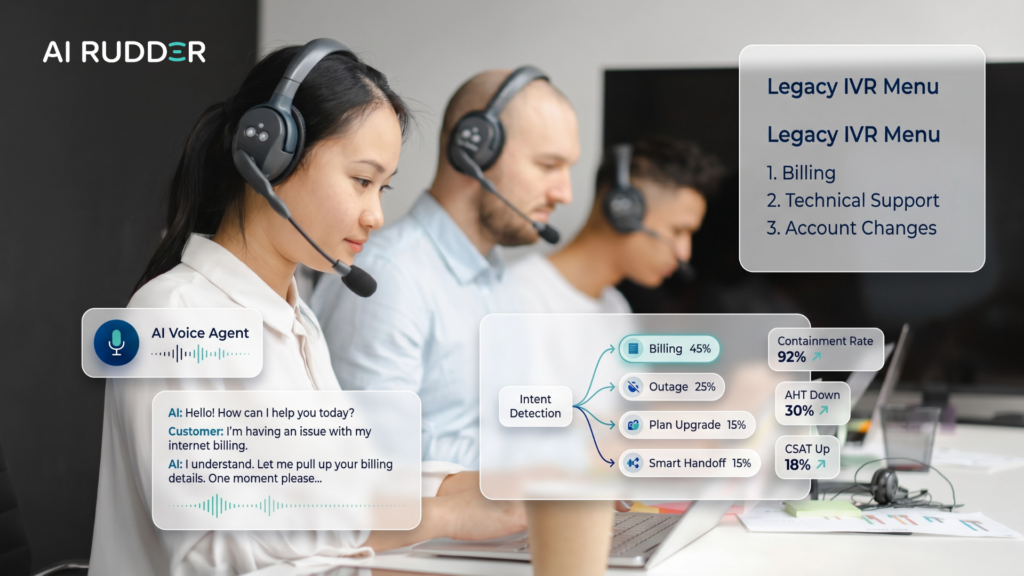
The traditional IVR experience is widely regarded as one of the most frustrating touchpoints in customer service. Callers are forced to navigate complex, multi-layered menus (“Press 1 for billing, Press 2 for technical support…”), sitting through irrelevant options before finding what they need. When a mistake is made or when an issue doesn’t fit a predefined category — customers are either disconnected or trapped in an endless loop, ultimately demanding to speak to a live agent.
This frustration has a direct financial impact on telecom companies. When customers cannot resolve their issues quickly, they become dissatisfied, leading to lower Net Promoter Scores (NPS) and higher churn rates. In a highly competitive market where switching providers is easier than ever, poor customer service is a primary driver of customer attrition. Furthermore, the inefficiency of IVR means that a significant percentage of calls still end up being routed to live agents, defeating the purpose of automation and driving up call center operational costs.
Legacy IVR vs. Conversational AI Voice Agents: What’s the Difference?
The fundamental difference between legacy IVR and modern AI voice agents lies in how they understand and interact with the caller. Traditional IVR is rules-based and relies on DTMF (Dual-Tone Multi-Frequency) tones or simple keyword recognition. It forces the customer to adapt to the machine’s structure.
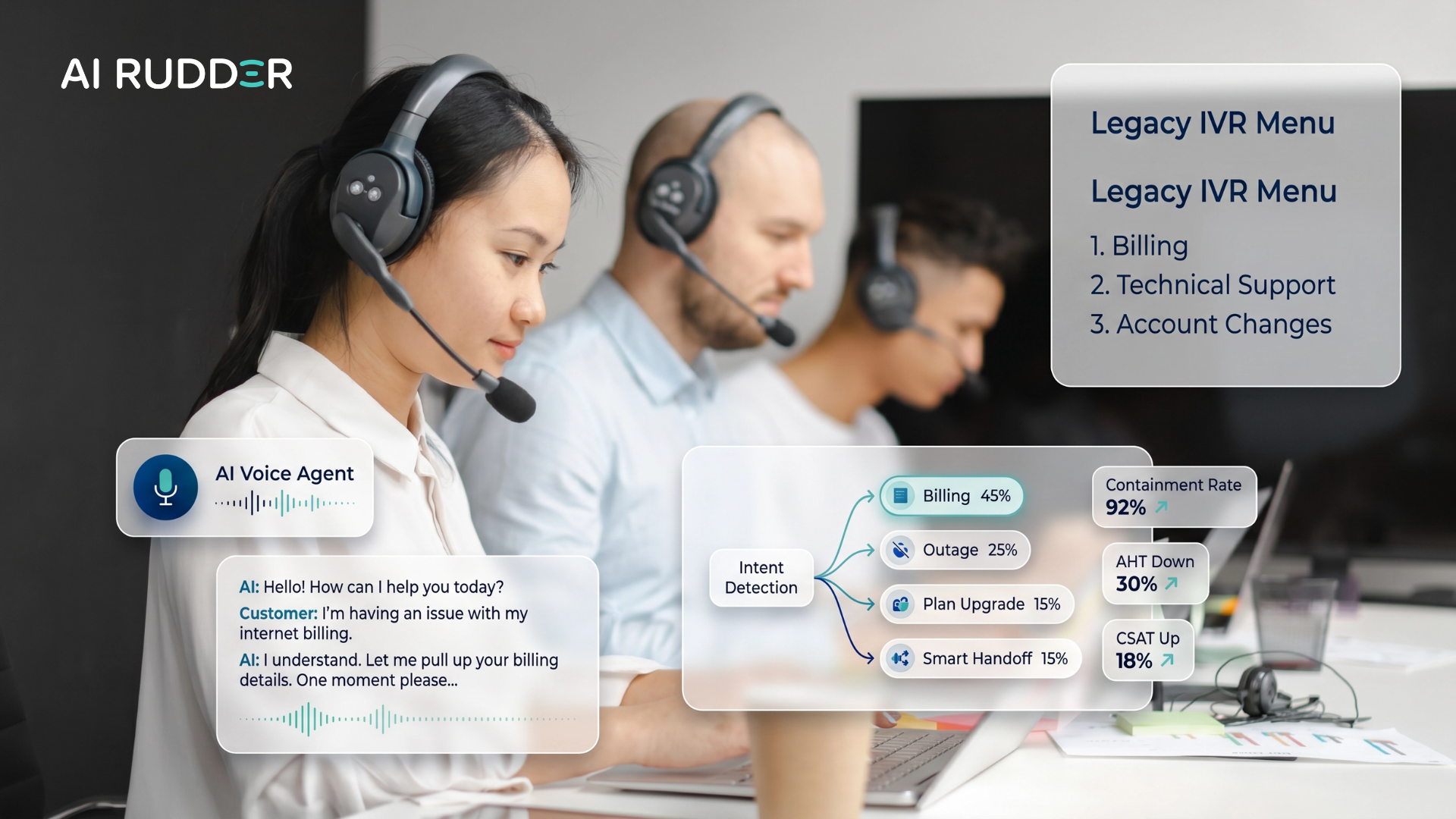
In contrast, an AI voice agent leverages advanced Natural Language Understanding (NLU) and speech recognition to facilitate open-ended, human-like conversations. Instead of presenting a menu, the AI simply asks, “How can I help you today?” The customer can speak naturally, explaining their issue in their own words. The AI understands the intent, context, and sentiment behind the query, allowing it to provide immediate, relevant assistance or route the call accurately without the need for complex menus.
Key Capabilities to Look for in an AI Voice Agent Solution
When evaluating AI voice agent solutions to replace legacy IVR, telecom companies should prioritize several critical capabilities:
Advanced Natural Language Understanding (NLU): The system must be able to accurately comprehend complex sentences, varied accents, and colloquialisms, ensuring that customer intents are recognized even when phrased unpredictably.
Multilingual and Local Dialect Support: In diverse markets, especially across regions like Southeast Asia, the ability to converse fluently in multiple languages and local dialects is essential for providing an inclusive customer experience.
Seamless CRM Integration: The AI must integrate deeply with the telecom’s Customer Relationship Management (CRM) and billing systems. This allows the agent to access real-time customer data, personalize interactions, and perform transactional tasks (like processing payments or upgrading plans) directly within the conversation.
Intelligent Escalation (Smart Handoff): When an issue is too complex or emotionally sensitive for the AI to handle, it must seamlessly transfer the call to a human agent, passing along the full context and history of the conversation so the customer doesn’t have to repeat themselves.
Top Use Cases for AI Voice Agents in Telecom
AI voice agents excel at automating the high-volume, routine inquiries that typically overwhelm telecom call centers:
Billing Inquiries and Payments: Customers can naturally ask for their current balance, due dates, or payment history. The AI can securely process payments or set up payment arrangements over the phone.
Plan Changes and Upgrades: AI agents can handle requests to change data plans, add roaming packages, or upgrade services, often identifying upsell opportunities based on the customer’s usage patterns.
Outage Notifications: During network outages, AI voice agents can proactively inform callers about the issue and estimated resolution times, deflecting massive spikes in call volume.
SIM Activation and Onboarding: The AI can guide new customers through the SIM activation process step-by-step, verifying identity and ensuring a smooth onboarding experience.
How to Migrate from IVR to AI Without Disrupting Operations
Replacing a core piece of infrastructure like an IVR system can seem daunting, but a phased approach minimizes risk and ensures a smooth transition. Telecom companies should avoid a “rip-and-replace” strategy.
Instead, start by deploying the AI voice agent alongside the existing IVR to handle a specific subset of calls or a particular use case, such as billing inquiries. This allows the organization to test the system, gather data, and refine the AI’s conversational flows in a controlled environment. As confidence in the system grows and performance metrics are validated, the AI can gradually take over more call types and routing responsibilities, eventually phasing out the legacy IVR entirely.
Key Metrics to Track After Migrating from IVR to AI Voice Agents
To measure the success of migrating from IVR to an AI voice agent, telecom companies should monitor key performance indicators (KPIs) that reflect both operational efficiency and customer satisfaction:
Containment Rate: The percentage of calls fully resolved by the AI without human intervention. A significant increase in containment indicates successful automation.
Average Handle Time (AHT): The total time a customer spends on the call. AI agents should reduce AHT by eliminating menu navigation and providing instant answers.
Customer Satisfaction (CSAT) and NPS: Post-call surveys should reflect higher satisfaction scores as customers appreciate the faster, more natural interaction.
Agent Utilization: Human agents should see a decrease in routine, repetitive calls, allowing them to focus on complex, high-value interactions.
By replacing legacy IVR with intelligent AI voice agents, telecom companies can transform their customer service from a point of friction into a competitive advantage, delivering the fast, personalized experiences that today’s consumers demand.
Ready to Replace Your Legacy IVR? Transform Telecom CX with AI Rudder
AI Rudder is a globally trusted conversational AI partner purpose-built for enterprise-scale deployments. With a proven track record of handling over 80 million interactions across 500+ enterprises in 20 languages, AI Rudder’s AI Voice Agent delivers ultra-low latency, human-like responses in under one second — ensuring every customer interaction feels natural, fast, and personal.
Whether you are looking to replace a legacy IVR system, automate high-volume inbound inquiries, or create a seamless omnichannel experience for your subscribers, AI Rudder provides the technology and expertise to make it happen. Our infrastructure meets leading international security standards, including SOC 2, ISO 27001, GDPR, and PDPA, so you can modernize your customer service with full confidence.
Ready to leave IVR behind and deliver the intelligent voice experience your customers deserve? Contact AI Rudder today to schedule a demo and see how our AI Voice Agent can transform your telecom operations.
The telecommunications industry is currently at a critical point of transformation. Competition is intensifying, customers demand fast, personalized, and consistent service, while digital services are becoming increasingly complex with the presence of 5G, IoT, and various new digital solutions.
In the midst of this situation, telcos face a significant challenge: how to remain operationally efficient while still delivering a personalized and responsive customer experience. Traditional approaches are often lacking, as innovation typically relies on limited technical teams and long development cycles.
This is where AI agent builders come in as a solution. These platforms, both no-code and low-code, enable teams across an organization to design, train, and deploy AI agents without relying on significant IT resources. With this technology, innovation is no longer the sole responsibility of a certain teams, but can be carried out by various teams, from customer support and operations to product management. AI agent builders democratize the use of AI, accelerate the innovation cycle, and enable every team to experiment and improve customer interactions directly.
The Role of AI Agent Builders in Telco Modernization
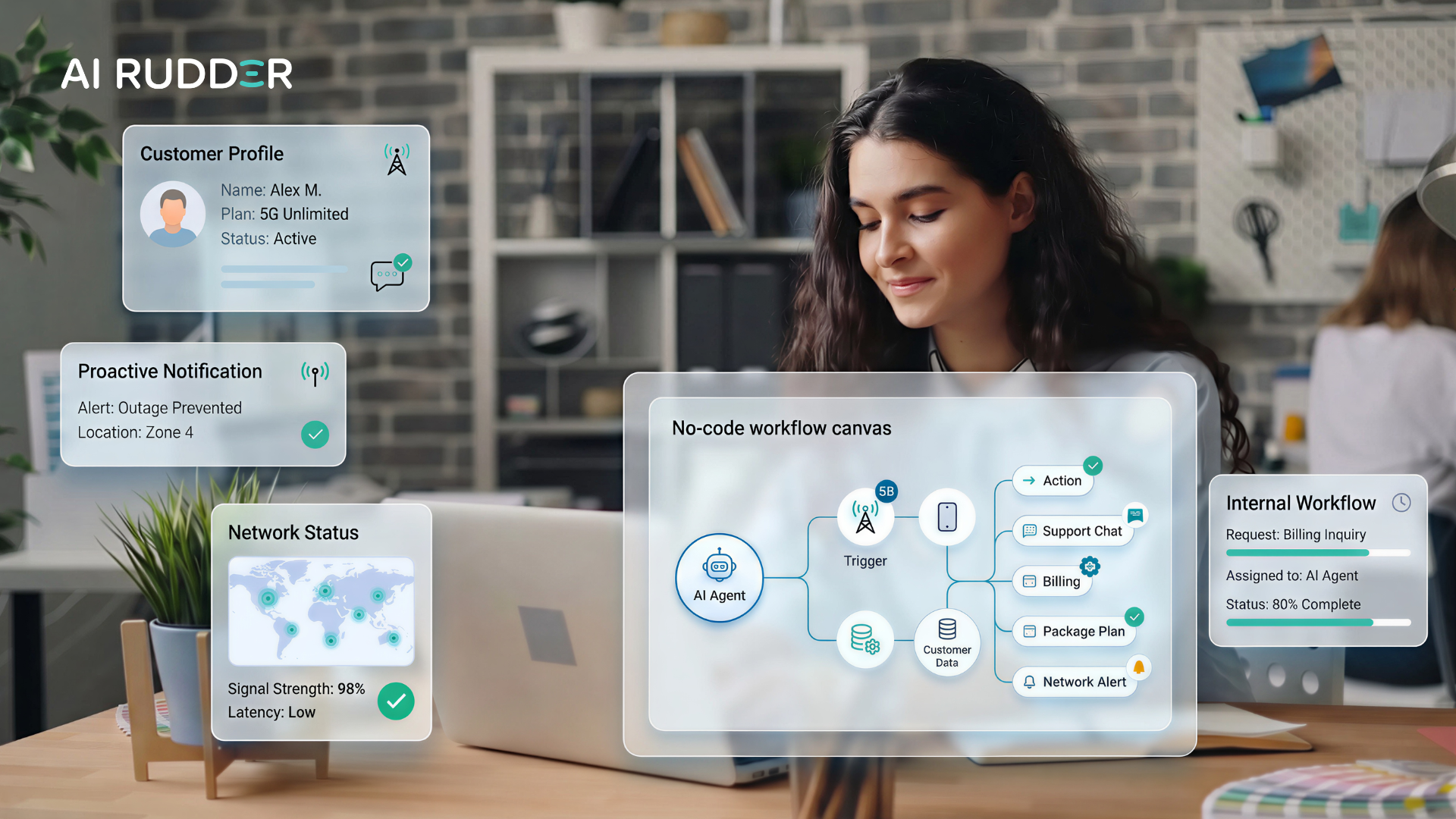
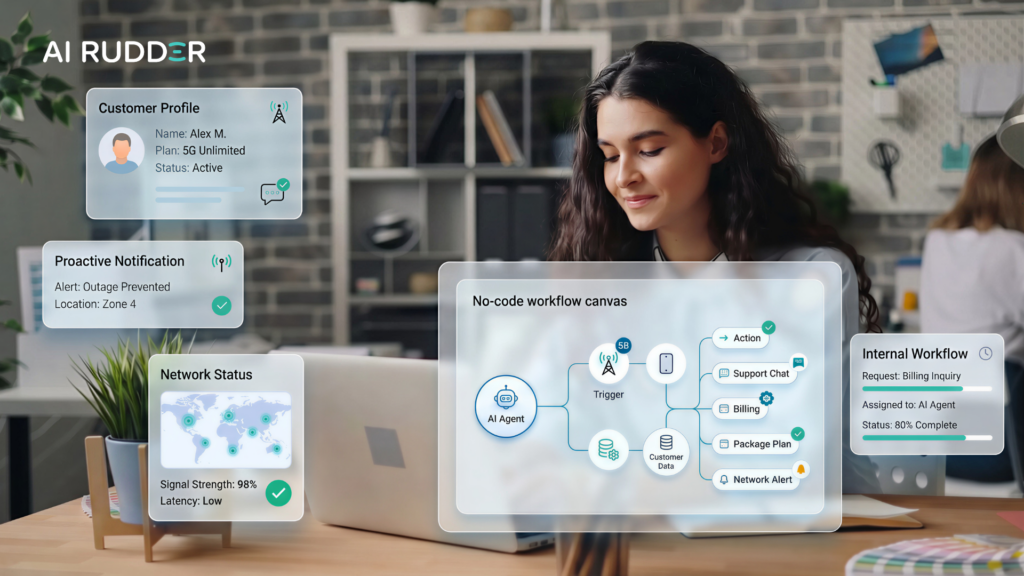
The implementation of AI agent builders in the telco industry has had a significant impact. For customers, AI agents can automate routine inquiries, such as bill checks, package details, or network troubleshooting. Furthermore, AI agents can provide proactive notifications to customers, such as network outages, the latest promotions, or upcoming bill dues. Sales teams also benefit from AI agents, which can help customers choose packages based on their usage patterns, making the experience more personalized and relevant.
Moreover, AI agents streamline internal processes at telecom companies. Internal teams can utilize AI agents to update systems, generate reports, and monitor project status without time-consuming manual tasks. This not only increases efficiency but also frees employees to focus on strategic tasks. Therefore, AI Agent Builder is not just an automation tool, it acts as a catalyst for empowering the entire organization.
In addition to driving efficiency, AI agent builders also accelerate the innovation process. With these platforms, new ideas can be tested, optimized, and implemented in a much shorter time compared to traditional methods. Telecom operators can respond quickly to market changes while maintaining large operational scales without significantly increasing human resources. In the era of 5G and IoT, this capability enbales telcos to evolve into ecosystem enablers, rather than simply connectivity providers, by offering intelligent, adaptive, and scalable digital experiences to customers.
One of the most transformative aspects of AI agent builders is how they shape a culture of innovation within telco organizations. Previously, digital innovation was often limited to IT or R&D teams. Now, with easily accessible platforms, marketing, operations, and even customer service teams can build their own solutions. This encourages faster experimentation, more visible results, and decisions that are closer to customer needs. Innovation is no longer the responsibility of a single department but is becoming part of the daily work across the organization.
Real-world Use Cases: From Automation to Personalization
Telecom companies are increasingly utilizing AI agent builders to deliver a more efficient and personalized customer experience. An example of this is customer service automation, where AI agents handle routine inquiries such as checking bills, package details, or signal troubleshooting. This automation frees human agents to focus on more complex issues that require a personal touch.
AI agents also play a role in proactive notifications, informing customers about network disruptions, the latest promotions, or upcoming bills. This approach ensures customers always receive timely information, without having to wait for them to contact the call center.
On the sales side, AI agent builders support Sales Assistance, helping customers choose packages that suit their usage patterns, making interactions more relevant and personalized. AI agents are not only used for external services, they are also deployed in internal operations, helping internal teams update systems, generate reports, or monitor project status through internal chatbots.
From frontline interactions to internal workflows, AI agent builders are transforming the way telcos operate and communicate, making processes faster, more efficient, and more responsive to the needs of both customers and internal teams.
Building the Future of Telecom Innovation
AI agent builders are more than just automation tools, they are the foundation of digital transformation for the telecom industry. With this technology, telcos can move faster, work smarter, and deliver relevant, personalized, and continuous customer experiences. The next wave of innovation in the telco world begins with the ability to build solutions intelligently, quickly, and collaboratively.
Empower Your Telco Innovation with AI Rudder
AI Rudder helps telcos transform operations and customer experiences through intelligent, no-code AI agents. With this platform, every team can create their own innovations, accelerate workflows, and take organizations to the next level. Contact us for more information and discover how AI Rudder can help your telco innovate smarter, faster, and more collaboratively.
For years, customer service in the telecommunications industry has always been viewed as a cost burden. It’s been considered a cost center that constantly drains budgets to pay for dozens of agents and operations without actually generating revenue. Customer complaint, support request, or billing inquiry adds to operational cost. As a result, many telecom companies have historically focused on cost reduction rather than value creation in their customer service strategy.
However, that has changed now. Customer service that were previously only considered expenses can be transformed into revenue-generating engines thanks to conversational AI. This technology is not just an automated chatbot that replies to messages, but a smart digital companion. They not only resolve customer issues but also actively seek sales opportunities in every interaction. The future of customer service is no longer just a cost center, but has transformed into a real revenue source.
The Dilemma of the Modern Telecommunications Operator
Telecommunications companies are caught up in an unhealthy price war as industries become more competitive. They kept offering cheap packages, but it turned out they weren’t sustainable. On one hand, margins continue to shrink, while on the other hand, operating costs keep rising. This is an endless cycle that’s hard to stop.
In fact, today’s customers actually want more than just low prices. They also want a personal and special experience. Unfortunately, the existing service systems are often too rigid and generic. As a result, so many great possibilities are missed, chances to sell upgrade packages, offer new services, or simply retain customers who are about to cancel their contracts often slip by because they weren’t handled properly at the right time.
How Conversational AI is Transforming Telecom Customer Service
This is where Conversational AI shows its transformative role in the telecommunications industry. This technology distinguishes itself from traditional automation systems by its ability to shift from a reactive to a proactive mindset. Instead of waiting for customers to realize their quota is running out, AI can detect usage patterns and provide solutions before problems arise. AI can notify customers if their internet quota is about to run out and immediately offer to purchase more data. This approach converts potential disappointment into a mutually beneficial business opportunity.
The true power lies in the ability for personalization that was previously difficult to achieve. Conversational AI can leverage data to understand each customer’s individual preferences and habits. For users who frequently play online games, the system will offer low-latency packages. Meanwhile, business customers who frequently make international calls might receive recommendations for more economical international phone plans. This is what sets apart ordinary service from a truly personalized experience.
More than just an efficient question answerer, Conversational AI is evolving into a skilled sales partner. Its greatness lies in its ability to naturally cross-sell and up-sell within the flow of conversation. For example, when a customer asks for billing details, AI can not only provide the requested information but also offer other packages. Interactions like this feel natural and unforced because they arise in the right context and are supported by an understanding of customer needs. This transformation shows that Conversational AI is not just an efficiency tool, but a strategic asset that unlocks added value in every customer interaction.
Real-World Use Cases that Generate Revenue
One of the most intelligent implementations is how a proactive AI system can become an effective sales machine. AI can ask and offer customers to purchase another package when their quota runs out. This kind of approach doesn’t seem aggressive: instead, it feels like genuine care. Instead of waiting for customers to become frustrated because they ran out of data, the operator provided a timely solution that also increased revenue.
Personalized offers delivered by conversational AI also have a high success rate due to their relevance. When customers feel treated specially and differently from other customers, their sense of loyalty will be built. It is the right offer to the right person that transforms ordinary interactions into profitable transactions.
Equally important, conversational AI’s ability to retain customers is equivalent to preserving current revenue. This system can detect signs that a customer wants to switch providers, such as frequently checking their remaining active period or asking about cancelation procedures. If the sign is detected, AI can immediately offer a loyalty discount or other exclusive benefits. Retaining existing customers is proving to be far more cost-effective than acquiring new ones, and this is what makes conversational AI such a valuable investment.
Not Just Revenue, But Also Efficiency
The benefits of implementing Conversational AI are actually mutually beneficial. On the one hand, this technology opens up new revenue streams thru proactive and personalized sales. But equally important, it also creates significant operational efficiencies within the organization.
With AI handling various routine tasks such as upselling, upgrade offers, and other basic services, human teams can be freed up to focus on things that require a deeper personal touch. Customer service agents now have more time to handle complex cases, resolve complex customer complaints, and build stronger emotional connections with customers. This complementary division of roles between AI and humans creates a far more effective operational structure.
Most interestingly, all these benefits ultimately lead to an overall improvement in the customer experience. When customers feel their needs are understood, they are served quickly, and they receive relevant solutions, their loyalty will naturally grow. Customer lifetime value also increased as the relationship between customers and operators grew stronger. This is what ultimately creates sustainable competitive advantage in this increasingly crowded telecommunications industry.
Conversational AI as a Strategic Telecom Investment
Conversational AI in telecom has moved beyond its status as a mere add-on technology. In the increasingly competitive telecommunications industry, this has become a strategic necessity not only to survive, but to truly excel. This technology represents an opportunity to transform service departments from cost burdens into intelligent and proactive revenue engines.
At AI Rudder, we help telecom operators deploy advanced conversational AI solutions—including AI voicebots, automated calling systems, and AI contact center platforms—to transform customer interactions into measurable business outcomes.
Contact AI Rudder today to discover how conversational AI can turn every customer conversation into a new opportunity for growth.
CBN, one of Indonesia’s leading Information and Communications Technology providers, continues to enhance its customer experience by combining technology with human expertise. As customer…
Telecommunications is a fiercely competitive industry where proactive customer engagement is crucial for driving revenue. Telcos regularly run massive outbound telemarketing campaigns to promote…
Legacy Interactive Voice Response (IVR) systems remain one of the single biggest sources of customer frustration in the telecommunications industry. For decades, telecom companies…
The telecommunications industry is currently at a critical point of transformation. Competition is intensifying, customers demand fast, personalized, and consistent service, while digital services…
For years, customer service in the telecommunications industry has always been viewed as a cost burden. It’s been considered a cost center that constantly…
May 7, 2026
We use cookies to improve your experience. By continuing to browse, you agree to our Privacy Policy.