CBN, one of Indonesia’s leading Information and Communications Technology providers, continues to enhance its customer experience by combining technology with human expertise. As customer outreach volumes fluctuated throughout the month, the company sought a more scalable way to support outbound communications while ensuring customers continue to receive timely information and easy access to its customer service team.
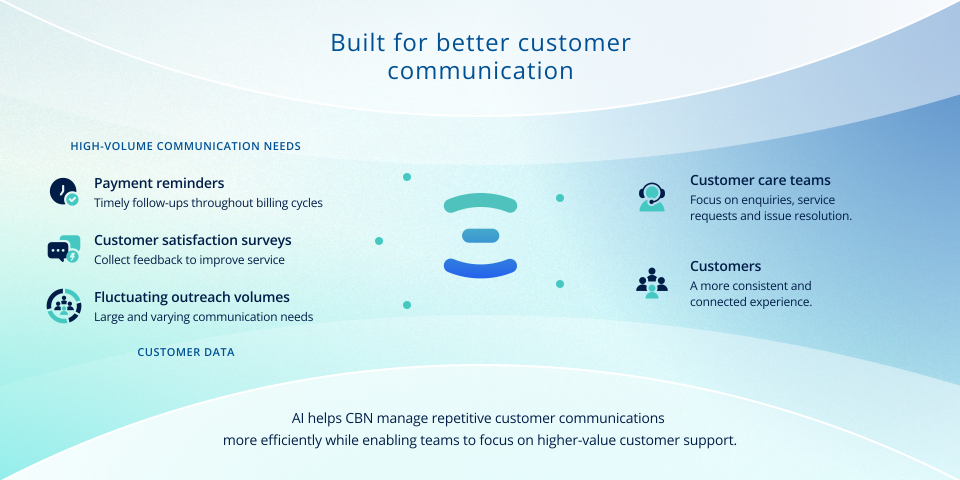
Working with AI Rudder, CBN implemented AI-powered voice automation to support selected outbound communications, specifically for payment reminders and customer satisfaction surveys. The solution complements CBN’s existing customer operations, allowing human agents to focus on handling more complex customer needs and interactions.
Today, the AI-assisted solution helps process between 150,000 and 200,000 customer records each month, supporting more consistent outreach while maintaining a seamless customer experience.
At a glance
Customer
CBN
PT Cyberindo Aditama
Industry
Information & Communications Technology (ICT)
Location
Indonesia
Key challenges
Fluctuating outbound communication volumes each month.
Maintaining consistent customer outreach without continually scaling operational resources.
Enabling customer service teams to focus on higher-value customer interactions.
AI Rudder solution
AI Voicebot
Supporting Better Customer Communications
As one of Indonesia’s leading ICT companies, CBN delivers a broad portfolio of digital solutions for businesses, while also serving residential customers through CBN Fiber. Alongside delivering reliable digital services, CBN continuously enhances its customer experience through proactive communications, including payment reminders and customer satisfaction surveys, which help strengthen customer relationships and support continuous service improvement.
As outreach volumes vary throughout each billing cycle, managing large-scale outbound communications using manual processes alone became increasingly challenging. CBN wanted a solution that could help handle repetitive outbound activities more efficiently while allowing its customer care teams to dedicate more time to customer inquiries, service requests, and issue resolution.
Recognising the need for a more flexible approach, AI was introduced to support CBN’s customer service operations.
A new chapter in customer outreach
CBN partnered with AI Rudder to introduce AI Voicebot technology into two outbound communication processes: payment reminder calls and customer satisfaction surveys. This allows CBN to manage changing outbound workloads more efficiently without relying solely on manual calling, creating a more scalable approach to day-to-day customer outreach.
The AI Voicebot automates routine outbound calls for payment reminders, helping CBN consistently reach customers at scale. In parallel, InfoChecker Voicebot conducts automated customer satisfaction surveys, providing an additional channel for customers to share feedback following their service experience.
The AI Voicebot automates routine outbound calls for payment reminders, helping CBN consistently reach customers at scale. In parallel, InfoChecker Voicebot conducts automated customer satisfaction surveys, providing an additional channel for customers to share feedback following their service experience.
Following the implementation, CBN achieved an average 27% connection rate across its collection activities, with 6–10% of connected customers completing the intended collection outcome. More consistent outbound coverage has enabled the company to reach a larger share of customers despite fluctuations in monthly outreach volumes.
Today, CBN has established a more structured approach to managing collections and customer satisfaction surveys. Automation helps ensure that routine communications are delivered consistently while customer service representatives remain available to provide personalized assistance whenever customers require further support.
Improving Efficiency While Keeping Customers at the Center
Automated customer satisfaction surveys have also provided CBN with a more consistent way to gather customer feedback, helping teams better understand customer sentiment and identify opportunities to improve the overall service experience.
By combining AI-powered automation with human expertise, CBN has established a more scalable customer communication model that supports operational efficiency without compromising service quality. Manual workloads and operational costs have been reduced by 50–70%, while overall productivity has improved by 100–200%. These gains allow customer care teams to focus their time on interactions where empathy, problem-solving, and personalized assistance create the greatest value for customers.
As customer expectations continue to evolve, CBN remains committed to leveraging technology responsibly by using AI where it can improve efficiency while ensuring customers continue to have convenient access to knowledgeable customer service representatives whenever they need assistance.
“As CBN continues to expand its portfolio of digital solutions, delivering an excellent customer experience remains one of our highest priorities. Working with AI Rudder helps us manage routine outbound communications more efficiently, allowing our teams to focus on personalized support where it matters most.”
Dedi Handoko, Commerce Director CBN
CALL-E, AI Rudder’s newest goal-based voice AI agent, is designed to do more than simply connect a call. To complete a task, CALL-E must know when to listen, when to wait, when to press a key, and how to determine whether the phone system actually received its selection.
By Yuanshan Zhang, Lin Si, and Xinyuan Huang
The hardest part may happen before a human ever answers
Imagine that you need to call a clinic to reschedule an appointment.
The call connects, but a person does not answer. The system plays a welcome message, asks you to choose a language, and then offers options for appointments, billing, prescriptions, and other requests. At the next level, it may ask for a member ID—or ask you to stay on the line until a representative becomes available.
For a person, this is merely a slightly tedious phone call. We listen to the menu, remember the right number, press the key, and then naturally continue the conversation when the hold music ends and someone answers.
For an AI agent, however, this is not simply a matter of hearing a number and pressing it.
The agent must first determine what it is interacting with: a live person, voicemail, a hold message, or an automated phone menu. It must know whether the menu has finished playing and whether it should speak, stay silent, or send a keypad tone. After pressing a key, it must keep listening to determine whether the call has moved to a new menu, entered a transfer, reached a person, or simply started replaying the same prompt.
A connected call is not necessarily a completed task.
That is why CALL-E began building IVR (Interactive Voice Response) navigation.
Teaching AI to use the phone system—not just speak through it
Traditional IVR systems—the familiar “press 1 for billing, press 2 to change an appointment”—still handle a large share of real-world calls. Clinics, insurers, pharmacies, airlines, public agencies, and many local businesses rely on them to route callers.
If an AI agent cannot get through those menus, even the most natural conversation skills never get a chance to help the user complete the task.
To solve this, CALL-E added DTMF (Dual-Tone Multi-Frequency) keypad support to its Calling Subagent, allowing it to send telephone keypad tones when an IVR menu clearly requests them. DTMF is the signaling method phones use to send keypad inputs—such as 1, 2, or #—to automated menus. Once this capability reached real telephone networks, we continued iterating on speech segmentation, menu understanding, keypad transmission, and outcome verification.
Listen to the latest information from the call.
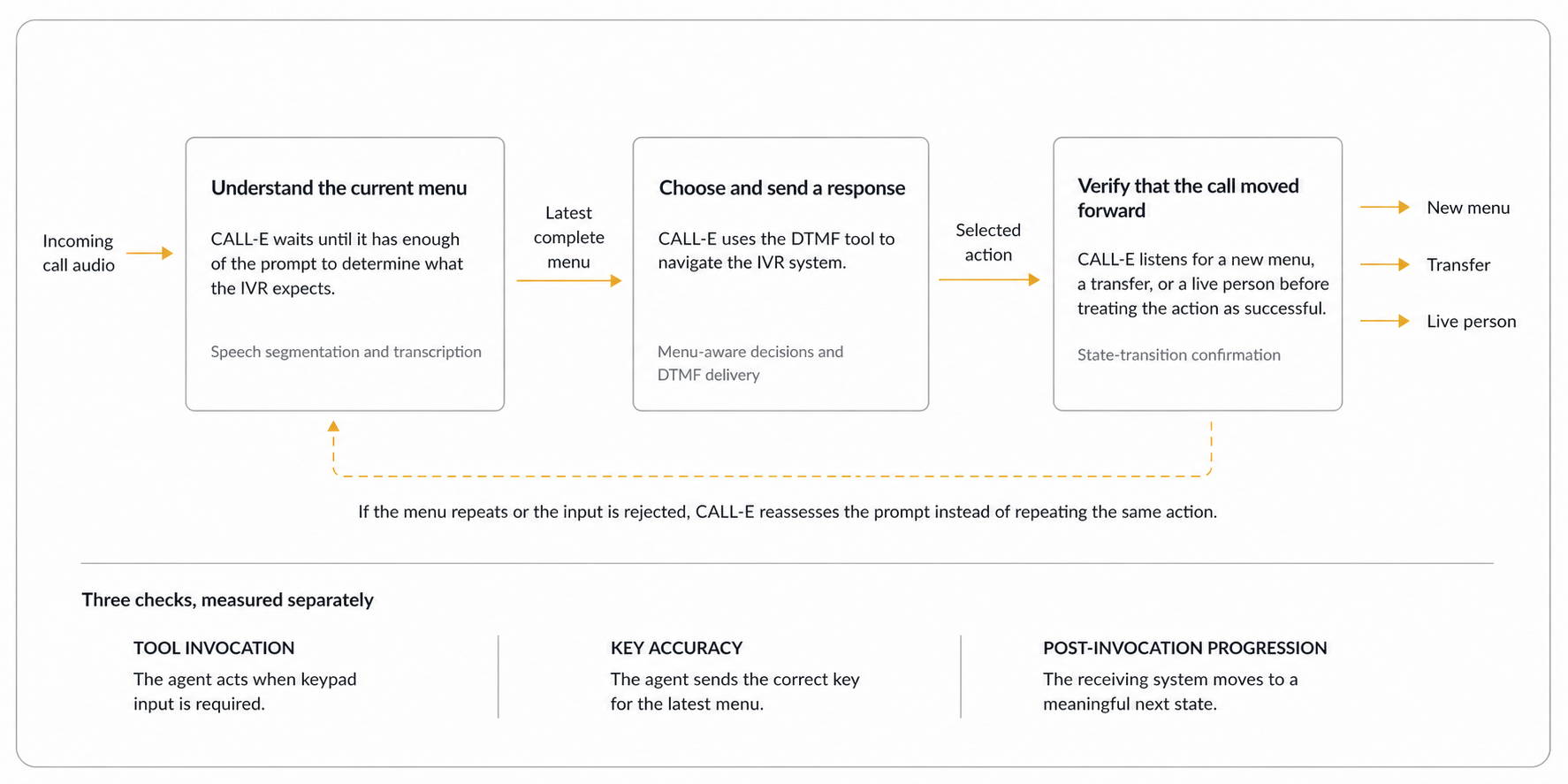
Determine whether the current state is a live conversation, an automated menu, a transfer queue, or something else.
Choose among waiting, speaking, and sending a keypad tone.
Observe the phone system’s response and decide what to do next.
When a complete menu clearly requests keypad input, CALL-E can choose the option that best matches the user’s goal. If the menu offers a clear route to a representative, it can prioritize reaching a person.
At the same time, CALL-E will not guess an account number, PIN, member ID, or other information the user has not provided. If the information required for the next step is unavailable, it will try to explain the purpose of the call or request a representative rather than inventing an input.
That sounds straightforward. But once the capability encountered real telephone networks, we quickly learned that making a tool available solves only the first layer of the problem.
Pressing the right key is only half the job
After launch, we separated an IVR interaction into three independent questions:
Did the agent invoke the keypad tool when it should have?
Did the selected key match both the user’s goal and the current menu?
After the key was sent, did the receiving phone system recognize it and advance to the next step?
These questions are easy to conflate, but they have very different causes and require different solutions.
Sometimes the agent did not press a key when it should have
In some early calls, the agent interpreted “press 1” as a request for a spoken answer. It said the number aloud or continued waiting for the system to accept speech. In other cases, after several keypad attempts appeared to have no effect, the agent remained silent without explaining the task again or requesting a transfer to a person.
We therefore made the boundary for keypad use explicit: the agent sends a key only when the latest menu clearly requests keypad input, the menu is complete, and the correct selection can be determined. During the turn in which it sends a key, it does not speak at the same time, preventing speech and DTMF from interfering with each other.
Sometimes the menu the agent sees is incomplete
Real IVR menus are rarely a single clean, uninterrupted recording. A system may say, “Please listen carefully to the following options,” pause, and only then begin listing departments and numbers. Transfers, background noise, and language changes can introduce additional boundaries in the audio.
Telephone audio is transmitted and recognized as it arrives. The system uses voice activity detection (VAD) to decide whether the other side has finished speaking, and automatic speech recognition (ASR) to convert the audio into text. The problem is that VAD largely relies on sound and silence to divide speech into turns. A natural pause in an IVR recording can therefore be mistaken for the end of an utterance.
Instead of receiving the whole menu, the agent may first see only a fragment such as:
Press 3 for Hypoluxo in Congress in Boynton Beach. Press 4 for …
The rest of the option does not arrive until the next segment.
Consider a location directory that is playing the following menu:
For Deerfield Beach, press 1; for West Boynton Beach, press 2; for Hypoluxo, press 3; and for other locations, press…
To a person, this is obviously an unfinished list. On a real call, however, a long menu and the pauses between options may cause the audio to be divided into multiple segments. If voice activity detection decides too early that the system has finished speaking, the agent may temporarily receive only “for other locations, press…,” without the number. If it treats that fragment as a complete instruction, it may guess a key, start speaking too early, or incorrectly conclude that the menu does not contain a relevant option.
An even simpler example is a system that first says:
“For service in English, please press…”
and adds, after a brief pause:
“…three.”
To a human listener, these audio segments form one sentence. In a real-time system, they may arrive as two separate inputs. Reliable behavior means recognizing that the action is present but its parameter is missing. Instead of guessing from the word “press,” the agent stays silent and waits until it hears the complete instruction, “press 3,” before sending the key.
Long prompts create another boundary. When an automated recording exceeds the maximum duration allowed for a single speech turn, the system may be forced to split it. We later increased that limit significantly, reducing the number of long menus cut off by a hard duration boundary. But a longer limit does not prevent VAD from ending a segment at a shorter pause. This remains a tradeoff between responsiveness and completeness: waiting longer provides more context, but can make ordinary human conversations feel sluggish.
Waiting is not inaction. It is a necessary IVR navigation behavior.
We therefore did not rely on speech-segmentation settings alone. We added a second guardrail at the agent’s decision layer: DTMF is allowed only when the agent has both a complete option and the explicit key associated with it. If the latest input ends with “please press,” “please select,” or an introduction to options that have not yet played, the agent treats the menu as incomplete, preserves the IVR state, and keeps listening. A brief silence does not mean the menu is over.
This prevents the agent from guessing 0, *, or another key that was never offered. It is still a recovery strategy built on an incomplete transcript. If the remaining audio is never recognized correctly, the agent can wait or look for a route to a representative, but it cannot reconstruct a missing digit out of thin air. We are continuing to explore more reliable ways to combine menu fragments and reason about audio state.
Sometimes the agent chose correctly, but the key did not make it through the network
One real call illustrates the problem well. CALL-E needed to contact an automotive service business to schedule a tire installation and vehicle diagnostic. After entering the IVR, the agent selected the correct options based on the menu it had heard. Twice, however, the receiving system responded with “invalid selection.” The call never reached the scheduling branch or a representative.
From the agent’s perspective, the decision was correct. From the task’s perspective, the menu was never passed.
Choosing the correct key and successfully delivering that key through the telephone network are two different problems.
A successful tool response tells us only that CALL-E initiated a keypad action. It does not prove that the receiving system accepted it. In a telephone network, DTMF is not a text message that says “the user pressed 1.” A key is encoded as a sequence of telephone events—with duration and end markers—using RTP telephone-event, then passed through the calling platform and network to the receiving IVR.
The timing of that sequence matters. If an event is too short, if multiple packets are emitted in a burst, or if consecutive digits are sent without enough separation, the receiving system may miss a key or interpret several keys as an invalid input. In other words, choosing the right key does not guarantee that it was sent in a form every IVR can recognize.
In an early group of failed calls, we repeatedly saw CALL-E produce a DTMF action while the receiving system still returned invalid or replayed the same menu. That pattern narrowed the problem from “did the model press a key?” to “did the receiving IVR recognize it?”
We then changed the transport-layer sending model. Event packets were paced according to real time, individual key events were given a longer effective duration, end markers were repeated, and distinct gaps were added between consecutive digits. Multiple keypad requests within the same call were serialized to prevent two sequences from interleaving. After these changes, the concentrated pattern of unrecognized inputs declined significantly.
Even so, improving the transport layer does not guarantee that every IVR will accept every input. We therefore distinguish three separate states: the system accepted the keypad request, the telephone layer completed transmission, and the receiving IVR confirmed progress. The first two cannot substitute for the third.
After sending a key, the agent must keep listening for a new menu, a transfer, or a live person. If it hears invalid or receives the same menu again, it treats the action as a navigation failure and changes strategy instead of blindly repeating it. Our observability follows the same path, allowing us to distinguish rejected requests, interrupted transmissions, and keys that were sent but not recognized—rather than collapsing them all into a generic “keypad failure.”
Real calls revealed the problem layer by layer
During the first production observation period, the tool itself was already triggering reliably, yet some invocations still failed to advance beyond the menu. Other calls successfully sent a key but then failed to interpret the resulting hold or transfer state.As our evaluation criteria matured, we began measuring three dimensions separately:
Tool invocation: When keypad input was clearly required, did the agent act?
Key accuracy: Did the key sent by the agent match the user’s goal and the options in the latest menu?
Post-invocation progression: Did the receiving system stop replaying the same menu and move to a new menu, a transfer, a live person, or another meaningful next step?
This separation showed that similar-looking failures to “get through the menu” could have completely different causes.
An inaccurate key, for example, may come from two very different sources. At the decision layer, the agent might choose the wrong option, send a key the menu never offered, or repeat a key from the previous menu after the call has already moved on. At the perception layer, ASR may fail to recognize a number, or VAD may end the segment too early at a pause, causing the agent to act on only half of the menu.
A post-invocation failure, by contrast, typically appears as an invalid-input response, a replay of the same menu, or no observable state change after the key. Diagnosing it requires two kinds of evidence. The agent’s decision record answers whether the chosen key was correct; the keypad event and the receiving system’s next prompt answer whether that key was received. Only when the first is correct and the second fails should the telephone transport path become the focus of the investigation. A failed task alone is not proof that the agent never sent a key.
We also learned that evaluation criteria must remain aligned with product policy. If the product is designed to prioritize a clearly offered route to a representative, an evaluator should not mark the decision incorrect merely because the agent did not choose the department whose name most closely resembled the user’s request.
Improving a voice agent means improving not only the agent, but also the way we measure it.
How we made CALL-E more reliable
CALL-E treats IVR navigation as a verified state transition rather than a one-way keypad action.
Every class of production failure prompted us to tighten a decision boundary.First, we made the distinctions among IVR, live humans, voicemail, and transfer queues more explicit. A recorded greeting is not necessarily voicemail. “Please stay on the line” does not mean a person has answered. Sending a key means only that the agent initiated a navigation action; it does not mean the call has reached a person.Second, we addressed premature actions at both the audio and decision layers. At the audio layer, we increased the maximum duration of a speech turn to reduce hard splits in long menus. At the decision layer, a complete menu became a prerequisite for keypad input. Even if VAD still creates an early endpoint at a pause, the agent should recognize an incomplete fragment and wait for the rest instead of guessing.
Third, every key is bound to the latest complete menu. The agent cannot send an option that was never offered, invent missing identifying information, or keep sending 3 merely because the original goal mentioned it after the call has moved to a different menu. It also does not speak and send DTMF in the same turn.
Finally, we made the response after a key part of the state transition. Navigation advances only when the receiving system enters a new menu, begins a transfer, or connects to a person. If the system repeats the menu or reports invalid input, the agent stops repeating the same action and instead waits for a complete prompt, looks for a route to a representative, or ends safely when no viable path remains. This makes transport, perception, and decision failures independently observable.
We built continuous evaluation around these behaviors. Real calls reveal problems, structured metrics distinguish among missing actions, inaccurate keys, and post-invocation failures, and regression cases tell us whether a change breaks a different scenario.
This was not a one-time feature launch. It is a continuous learning loop.
How we measure whether IVR is actually improving
A prompt change performing better in a handful of examples does not mean the IVR capability has truly improved. To make each iteration comparable, we combine offline regression testing with monitoring of real calls.
Building test sets from real failures
Our test sets come from patterns that repeatedly appeared in real calls, but they do not ask the agent to memorize a fixed phone tree. Each case provides only the task goal, what the agent has heard so far, and the necessary user information. We then observe whether the agent can choose the correct action without knowing the remaining menu structure in advance.
The test sets include menus split across multiple segments, options that have not finished playing, transitions to deeper menu levels after a key, silence during transfers, rejected inputs or repeated menus, and recorded audio that suddenly gives way to a live person.
At important points in the call, we use checkpoints to determine whether the agent:
invoked DTMF when keypad input was clearly required instead of speaking the number;
waited for complete menu information and selected the option that matched the user’s goal;
recognized a new menu, transfer, or waiting state after sending a key instead of repeating the previous action; and
stopped rather than guessing when an account number, PIN, or other required information was unavailable.
These checks evaluate behavior rather than requiring the agent to produce a particular sentence. The same cases can be run against different versions, allowing us to test whether a prompt or runtime change resolves an old failure, and whether that fix breaks a different IVR scenario. Cases that depend on real audio, timing, and DTMF transmission are also tested through the actual telephone network. Offline regression and production monitoring answer different questions, and we use both.
Key takeaway: A reliable voice agent must understand silence, too
Voice AI is often judged by how natural it sounds. A natural voice, appropriate pacing, and smooth interruption handling all matter.
But IVR navigation taught us that a reliable phone agent must also know when to send a key, when to recognize that a key did not work, when to choose a different path, and when it can finally be confident that a person is on the other end of the line.
CALL-E’s goal is not merely to let AI place a call or make the conversation sound more human. We want it to navigate the imperfect phone systems that exist in the real world, keep acting toward the user’s goal, and actually complete the task.
One task. One call.
Behind every call is a deeper understanding of the real world.
Telecommunications is a fiercely competitive industry where proactive customer engagement is crucial for driving revenue. Telcos regularly run massive outbound telemarketing campaigns to promote plan upgrades, launch new products, and execute win-back programs for churned customers. However, executing these campaigns at scale presents a significant operational challenge.
Relying solely on human agents for high-volume outbound calling is expensive, inefficient, and difficult to scale quickly. Agents spend countless hours dialing numbers, leaving voicemails, and dealing with unanswered calls, leading to low productivity and high burnout. Enter AI-powered telemarketing: a transformative approach that allows telecom companies to scale their outbound campaigns exponentially without the need to continuously expand their call center headcount.
The Challenge of Scaling Outbound Telemarketing in Telecom
Traditional outbound telemarketing in the telecom sector is fraught with inefficiencies. The sheer volume of customers that need to be contacted for a new promotion or upgrade offer requires a massive workforce. Human agents are limited by the number of calls they can make in a shift, and their productivity is heavily impacted by low connection rates.
When agents finally do connect with a customer, the interaction is often brief and transactional, yet it consumes valuable time that could be spent on more complex, high-value sales conversations. Furthermore, scaling up human teams for seasonal campaigns or major product launches involves significant recruitment, training, and infrastructure costs, making it difficult for telcos to remain agile and responsive to market opportunities.
What AI Voice Agents Can Do for Telecom Outbound Campaigns
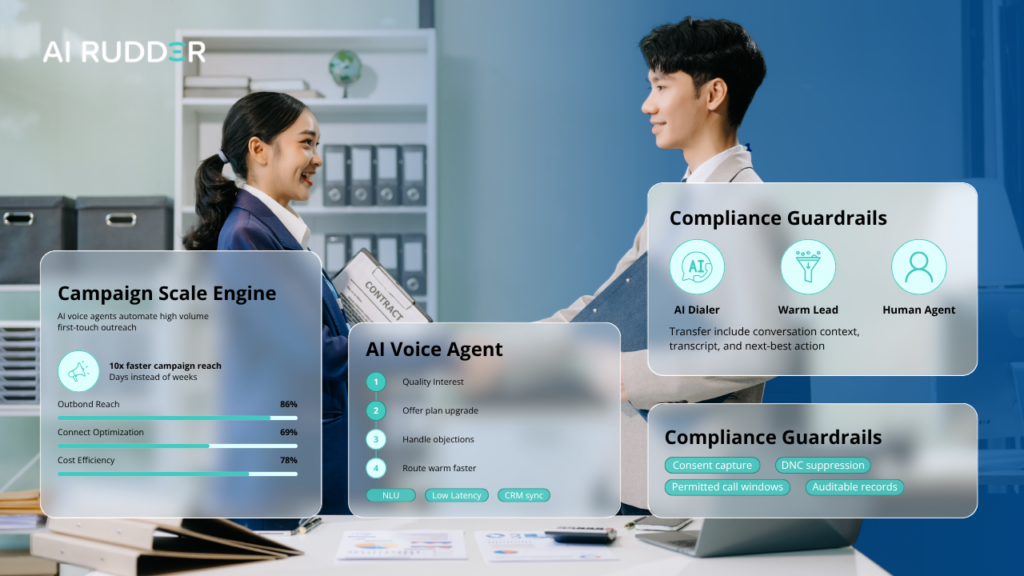
AI voice agents are revolutionizing outbound telemarketing by automating the initial, high-volume stages of customer outreach. These intelligent systems can dial thousands of numbers simultaneously, ensuring maximum reach in a fraction of the time it would take a human team.
In the context of telecom campaigns, AI voice agents are highly effective at several key tasks:
Lead Qualification: The AI can engage customers in natural conversations to gauge their interest in a new offer or plan upgrade, filtering out those who are not interested.
Plan Upgrade Offers: AI agents can proactively contact customers whose data usage suggests they would benefit from a higher-tier plan, explaining the benefits and seamlessly processing the upgrade if the customer agrees.
Appointment Setting: For complex B2B telecom solutions, the AI can qualify the lead and schedule a follow-up call or meeting with a specialized human sales representative.
Win-Back Campaigns: AI can reach out to former customers with targeted re-engagement offers, gathering feedback on why they left and presenting compelling reasons to return.
How AI Handles Objections and Escalates to Human Agents
A common concern with automated outbound calls is how the system handles customer objections or complex questions. Modern AI voice agents are equipped with advanced Natural Language Understanding (NLU) that allows them to interpret and respond to common objections smoothly. If a customer says, “I can’t afford that right now,” the AI can be programmed to offer a more budget-friendly alternative or highlight the long-term savings of the proposed plan.
Crucially, AI agents are designed to recognize their own limitations. When a conversation becomes too complex, or if the customer expresses a strong desire to speak with a person, the AI performs a “smart handoff.” It seamlessly transfers the call to a human agent, providing them with the full context and transcript of the conversation up to that point. This ensures that the human agent can pick up exactly where the AI left off, focusing their expertise on closing the sale rather than repeating introductory information.
Compliance and Consent Management in Automated Outbound Calls
In the telecom industry, outbound calling is subject to strict regulatory frameworks regarding consumer privacy and consent (such as TCPA in the US or GDPR in Europe). Maintaining compliance is non-negotiable.
AI-powered telemarketing systems are built with robust compliance features. They can automatically scrub call lists against Do Not Call (DNC) registries and ensure that calls are only made within legally permissible hours. Furthermore, AI agents can be programmed to explicitly ask for and record customer consent at the beginning of the call, maintaining a secure and auditable trail of compliance that is far more reliable than manual human processes.
Key Metrics for Measuring AI Telemarketing Performance in Telecom
To evaluate the effectiveness of AI-powered outbound campaigns, telcos should focus on specific performance metrics that highlight both reach and conversion:
Connect Rate: The percentage of dialed calls that are successfully answered by a human. AI systems can optimize dialing patterns to improve this rate.
Conversion Rate: The percentage of connected calls that result in a desired outcome (e.g., a plan upgrade or a scheduled appointment).
Cost Per Acquisition (CPA): By automating the bulk of the outreach, AI significantly lowers the CPA compared to traditional human-led campaigns.
Human Agent Utilization: Tracking how human agents spend their time post-implementation should show a shift toward high-value closing conversations rather than repetitive dialing.
Real-World Results: What AI Telemarketing Delivers for Telcos
When implemented effectively, AI-powered telemarketing delivers dramatic improvements in campaign performance. Telecom companies utilizing advanced AI voice agents report the ability to execute campaigns 10x faster than manual teams, reaching the entire target audience within days rather than weeks.
Because the AI filters out unanswered calls and unqualified leads, human agents receive a steady stream of “warm” transfers—customers who have already expressed interest. This targeted approach not only boosts overall sales conversion rates but also significantly improves human agent morale and retention, as they spend their time succeeding rather than dialing. By leveraging AI for outbound telemarketing, telcos can transform their sales operations into highly efficient, scalable growth engines.
Scale Your AI Telecom Campaigns with AI Rudder
AI Rudder is a globally trusted conversational AI partner that has powered over 80 million interactions for 500+ enterprises across 20 languages. Our AI Voice Agent is purpose-built for high-volume outbound campaigns, delivering human-like conversations at scale with ultra-low latency responses — ensuring every customer interaction feels natural and engaging, not robotic.
Telecom companies across Southeast Asia and beyond rely on AI Rudder to automate their outbound telemarketing operations, from plan upgrade campaigns and new product launches to win-back programs. Our platform integrates seamlessly with your existing CRM and dialing infrastructure, and our enterprise-grade compliance features ensure every campaign meets regulatory requirements.
Ready to scale your outbound campaigns without scaling your headcount? Contact AI Rudder today to schedule a demo and see how our AI Voice Agent can supercharge your telemarketing performance.
Legacy Interactive Voice Response (IVR) systems remain one of the single biggest sources of customer frustration in the telecommunications industry. For decades, telecom companies have relied on these rigid, menu-driven systems to route calls and manage high-volume inquiries — yet as customer expectations for fast, seamless, and personalized service continue to rise, the limitations of traditional IVR have become impossible to ignore. Today, replacing legacy IVR with AI voice agents is no longer an optional upgrade; it is a strategic imperative for telcos aiming to reduce churn, improve customer satisfaction, and lower operational costs. This article examines why legacy IVR is failing, how conversational AI transforms the customer experience, and how telecom companies can navigate the transition without disrupting operations.
Why Customers Hate Traditional IVR and What It Costs Telcos
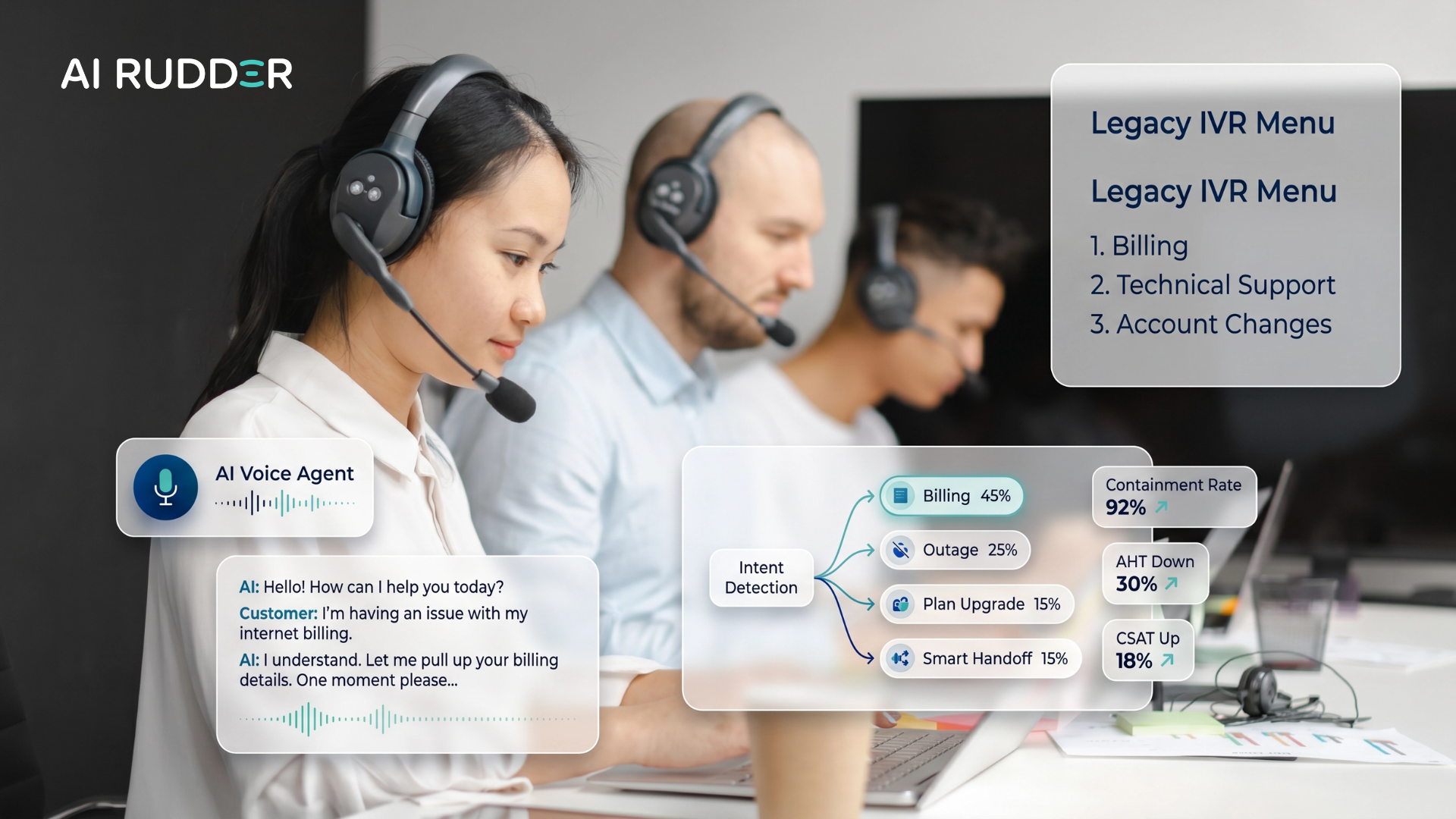
The traditional IVR experience is widely regarded as one of the most frustrating touchpoints in customer service. Callers are forced to navigate complex, multi-layered menus (“Press 1 for billing, Press 2 for technical support…”), sitting through irrelevant options before finding what they need. When a mistake is made or when an issue doesn’t fit a predefined category — customers are either disconnected or trapped in an endless loop, ultimately demanding to speak to a live agent.
This frustration has a direct financial impact on telecom companies. When customers cannot resolve their issues quickly, they become dissatisfied, leading to lower Net Promoter Scores (NPS) and higher churn rates. In a highly competitive market where switching providers is easier than ever, poor customer service is a primary driver of customer attrition. Furthermore, the inefficiency of IVR means that a significant percentage of calls still end up being routed to live agents, defeating the purpose of automation and driving up call center operational costs.
Legacy IVR vs. Conversational AI Voice Agents: What’s the Difference?
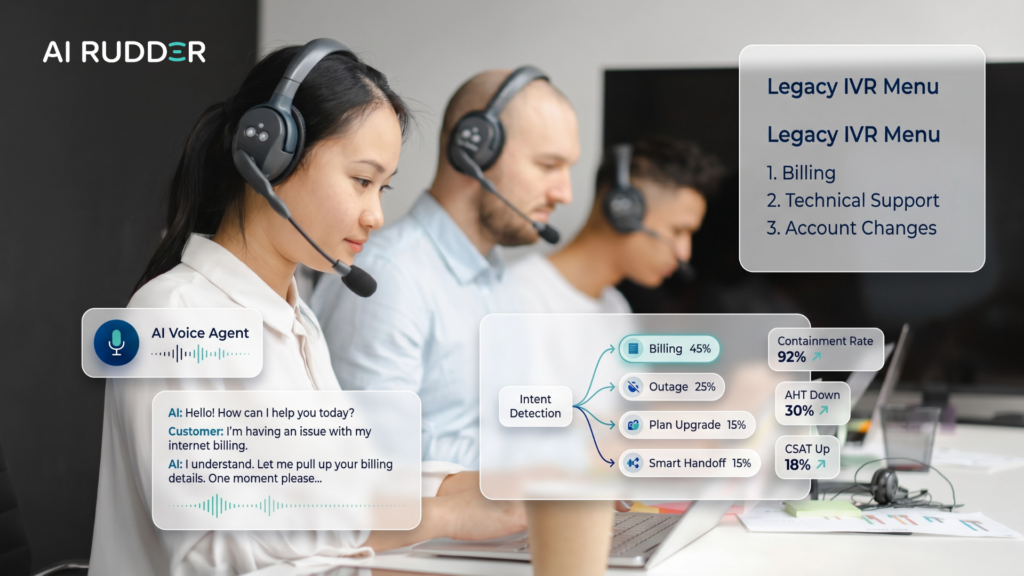
The fundamental difference between legacy IVR and modern AI voice agents lies in how they understand and interact with the caller. Traditional IVR is rules-based and relies on DTMF (Dual-Tone Multi-Frequency) tones or simple keyword recognition. It forces the customer to adapt to the machine’s structure.
In contrast, an AI voice agent leverages advanced Natural Language Understanding (NLU) and speech recognition to facilitate open-ended, human-like conversations. Instead of presenting a menu, the AI simply asks, “How can I help you today?” The customer can speak naturally, explaining their issue in their own words. The AI understands the intent, context, and sentiment behind the query, allowing it to provide immediate, relevant assistance or route the call accurately without the need for complex menus.
Key Capabilities to Look for in an AI Voice Agent Solution
When evaluating AI voice agent solutions to replace legacy IVR, telecom companies should prioritize several critical capabilities:
Advanced Natural Language Understanding (NLU): The system must be able to accurately comprehend complex sentences, varied accents, and colloquialisms, ensuring that customer intents are recognized even when phrased unpredictably.
Multilingual and Local Dialect Support: In diverse markets, especially across regions like Southeast Asia, the ability to converse fluently in multiple languages and local dialects is essential for providing an inclusive customer experience.
Seamless CRM Integration: The AI must integrate deeply with the telecom’s Customer Relationship Management (CRM) and billing systems. This allows the agent to access real-time customer data, personalize interactions, and perform transactional tasks (like processing payments or upgrading plans) directly within the conversation.
Intelligent Escalation (Smart Handoff): When an issue is too complex or emotionally sensitive for the AI to handle, it must seamlessly transfer the call to a human agent, passing along the full context and history of the conversation so the customer doesn’t have to repeat themselves.
Top Use Cases for AI Voice Agents in Telecom
AI voice agents excel at automating the high-volume, routine inquiries that typically overwhelm telecom call centers:
Billing Inquiries and Payments: Customers can naturally ask for their current balance, due dates, or payment history. The AI can securely process payments or set up payment arrangements over the phone.
Plan Changes and Upgrades: AI agents can handle requests to change data plans, add roaming packages, or upgrade services, often identifying upsell opportunities based on the customer’s usage patterns.
Outage Notifications: During network outages, AI voice agents can proactively inform callers about the issue and estimated resolution times, deflecting massive spikes in call volume.
SIM Activation and Onboarding: The AI can guide new customers through the SIM activation process step-by-step, verifying identity and ensuring a smooth onboarding experience.
How to Migrate from IVR to AI Without Disrupting Operations
Replacing a core piece of infrastructure like an IVR system can seem daunting, but a phased approach minimizes risk and ensures a smooth transition. Telecom companies should avoid a “rip-and-replace” strategy.
Instead, start by deploying the AI voice agent alongside the existing IVR to handle a specific subset of calls or a particular use case, such as billing inquiries. This allows the organization to test the system, gather data, and refine the AI’s conversational flows in a controlled environment. As confidence in the system grows and performance metrics are validated, the AI can gradually take over more call types and routing responsibilities, eventually phasing out the legacy IVR entirely.
Key Metrics to Track After Migrating from IVR to AI Voice Agents
To measure the success of migrating from IVR to an AI voice agent, telecom companies should monitor key performance indicators (KPIs) that reflect both operational efficiency and customer satisfaction:
Containment Rate: The percentage of calls fully resolved by the AI without human intervention. A significant increase in containment indicates successful automation.
Average Handle Time (AHT): The total time a customer spends on the call. AI agents should reduce AHT by eliminating menu navigation and providing instant answers.
Customer Satisfaction (CSAT) and NPS: Post-call surveys should reflect higher satisfaction scores as customers appreciate the faster, more natural interaction.
Agent Utilization: Human agents should see a decrease in routine, repetitive calls, allowing them to focus on complex, high-value interactions.
By replacing legacy IVR with intelligent AI voice agents, telecom companies can transform their customer service from a point of friction into a competitive advantage, delivering the fast, personalized experiences that today’s consumers demand.
Ready to Replace Your Legacy IVR? Transform Telecom CX with AI Rudder
AI Rudder is a globally trusted conversational AI partner purpose-built for enterprise-scale deployments. With a proven track record of handling over 80 million interactions across 500+ enterprises in 20 languages, AI Rudder’s AI Voice Agent delivers ultra-low latency, human-like responses in under one second — ensuring every customer interaction feels natural, fast, and personal.
Whether you are looking to replace a legacy IVR system, automate high-volume inbound inquiries, or create a seamless omnichannel experience for your subscribers, AI Rudder provides the technology and expertise to make it happen. Our infrastructure meets leading international security standards, including SOC 2, ISO 27001, GDPR, and PDPA, so you can modernize your customer service with full confidence.
Ready to leave IVR behind and deliver the intelligent voice experience your customers deserve? Contact AI Rudder today to schedule a demo and see how our AI Voice Agent can transform your telecom operations.
In the insurance industry, time directly impacts customer trust. When customers call to report an accident or inquire about the claim status, long waiting times quickly become frustration. To meet these demands, many firms are turning to AI voicebot solutions for insurance companies to accelerate service. However, the challenge lies in choosing a solution that doesn’t just “talk,” but truly understands the complex, sensitive context of insurance.
Selecting the wrong technology can lead to wasted investment and poor customer experiences that damage brand trust. To avoid these pitfalls, it is essential to evaluate the best AI voice agents for insurance that are built to handle high-stakes financial transactions and sensitive policyholder data. So, how do you find a truly reliable solution for your insurance operations? Let’s talk about it in this article.
Key Use Cases: Beyond Basic FAQs
Modern AI voicebot solutions for insurance extend far beyond answering basic FAQs. They support critical policyholder interactions across the customer lifecycle:
Claim Submission & Status Updates
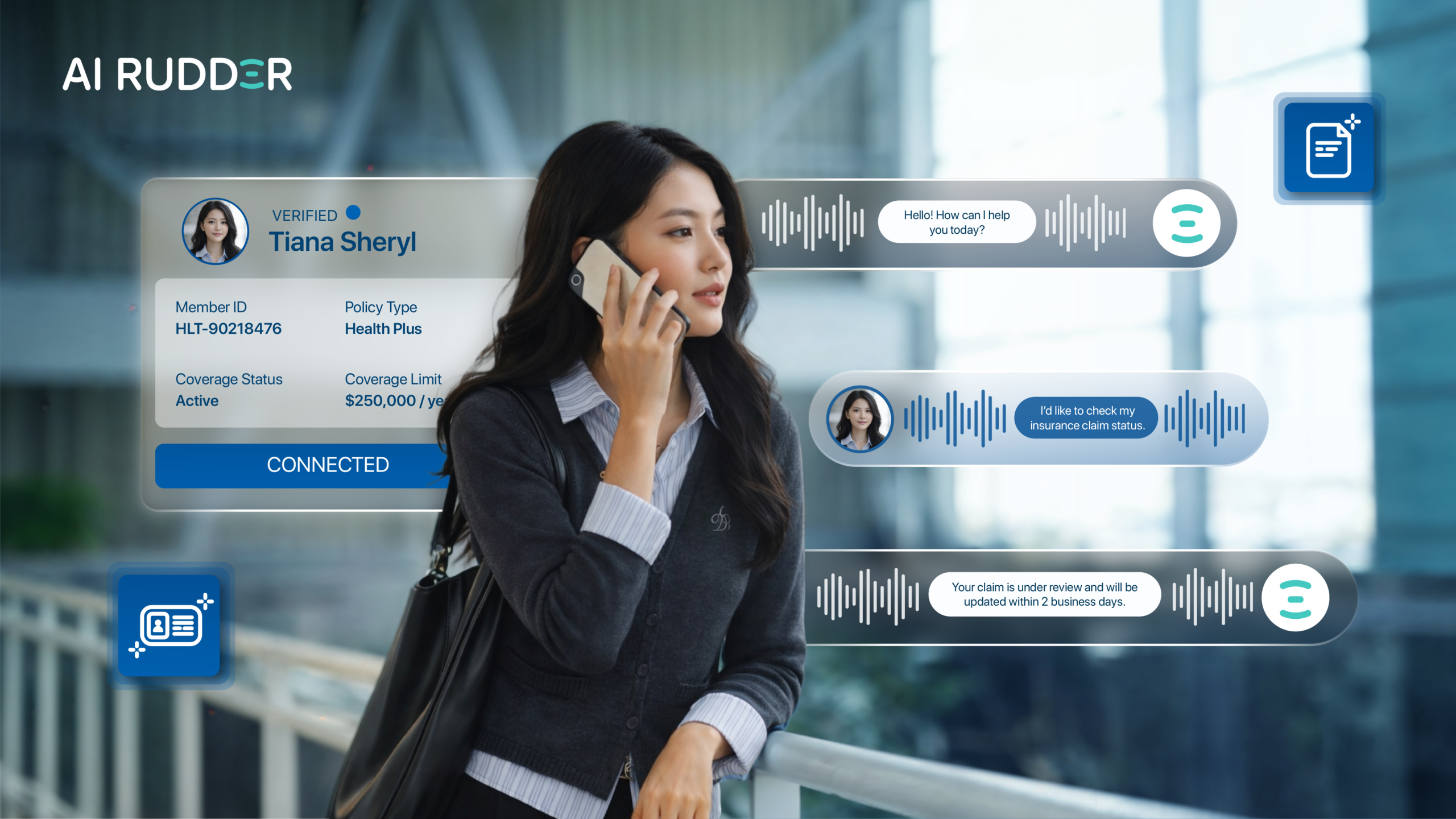
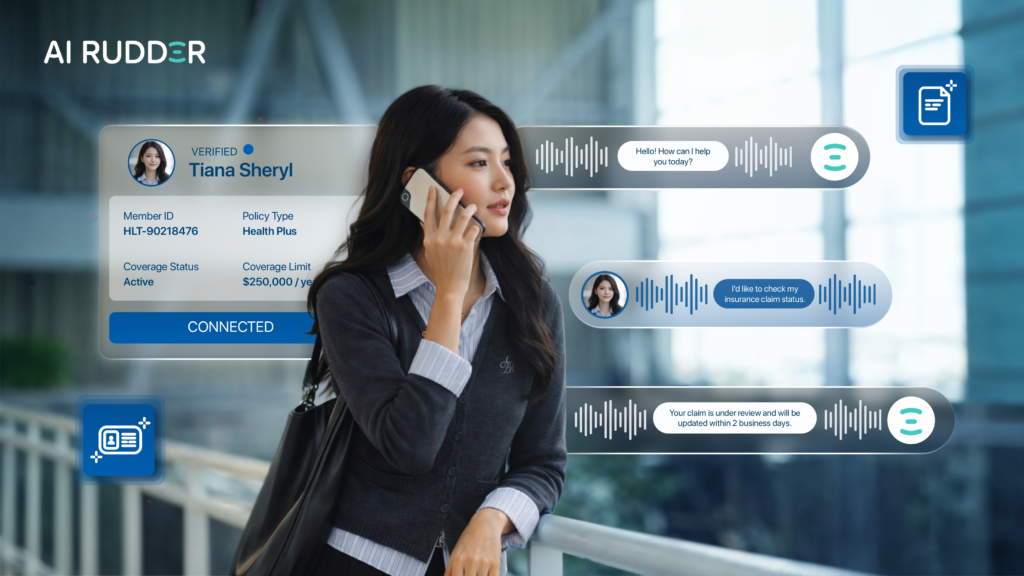
AI Voicebot acts as the first point of contact for claim reporting, capturing incident details automatically, generating reference numbers, and enabling real-time status tracking without waiting for human agents.
Policy Changes
Routine updates such as addresses, phone numbers, or policy details can now be done without manual intervention. AI Voicebot guides customers in making these data changes quickly, accurately, and directly stored in the system.
Premium Renewal
Reduce the risk of churn with proactive calls. AI Voicebot contacts customers approaching their policy expiration, explains the benefits of renewal, and helps them extend their coverage in a brief conversation.
Implementing AI Voicebot isn’t about replacing the role of human agents, but about strengthening and improving the operational systems of insurance companies to be more resilient and cost-effective. Here are the real impacts on operations:
Operational Cost Efficiency
Automating routine voice interactions such as checking claim inquiries or sending premium reminders, which can reduce the workload of the call center team and allows budget to shift toward strategic initiatives instead of headcount expansion.
Unlimited Scalability
When there is a surge in calls, AI Voicebot can handle thousands of calls simultaneously. Customers no longer need to wait in line or have their calls dropped due to a full line.
Increasing Agent Productivity
By assigning repetitive tasks to AI, human agents can focus on cases that require high empathy and in-depth analysis. This reduces employee burnout and enhances service quality for critical cases.
Better Data Accuracy
Human agents often make mistakes when inputting data. AI Voicebot automatically records and transcribes every detail of the conversation into the CRM system, ensuring that the information received from customers is 100% accurate without anything being missed.
24/7 Service Without Night Shift
Insurance operations shouldn’t stop when the office is closed. AI Voicebot ensures that customers calling outside of working hours due to emergencies still receive instant assistance, significantly increasing customer satisfaction.
What Should You Consider Before Choosing an AI Partner
Choosing an AI Voicebot solution for insurance companies involves far more than a simple cost-benefit analysis, it is about selecting a strategic partner capable of navigating a high-stakes industry. To ensure you are selecting from the best AI voice agents for insurance, evaluate these five pillars:
Omnichannel Integration
Policyholders don’t only call, they also use WhatsApp or other applications. Make sure AI Voicebot can integrate with various channels/applications (omnichannel) so that customers receive a consistent experience wherever they contact you.
Insurance-Specific Integrations
The insurance industry has a unique workflow, such as the claims process and policy verification. Choose a solution that is specifically designed to understand the logic of the insurance business, not just a general bot for all industries.
Seamless System Integration
Voice AI must integrate with existing CRM, policy administration, and legacy systems to avoid costly infrastructure changes.
Security & Compliance
Insurance data is very sensitive. Consider whether the AI partner has high security standards and compliance with financial industry regulations. This is not an area that can be tolerated.
Multilingual & Local Language Support
Policyholders are spread across various regions. It is crucial for AI to understand local dialects, accents, and languages so that customers feel comfortable and there is no miscommunication during critical processes such as claim reporting.
Why Partner with AI Rudder?
AI Rudder is not just an ordinary voice AI technology, we are a strategic partner specifically designed to address the unique challenges in the insurance industry. By providing specialized AI voicebot solutions for insurance companies, AI Rudder enables insurers to streamline customer communication across claims, policy management, and renewals through intelligent, human-like voice automation. We understand that in this industry, every second counts. That is why our voice AI delivers ultra-low latency, providing human-like responses in under one second to engage policyholders naturally with 24/7 conversational voice experiences that feel personal and responsive.
With a proven track record of handling over 80 million interactions for 500+ enterprises in 20 languages, we ensure that every conversation is seamless and accurate. Our AI Voicebot allows you to automate high-volume interactions such as claim status updates, premium reminders, and coverage inquiries to significantly improve operational efficiency. Furthermore, AI Rudder helps drive proactive customer follow-ups with AI agents that ensure timely engagement and smoother policyholder journeys, reducing churn and increasing loyalty.
Security and compliance are at the heart of everything we do. We help you maintain trust and compliance through enterprise-level security, encryption, and continuous monitoring safeguards. Our platform is fully compliant with global standards, including SOC 2, ISO 27001, GDPR, PDPA, IMDA, and CSA. By integrating smoothly with your existing legacy systems, AI Rudder helps you enhance responsiveness and improve customer satisfaction, all while keeping your insurance operations efficient, secure, and future-ready.
Take the Next Step Toward Smarter Insurance Operations
Choosing the right AI Voicebot is a strategic investment in customer trust and operational resilience. With the right partner, you not only cut operational costs but also stand by your customers during their most crucial moments. AI Rudder is ready to be the best AI Voicebot solutions for insurance company that helps you achieve the ideal balance between automation efficiency and human-centered service.
Ready to see how AI Rudder transforms your insurance operations? Contact us for a demo now.
The banking industry is on the brink of a major transformation where voice has now become the main point of contact in financial interactions. The implementation of voicebots for banking has evolved from mere tools into strategic pillars that redefine how financial institutions interact with customers. In the midst of a rapidly evolving digital ecosystem, the need for instant, accurate, and personalized services has become a top priority for every bank that wants to remain competitive.
This revolution is driven by the ability of artificial intelligence (AI) to understand context, dialects, and customer intent in real-time. The use of voicebots for banking allows banks to be proactively present in every customer lifecycle, from the acquisition process to risk management, on an unlimited scale. Voicebots are not just about speech automation, but about building an intelligent communication system capable of executing complex tasks with high precision.
Transforming Inbound Services with Intelligent Voicebots for Banking
In the fast-paced banking industry, customers expect instant access to information without having to go through a tiring waiting process. This is where voicebots take a leading role in transforming inbound services. With advanced Natural Language Understanding (NLU), this technology allows customers to perform routine transactions such as account inquiries or balance checks simply through voice commands. This creates a truly seamless banking experience, where every customer inquiry is answered in real-time without the need to wait in line for a human agent.
Ultimately, the scalability offered by voicebots provide a strategic advantage for financial institutions in building customer loyalty. By providing service support that is always on standby 24/7, banks can ensure that every customer feels heard and well-served at every point of contact. Voicebots for banking are not just automation tools, but the frontline of intelligent customer service, capable of turning every incoming interaction into an opportunity to add value and strengthen customer trust.
Mastering Outbound Operations with Scalable Voicebots
In the banking industry, outbound activities such as collections and telemarketing often become a heavy operational burden due to their repetitive nature and the high mental resilience they require. The use of voicebots provides an intelligent solution by automating communication outreach on a massive scale without fatigue. In terms of billing, voicebots are capable of sending initial payment reminders with a tone that remains polite, consistent, and professional. AI not only makes phone calls but is also capable of basic negotiations and scheduling payment commitments, thereby keeping the bank’s cash flow healthy without relying on human agents for tedious routine tasks.
On the telemarketing side, voicebots for banking are transforming the way banks acquire customers through a much more efficient lead qualification process. Instead of letting human agents make hundreds of random calls that often end in rejection, voicebots can automatically conduct initial screening. AI will identify customers who have a genuine interest in products such as credit cards or loans, and only pass on these qualified leads to human agents. This approach ensures that the sales team’s energy is only allocated to opportunities with the highest conversion rates, which directly boosts the team’s productivity and morale.
The main advantage of using this voice assistant lies in its ability to interact personally and contextually without the risk of burnout. Unlike humans whose performance can decline after facing repeated rejections, the voicebot is able to maintain the same voice quality and level of friendliness from the first call to the thousandth call in a day. AI can adjust messages based on the customer’s risk profile or transaction history, creating an outbound experience that feels more relevant and less intrusive compared to traditional methods that are uniform for everyone.
By integrating voicebots, banks can achieve a scale of reach that was previously impossible to accomplish manually. The billing process becomes more measurable, and telemarketing campaigns become more targeted. In the end, voicebots for banking act as a force multiplier that enables financial institutions to remain proactive in approaching customers, increasing revenue, and minimizing credit risk, while still allowing human staff to focus on strategic tasks that require empathy and high-level problem-solving.
Simplifying the First Handshake with Automated KYC Solutions
The Know Your Customer (KYC) process often becomes a crucial point that determines the comfort of prospective customers in opening a bank account. This is where voicebots for banking play the role of a digital bridge that simplifies this “first handshake.” By automating data collection and identity verification through voice dialog, banks can eliminate long administrative hurdles and transform rigid procedures into short, intuitive, and efficient conversations.
In practice, voicebots for banking are capable of guiding customers through the data validation stage independently and in real-time. Customers only need to answer the voice assistant’s questions to confirm their identity, which is then automatically recorded and validated by the system. In addition to speeding up the onboarding process, the integrated voice biometric technology also provides an additional layer of security that is difficult to forge, ensuring that compliance standards are maintained without sacrificing service speed.
The implementation of voicebots in KYC allows banks to handle thousands of new customer applications simultaneously with consistent standards. This automation significantly reduces account activation time and minimizes manual data entry errors. As a result, the bank not only improved operational efficiency but also built a foundation of customer trust from the very first interaction thru a modern, secure, and seamless digital experience.
Turning Voice into Actionable Data
Voicebots are not only communication tools, but also extremely powerful data processors. Every voice interaction that occurs is recorded and automatically analyzed to capture valuable information that is often missed in manual conversations. With speech-to-text technology and advanced analytics, banks can transform thousands of hours of conversations into structured data that provides a clear picture of customer needs trends, campaign effectiveness, and real-time market behavior patterns.
Furthermore, the data generated by voicebots becomes the main fuel for the strategic decision-making process. Banks can identify systemic issues or gaps in their products based on the questions most frequently asked by customers to the AI. By transforming voice into actionable data, voicebots help banks shift from a reactive business model to a proactive one, ensuring that every business step is based on real evidence from direct conversations with users.
Why Voicebot is the Ultimate Banking Force Multiplier
Voicebots are essential elements that multiply the operational capabilities of modern banking. With the ability to handle thousands of simultaneous interactions consistently, voicebots allow banks to surpass the physical limitations of human labor without losing the personal touch in every conversation.
Adopting a voicebot is not just about automation, but about freeing human teams to focus on strategic tasks that require a high level of empathy. Choosing a technology partner like AI Rudder is a crucial step in transforming traditional operations into a smart, responsive growth engine, ready to face the future of customer-centric banking.
Ready to Transform Your Bank’s Operations?
The future of banking is no longer determined by the number of agents you have, but rather by how intelligently you communicate with customers on a large scale. AI Rudder is here to ensure your institution wins that competition thru the most natural, intelligent, and responsive AI Voice Agent currently available in the market.
As a pioneer of global voicebot technology trusted by over 500 companies in 31 countries, we are here to address your operational challenges. From efficient billing automation to seamless 24/7 customer service, our AI Voice Agent is specifically designed to meet the stringent standards of the financial industry.
Don’t let your operations be hindered by slow manual processes and ever-increasing costs. It’s time for you to reimagine customer engagement through intelligent voice solutions that can automate repetitive calls, enhance efficiency, and provide a human-like experience on an unlimited scale.
Schedule a free demo with AI Rudder today and see for yourself how voicebots for banking can improve recovery rates, accelerate KYC, and deliver an outstanding customer experience.
For decades, call centers have been viewed as cost centers. Necessary for customer service but draining resources without directly contributing to growth.
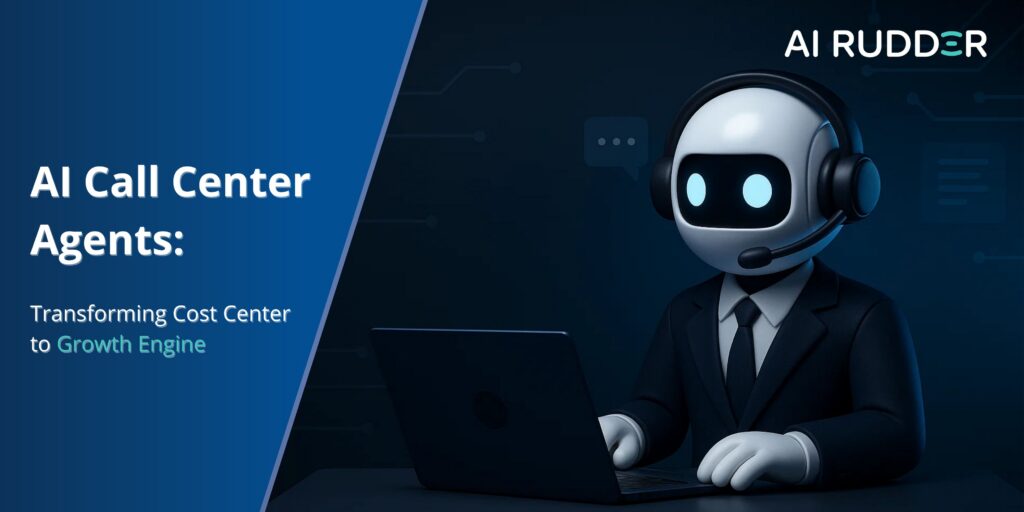
Nowadays, that perception is changing rapidly as AI call center agents are stepping in as the frontline of customer engagement. They don’t replace humans, they collaborate with humans by preparing the ground. By handling the first touch, solving routine queries, and surfacing opportunities, AI call center agents ensures every customer interaction is faster, smoother, and more meaningful. Human agents then step in where empathy, trust, and flexibility matter most.
Put simply, AI call center is not just about cost-cutting; it’s about driving growth through human-AI collaboration.
What Exactly Are AI Call Center Agents?
Think of them as your first line of defense and opportunity. Instead of waiting for a human agent to pick up, customers get immediate engagement from an intelligent system that understands intent, detects tone, and adapts in real time.
Unlike old-school IVR menus or scripted chatbots, AI call center agents can hold natural conversations, personalize recommendations, and seamlessly pass conversations to humans when the situation requires a deeper touch.
Now, this obviously raises a pressing question: Will AI replace call center agents?
The short answer? No.
We strongly believe that AI empowers human agents, not replaces. Human agents remain crucial for complex cases and empathy-driven interactions, while AI handles repetitive tasks, scales capacity, and surfaces growth opportunities.
As Kevin Wu, AI Rudder’s COO & Co-Founder always emphasize:
“We empower teams with AI Technology so they can focus on what humans do best: providing empathy, support, and flexibility“.
AI Call Center Shifts The Paradigm: From Cost-Saving to Revenue-Generating
Traditionally, call centers were considered an overhead. A department always bound to be minimized, not maximized. But with AI call center agents in the frontline, the equation shifts altogether as now they unlock sales, retention, and loyalty opportunities from the very first customer interaction.
Take one of AI Rudder’s financial services clients. By using AI for predictive dialing, their human agents no longer wasted time on unanswered calls. AI took care of outreach, instantly connecting live customers to human agents who could focus on conversations and deals. The result? Higher efficiency, better use of agent time, and a stronger conversion rate.
The strategic mindset is shifting: from cost efficiency to customer engagement and growth.
How AI At The Frontline Enhance Customer Experience
AI call center agents bring speed, scale, and consistency to customer interactions without losing the human touch. Imagine these scenarios:
A customer calls to ask about their current plan. The AI instantly recognizes usage patterns and suggests an upgrade tailored to their needs.
A frustrated customer reaches out late at night and receives immediate support from AI, with seamless handoff to a human when emotions come into play.
Early warning signs of churn are flagged by AI before the customer even voices dissatisfaction, giving teams a chance to act proactively.
AI as the frontline ensures no opportunity is missed, while human agents step in as relationship-builders who turn opportunities into lasting loyalty.
The result? Happier customers, stronger loyalty, and measurable revenue growth.
Conclusion
AI call center is not just about trimming costs, it’s about unlocking growth. By combining efficiency with revenue impact, AI call center agents are transforming customer service into a competitive advantage.
The real question isn’t “Will AI replace call center agents?” It’s rather “How quickly can businesses leverage AI to unlock new growth opportunities?”
Ready to Transform Your Call Center?
We provide cutting-edge AI call center agent solutions that help businesses reduce costs, increase revenue, and deliver exceptional customer experiences.
Reach out to us today for a consultation: business@airudder.com
As one of the largest players in the industry, Adira Finance continues to set the standard for digital transformation in the financial sector. By leveraging AI Rudder’s cutting-edge technology, their team has unlocked a new level of efficiency in customer engagement.
In this video, Adira Finance shares how integrating AI Voice Agent was the key to expanding their reach and connecting with customers at an unprecedented scale. Adopting AI Rudder’s solution has solidified their position as a digital pioneer, redefining what innovation looks like for the future of finance.
Watch the video to see the impact of this partnership in action.
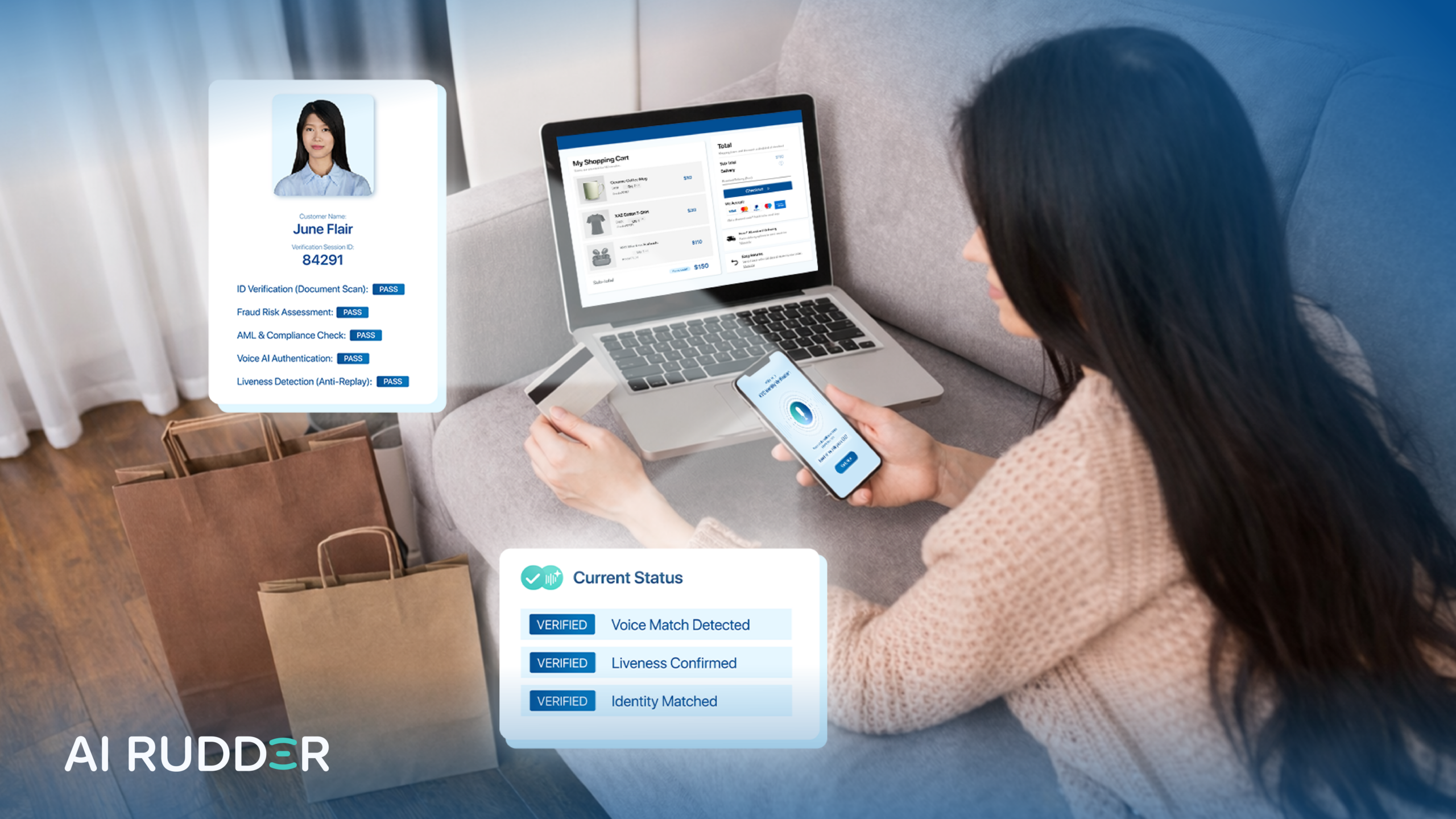
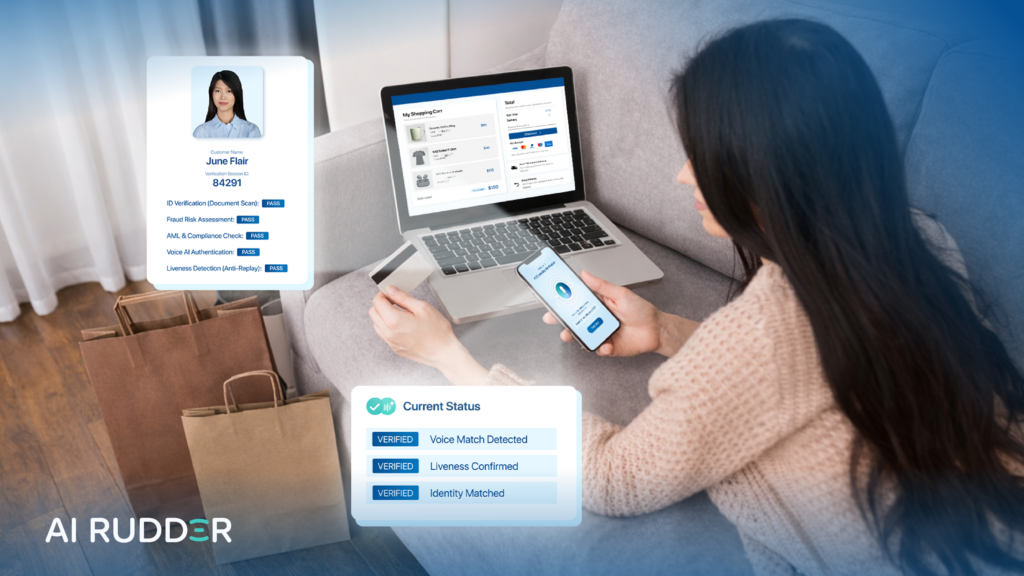
E-commerce has evolved at breakneck speed, from same-day delivery and one-click checkouts, yet identity verification in e-commerce remains stuck in the past. Many companies have invested heavily in accelerating the shopping experience, but the most crucial point in the customer journey still operates at 2016 speeds. The slow, repetitive, and complicated KYC process creates invisible but real friction: customers are lost before the transaction even begins.
In reality, KYC is not just a compliance checklist, it’s the gateway that determines whether customers feel safe, understood, and valued. Unfortunately, this gate is often overwhelmed due to a slow, non-scalable process that relies too heavily on manual intervention. Amidst growing transaction volumes, e-commerce requires a more adaptable verification foundation. This is where Voice AI for e-commerce KYC emerges as a game-changer: not only accelerating the KYC process but also building a more seamless and trustworthy ecosystem ready to keep pace with today’s industry speed.
The Trust Paradox in E-commerce Identity Verification
E-commerce has grown much faster than operational teams’ ability to manually verify identities as technology has advanced and customer expectations have increased. Every day, millions of new accounts are created, more transactions are made, and more payment methods are introduced. However, behind that growth rate, there’s a verification process that still relies on old methods, making it difficult for them to keep up with the volume and complexity of customers.
This is the gap that gives rise to increasingly difficult-to-control risks: sophisticated fraud, subtle identity spoofing, misuse of pay-later, and even promo exploitation that harms the brand. Even failed deliveries, which are frequently dismissed as a logistical issue, are the result of inaccurately verified identity data. These problems not only affect margins but also erode customer trust in the brand.
Ironically, many companies are willing to spend billions of dollars to attract traffic, only to lose customers due to slow or confusing verification points. Herein lies the great paradox of e-commerce: rapid growth increases the possibility of bottlenecks if verification does not evolve in tandem. This is no longer a technical issue that can be fixed, but rather a strategic challenge that determines whether a brand can grow sustainably or continues to stumble due to its inability to build trust at critical moments.
Why Traditional KYC Fails Modern E-commerce Platforms
Traditional KYC isn’t actually a bad thing. However, it was designed for an era when user volume was still manageable, verification was done on a regular basis, and digital risks were less complex than they are today. Consumer behavior is rapidly changing: users are mobile-first, accustomed to instant experiences, and have no patience for processes that require them to stop, upload documents, wait, and then repeat when an error occurs. In this fast-paced world, verification that feels manual will always be considered intrusive.
On the operational side, the challenges are growing. User volume grew far beyond the CS team’s ability to verify identities one by one, while the data that needed to be checked became increasingly diverse and error-prone when handled by humans. At the same time, fraudsters are evolving: they use more sophisticated, faster techniques and frequently exploit non-real-time verification gaps. When all of this comes together, the traditional KYC system is no longer just slow, but irrelevant.
That’s why KYC can’t rely solely on a simple automation. It must evolve into a proactive, real-time, conversational model capable of validating identity in a way that feels natural to users while identifying risks faster than fraud attempts. This approach not only enhances security but also creates a more human, scalable, and aligned experience with today’s digital expectations.
Voice AI as the New Foundation for E-commerce Trust
Voice AI not only supports tools that help customer service teams complete their tasks faster, but it is also becoming a new foundation in e-commerce. Voice AI transforms KYC, which was previously thought to be a static task (data check, match, verify), into a dynamic one in which the verification process occurs naturally, responsively, and is tailored to user behavior. Voice AI transforms previously mechanical and cold interactions into conversations that feel human, fast, and intuitive.
Voice allows the system to do things that were previously only possible for human agents, such as directly confirming identity information, assessing the consistency of answers in real time, and detecting signs of risk via speech patterns, pauses, and even tone. Voice AI is also capable of adjusting questions based on user responses, so the verification process is no longer the same for all users.
More importantly, Voice AI provides something that traditional automation cannot: emotional intimacy. Users don’t feel like they’re being tested by a robot, but rather guided by a system that feels personal and understands their context. The combination of higher security and a more natural experience makes Voice AI the new foundation of trust infrastructure, providing verification that is not only fast but also builds confidence and comfort from the very first interaction.
The Strategic Impact Most Leaders Underestimate
Voice AI not only automates KYC, but it is also transforming e-commerce control and operational mechanisms. What sets it apart from regular automation is its ability to interact, not just process. As transaction volume increases, Voice AI can handle thousands of verification conversations at once, complete with follow-up questions that adapt to user responses. This eliminates the primary bottleneck of manual verification, which is the need to add CS teams whenever traffic increases. Scaling becomes unpredictable, while costs remain stable.
Beyond that, Voice AI creates operational resilience that human teams cannot replicate. The system can verify identities 24/7, without fatigue, quality variation, or downtime. Every user gets the same fast, consistent, and clear flow experience. A smooth onboarding process like this not only makes it easier for users to navigate the process but also accelerates the building of trust, a factor proven to increase retention and lifetime value.
Voice AI has a security advantage over other methods, it can read behavioral patterns and voice characteristics. It can detect micro-signals such as unstable intonation, unnatural pauses, or inconsistent response patterns, which are risk indicators that cannot be detected using an ID photo or text input. This combination of voice biometrics and behavioral signals creates a much stronger layer of anti-fraud protection. The end result is a KYC experience that feels almost frictionless, yet is significantly more secure.
Behind all of these advantages lies an often-overlooked strategic insight: the faster the identity is verified, the faster transactions can be converted into revenue. Voice AI not only optimizes processes, but it also accelerates revenue generation and strengthens e-commerce’s fundamental structure.
The Future of E-Commerce KYC Is Invisible, Conversational, and Voice-Led
KYC will no longer feel like a process that requires people to stop, upload photos, or wait for an extended period of time. The process will become increasingly ambient, meaning it will run in the background without the user being aware they are being verified again. Voice AI will play a significant role here. By combining voice, passive signals, biometrics, and behavioral patterns, the system can recognize users in a much more natural way. The focus of verification has also shifted from “prove who you are first” to “we already know this is you, unless something appears amiss.”
This change will be a differentiating factor in the coming years. Brands that are starting to move now, that are brave enough to try new approaches and begin building trust from the outset, will be better prepared to face increasing growth and risks. Meanwhile, businesses that continue to rely on old processes will become increasingly overwhelmed, not because they are incompetent, but because the industry’s rhythm has changed.
Ultimately, it’s not about who’s the fastest to try new technology, but who best understands that trust is a growth asset. Voice AI is not just an add-on tool, it’s becoming the new foundation for creating e-commerce experiences that are safe, easy, and feel human.
The Future of E-commerce KYC is Voice, Powered by AI Rudder
AI Rudder helps e-commerce platforms verify identities faster, reduce fraud risk, and deliver seamless onboarding with Voice AI.
Contact us to see how Voice AI can transform KYC into a trust-building, revenue-accelerating experience.
CBN, one of Indonesia’s leading Information and Communications Technology providers, continues to enhance its customer experience by combining technology with human expertise. As customer…
Telecommunications is a fiercely competitive industry where proactive customer engagement is crucial for driving revenue. Telcos regularly run massive outbound telemarketing campaigns to promote…
Legacy Interactive Voice Response (IVR) systems remain one of the single biggest sources of customer frustration in the telecommunications industry. For decades, telecom companies…
In the insurance industry, time directly impacts customer trust. When customers call to report an accident or inquire about the claim status, long waiting…
For decades, call centers have been viewed as cost centers. Necessary for customer service but draining resources without directly contributing to growth. Nowadays, that…
E-commerce has evolved at breakneck speed, from same-day delivery and one-click checkouts, yet identity verification in e-commerce remains stuck in the past. Many companies…
Executive Summary AI-driven customer experience in banking has moved beyond experimentation and pilot projects. Today, leading banks are deploying AI at scale to improve…
At AI Rudder, we’re dedicated to propelling AmBank forward with our Voice AI solutions, transcending conventional banking interactions to forge a conversational banking model…
August 30, 2024
We use cookies to improve your experience. By continuing to browse, you agree to our Privacy Policy.