
Will AI Agent Builders Redefine the Way Insurance Work?
For years, insurers have relied heavily on IT teams or external vendors to automate even the simplest tasks. Every change, no matter how small,…
May 27, 2026
For years, insurers have relied heavily on IT teams or external vendors to automate even the simplest tasks. Every change, no matter how small, required long development cycles, multiple revisions, and cross-team coordination. As a result, claims, policy servicing, and underwriting teams often struggled to respond quickly to regulatory changes, customer needs, or market dynamics.
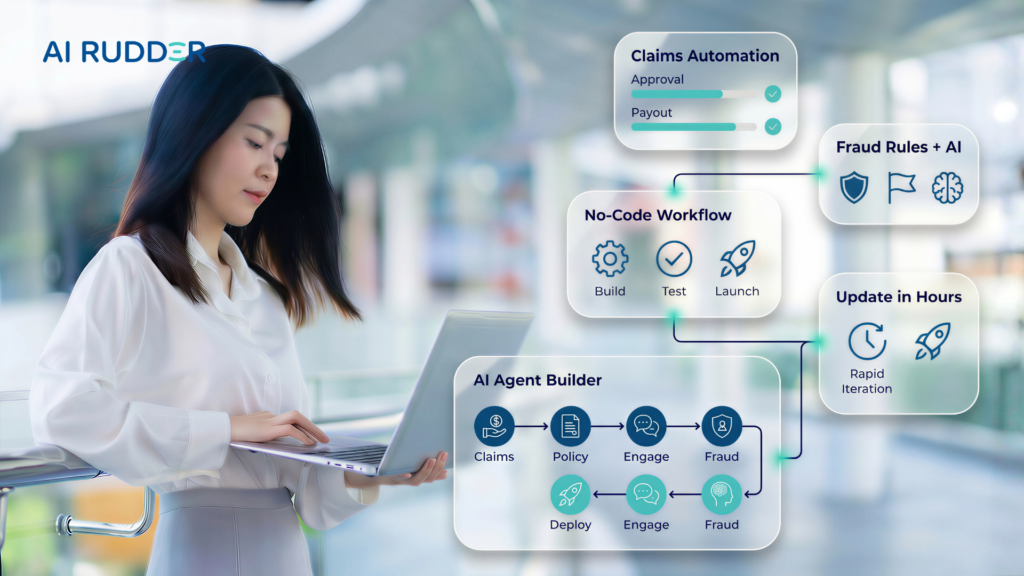
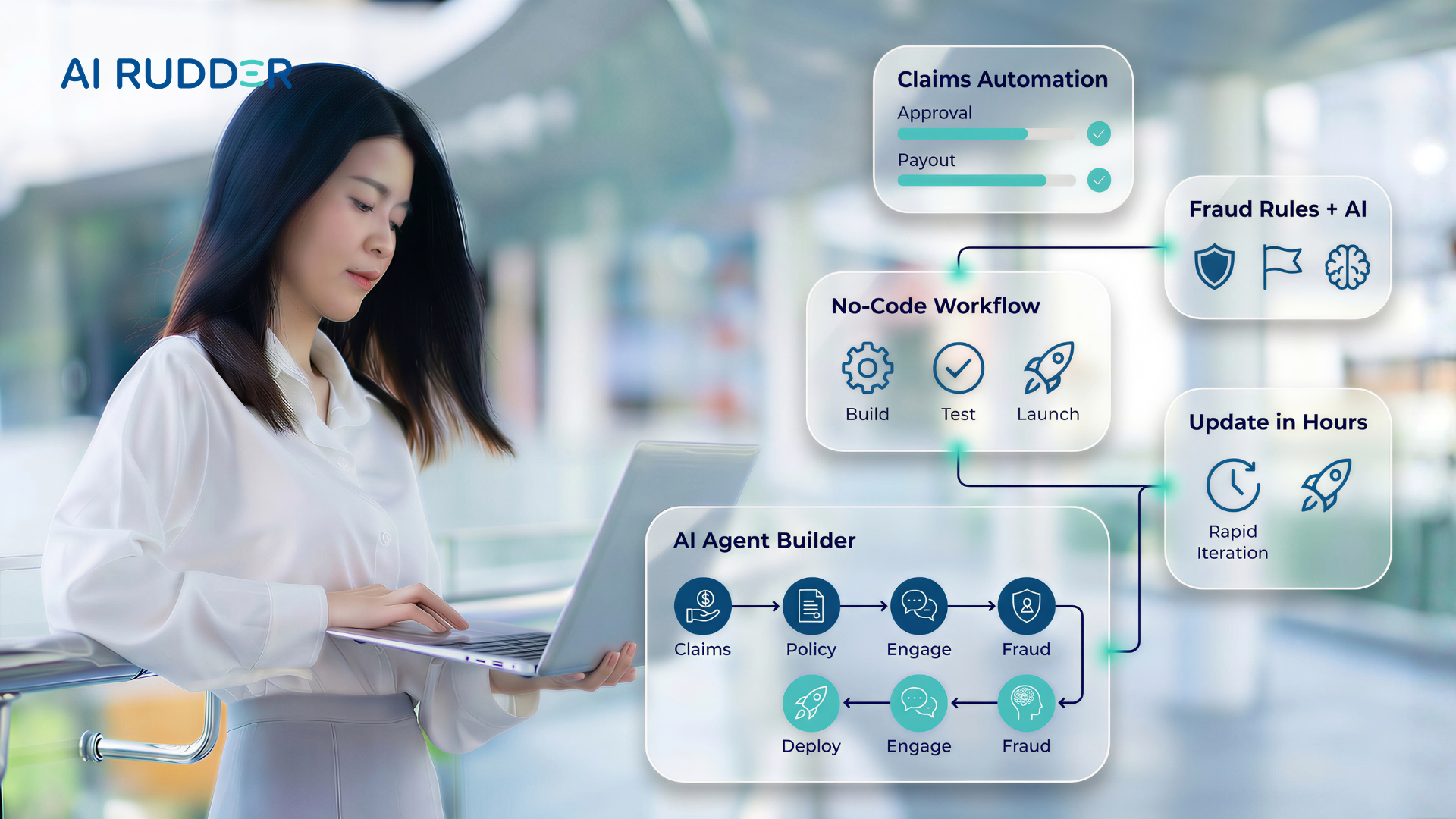
Now, that bottleneck is disappearing. With a no-code AI agent builder, insurance teams can design, edit, and launch their own workflows without writing a single line of code. Claims analysts, servicing staff, and underwriting teams can instantly translate their knowledge into automated processes, making updates in hours, not months. The result is a smarter company, where decisions move faster, teams are closer to customer needs, and insurers can adapt in real time to business demands.
Automation in the claims process isn’t just about AI agents that can automatically approve claims, the big change is who can build that automation. With AI agent builder, insurers can now design automated flows simply by drag and drop. They can also update scripts any time when new regulations arise without having to wait for the next IT sprint. All changes can be tested and deployed directly from the same platform.
This shift creates a cultural shift: ownership of the process now shifts to the claims team, no longer to developers. The team that best understands the details of the claims process now controls and develops its own automation.
In a highly competitive insurance landscape, operational speed is crucial. Imagine if policy servicing teams, who handle customer inquiries and service requests every day, could independently build automation to handle FAQs, endorsement requests, renewal reminders, or policy status checks.
This is what AI Agent Builder makes possible. With this intuitive platform, they are no longer entirely dependent on IT teams with long queues and slow development cycles. Each team member can become a developer of their own processes, creating and modifying digital AI agents directly within the builder without the need to write complex code.
This transformation completely changes the workflow. Instead of waiting quarterly or even annually for minor system updates, teams can now make changes on daily basis. When a recurring customer inquiry emerges, the team can quickly design an automation solution within hours. This flexibility makes operations highly agile and responsive to rapidly changing market needs. Ultimately, AI Agent Builder is beyond than an efficiency tool, but a shift that empowers servicing teams to become true product owners, managing and improving their service processes independently and continuously.
The era of engagement teams having to rely on technical teams for every change in wording or flow is over. With AI Agent Builder, marketing and customer service teams now gain full control. They can independently set the tone of voice, choose wording, and design the most effective conversation flow to serve customers. Even better, all of this can be coordinated across multiple channels like WhatsApp, websites, and mobile apps from a single, centralized builder, ensuring a consistent experience no matter where the interaction happens.
The key point is the empowerment of the business team itself. The focus isn’t on the complexity of the AI technology behind the scenes, but on how this tool gives teams the freedom and speed to refine their communication strategies directly, resulting in more personalized and responsive engagement.
Fraud detection teams typically rely on IT teams to implement their logic into rigid rules within the system. AI Agent Builder changes this by empowering them to visually build, test, and deploy their own investigation workflows. The platform makes it easy to create automated routing for incoming reports, risk-flagging systems, and additional verification processes.
A key advantage is the speed of response to new threats. When a new fraud pattern emerges, teams no longer need to wait for the next development sprint to update the system. They can simply jump into the builder, tweak existing workflows, and add new layers of defense within hours or even minutes. This agility not only makes it more difficult for fraudsters but also significantly improves operational efficiency by diverting IT resources to more complex tasks, while the fraud team maintains full control over their first line of defense.
Essentially, AI Agent Builder acts as a major bottleneck in insurance operations: over-reliance on IT teams and lengthy development cycles. By streamlining technical capabilities for business teams, the cycle time for any process changes or innovations is significantly reduced. This rapid iteration means companies can continuously refine the customer service experience, ensuring higher consistency and quality at every touchpoint.
The financial impact is also significant. Development costs previously incurred for small to medium-sized automation projects can be drastically reduced, as teams can address their own needs. Beyond efficiency, this transformation changes the work culture. Teams become more autonomous and fully accountable for the outcomes of their processes. This freedom not only increases job satisfaction but also opens up space for creativity and bottom-up innovation, where the best solutions come from those who best understand customers’ daily problems.
Ultimately, AI Agent Builder is more than just a tool. It represents a fundamental shift in the way insurers work. At the heart of this transformation is the shift from being passive technology users to active workflow creators. Those who best understand the complexities and nuances of daily work now have the power to design and build their own digital solutions.
By enabling this, AI Agent Builder unlocks the potential and expertise that was previously untapped within each team. Instead of waiting for solutions to be delivered, they can proactively create them. This shift from waiting for solutions to be created to creating solutions will redefine insurer agility, innovation, and competitiveness in the digital age.
Transform manual processes into intelligent, automated agents with AI Rudder. Reduce reliance on IT, accelerate innovation, and empower your team to build and manage digital solutions themselves, without writing a single line of code. Contact AI Rudder team today to start creating intelligent workflows that improve your team’s efficiency and responsiveness.
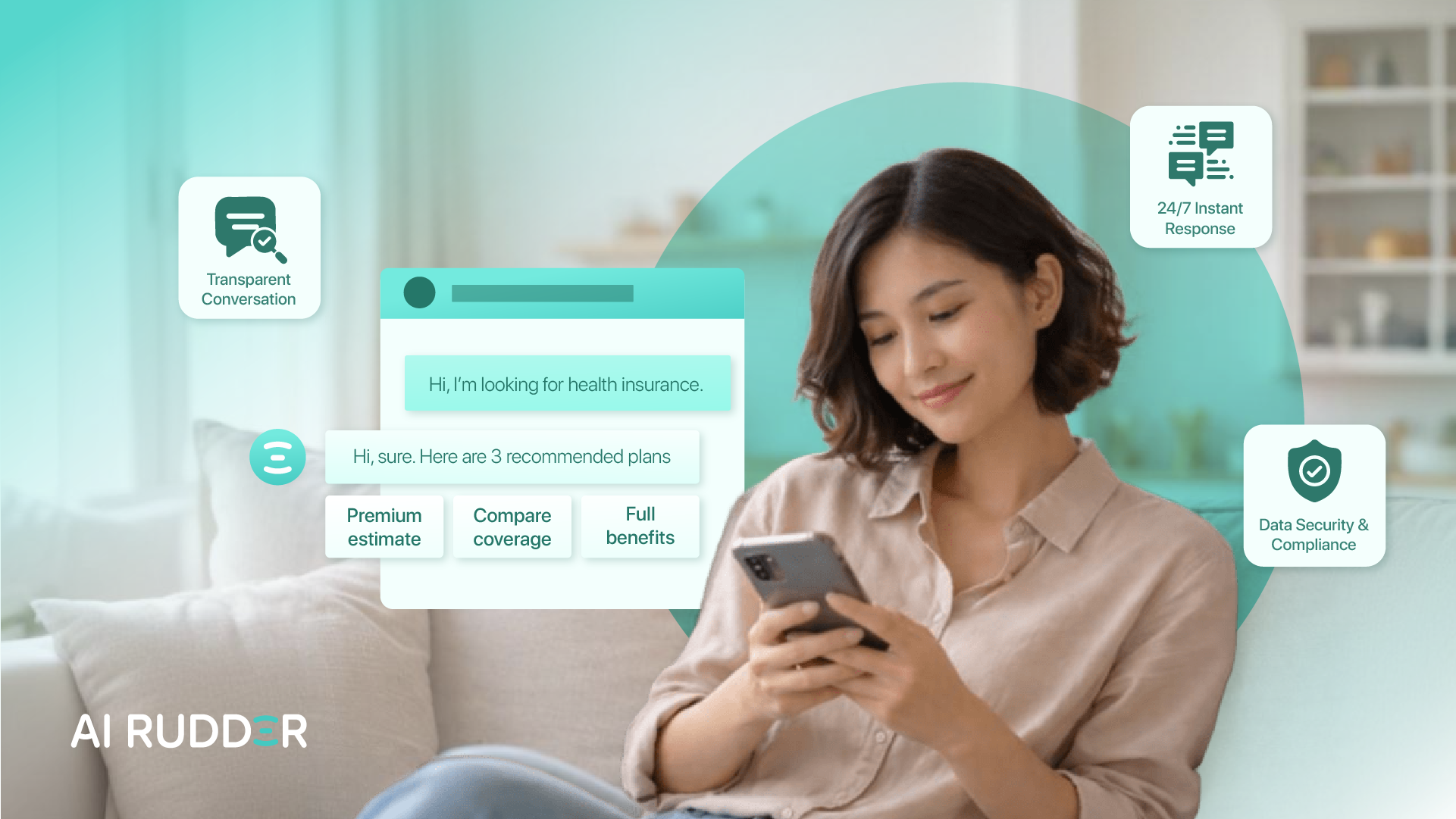
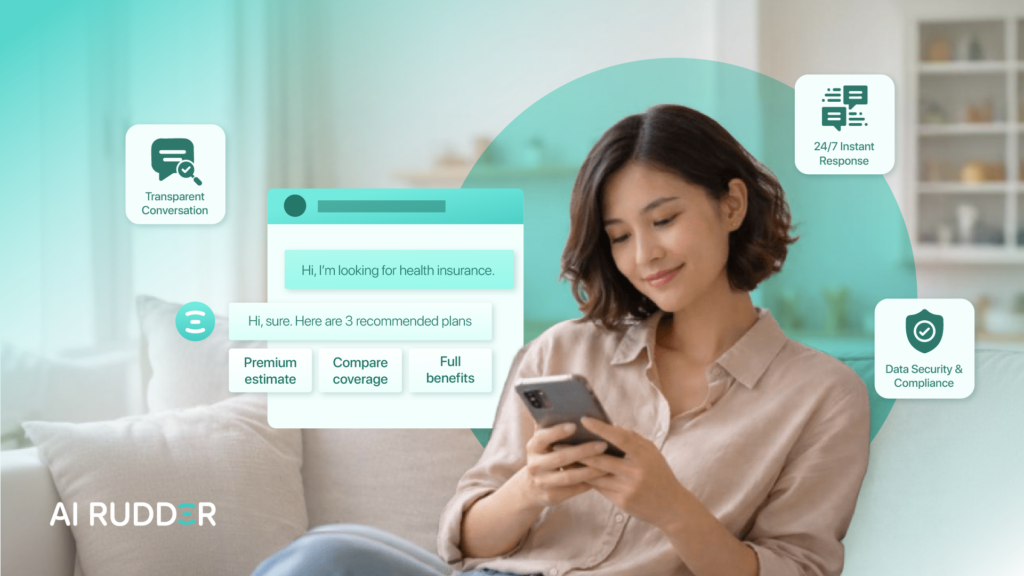
Traditional customer service models are no longer sufficient in this fast-paced era. In the insurance industry, trust is the main foundation that can be built through speed and accuracy. Customers no longer tolerate long wait times for basic answers. Therefore, the implementation of an insurance chatbot becomes crucial to ensure the company remains available around the clock and provides the instant responses needed by policyholders.
Depending solely on human labor has significant disadvantages, particularly in terms of scale and consistency. Human agents have limited working hours, are at risk for human error, and can easily become overwhelmed during simultaneous claim surges. By integrating AI, insurance companies can cover these operational gaps while maintaining stable service quality without the slow bureaucratic hurdles.
Beyond trust, transparency remains a core pillar of the insurance industry. In this case, AI chatbot for insurance plays an important role in building transparency by serving as an information bridge, translating complex language into simple explanations that policyholders can understand.
Insurance chatbot can explain and answer the details of their protection coverage. AI chatbot’s explanations are consistent and accurate without missing any information. This transparency ensures that there are no traps or unpleasant surprises during the claims process. With open access to information, customers feel they have full control over their insurance, which automatically strengthens the foundation of trust in the company.
Transparency extends beyond information clarity to data security. A trusted AI partner must demonstrate that every interaction and data is protected by high-level encryption. When insurance companies are open about how they protect policyholder privacy in those conversations, it will eliminate their doubts about sharing sensitive information.
Insurance chatbot can build policyholder trust throughout the entire policy process. Starting from easy access at the initial stage of protection search, which can instantly answer basic FAQs, gather basic customer needs, and assist in the self-service quotation process, customers feel they are receiving transparent information without pressure. The speed of the bot in processing personal data, addresses, and health information systematically gives an image of professionalism and shows the company’s readiness to serve potential customers from the very beginning.
Next, transparency in policy management reinforces policyholders’ confidence that they have full control over their accounts. Through AI chatbot for insurance, customers can easily change beneficiaries, switch payment methods, and check premium payment status independently. The ease of updating customer information such as residential address or contact details in real-time ensures that there are no communication barriers between the company and the policyholders.
Trust is most critical during the claims process, and this is where AI chatbot plays the role of a loyal companion. The bot provides clear instructions, facilitates the submission of necessary documents, and even helps with claim calculations. With the claim status check feature that can be accessed anytime, customers no longer feel left in the dark by uncertainty, which is a key factor in maintaining loyalty and trust.
Lastly, insurance chatbot maintains long-term relationships through responsive complaint handling. With Customer Sentiment Analysis technology, AI chatbot can accurately understand the level of customer satisfaction or disappointment. When issues become complex, the system seamlessly escalates conversations to human agents in real-time, ensuring that the customer’s complaint is heard and taken seriously. The synergy between the speed of the bot and the empathy of the human agent is what creates a new standard in maintaining customer trust in the digital era.
The technology that customers trust the most is not the one that tries to do everything, but the one that knows its limits. In the insurance industry, there are sensitive moments where human empathy cannot be replaced by algorithms, such as during the claims process (e.g. accidents or natural disasters) and policy renewals. An AI insurance chatbot must have protocols to automatically step back when detecting complex issues or high emotional load from customers.
Through the real-time transfer feature, AI chatbot for insurance ensures a seamless transition from bot to human agent. Customer trust will increase when AI chatbot performs a smart hand-off, where the entire conversation history and collected data are directly forwarded to the agent. That way, customers do not need to repeat their explanations from the beginning, which often becomes a major source of frustration.
This approach demonstrates that insurance chatbots are not replacing human roles, but rather to support them. By assigning administrative and repetitive tasks to bots, human agents have more time to focus on providing deep emotional and technical solutions for critical cases.
In the digital era, trust is no longer built on promises alone, it is built on responsiveness, clarity, and consistency. AI chatbots have transformed the service paradigm from being rigid and slow to a dynamic and transparent conversation. By providing instant answers, simplifying complex policy language, and accompanying the claims process in real-time, insurance companies demonstrate their commitment to always being on the side of customers without bureaucratic obstacles.
However, this technology is not about replacing the role of humans, but rather optimizing every interaction point in the policyholder’s lifecycle. Enduring trust is born from the synergy between the efficiency of machines that know their limits and the empathy of human agents who are ready to take over in critical moments. By adopting this strategy, insurance companies not only enhance operational efficiency but also build a reputation as a reliable, transparent brand that truly cares about the needs of its customers.
AI Rudder helps insurers implement advanced insurance chatbot solutions across the entire policy lifecycle, from quotation automation to intelligent claims support and proactive customer engagement. Our conversational AI is designed to understand human needs with precision, AI Rudder ensures that every interaction with your customers is fast, accurate, and still retains a personal touch.
To support this excellence, AI Rudder’s infrastructure meets leading international standards, including SOC 2, ISO 27001, GDPR, PDPA, IMDA, and CSA, ensuring full compliance and continuous protection for sensitive data.
Contact AI Rudder to transform your operations into a more efficient and trustworthy system in the eyes of policyholders with insurance chatbot.
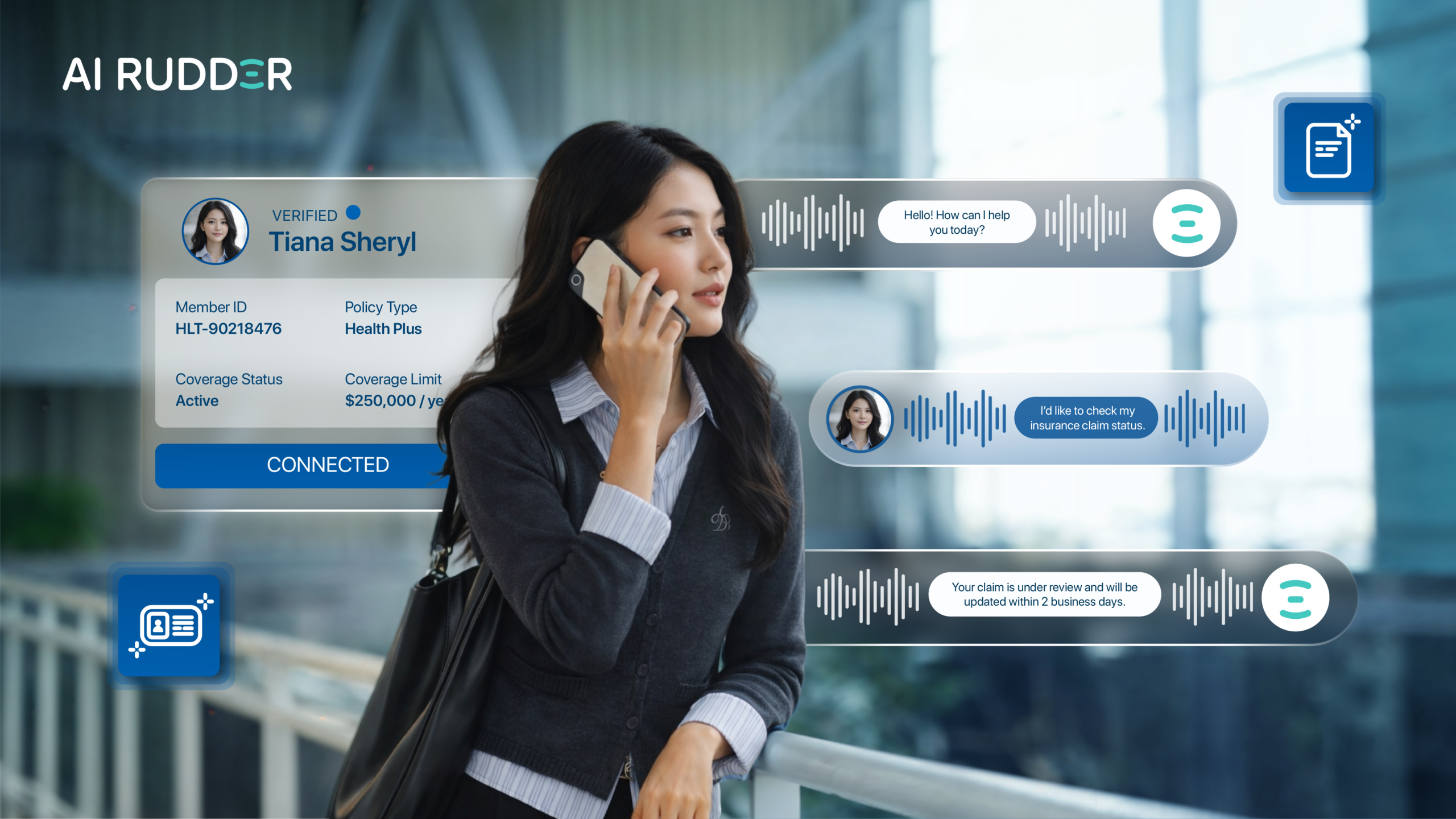
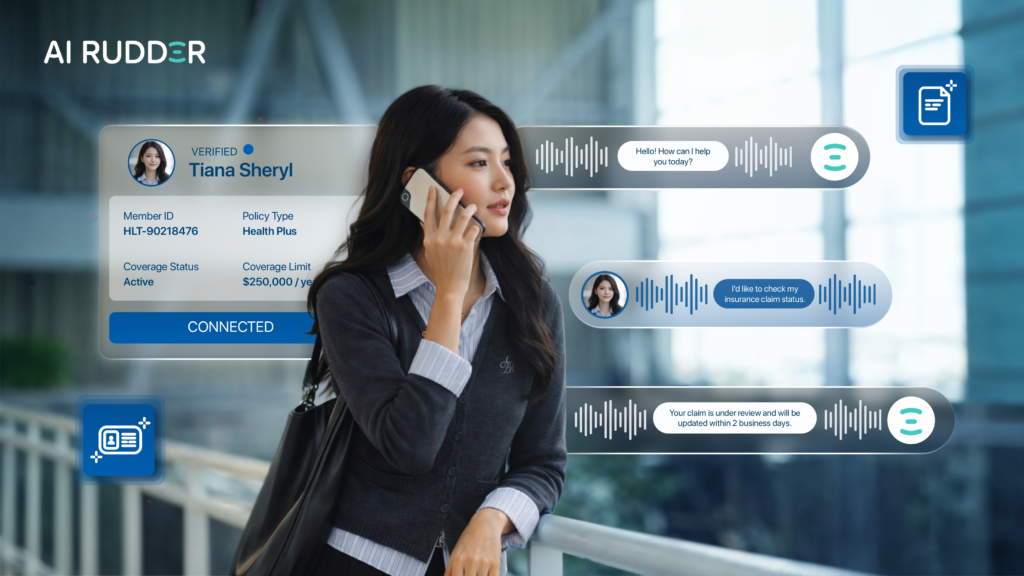
In the insurance industry, time directly impacts customer trust. When customers call to report an accident or inquire about the claim status, long waiting times quickly become frustration. To meet these demands, many firms are turning to AI voicebot solutions for insurance companies to accelerate service. However, the challenge lies in choosing a solution that doesn’t just “talk,” but truly understands the complex, sensitive context of insurance.
Selecting the wrong technology can lead to wasted investment and poor customer experiences that damage brand trust. To avoid these pitfalls, it is essential to evaluate the best AI voice agents for insurance that are built to handle high-stakes financial transactions and sensitive policyholder data. So, how do you find a truly reliable solution for your insurance operations? Let’s talk about it in this article.
Modern AI voicebot solutions for insurance extend far beyond answering basic FAQs. They support critical policyholder interactions across the customer lifecycle:
Implementing AI Voicebot isn’t about replacing the role of human agents, but about strengthening and improving the operational systems of insurance companies to be more resilient and cost-effective. Here are the real impacts on operations:
Choosing an AI Voicebot solution for insurance companies involves far more than a simple cost-benefit analysis, it is about selecting a strategic partner capable of navigating a high-stakes industry. To ensure you are selecting from the best AI voice agents for insurance, evaluate these five pillars:
AI Rudder is not just an ordinary voice AI technology, we are a strategic partner specifically designed to address the unique challenges in the insurance industry. By providing specialized AI voicebot solutions for insurance companies, AI Rudder enables insurers to streamline customer communication across claims, policy management, and renewals through intelligent, human-like voice automation. We understand that in this industry, every second counts. That is why our voice AI delivers ultra-low latency, providing human-like responses in under one second to engage policyholders naturally with 24/7 conversational voice experiences that feel personal and responsive.
With a proven track record of handling over 80 million interactions for 500+ enterprises in 20 languages, we ensure that every conversation is seamless and accurate. Our AI Voicebot allows you to automate high-volume interactions such as claim status updates, premium reminders, and coverage inquiries to significantly improve operational efficiency. Furthermore, AI Rudder helps drive proactive customer follow-ups with AI agents that ensure timely engagement and smoother policyholder journeys, reducing churn and increasing loyalty.
Security and compliance are at the heart of everything we do. We help you maintain trust and compliance through enterprise-level security, encryption, and continuous monitoring safeguards. Our platform is fully compliant with global standards, including SOC 2, ISO 27001, GDPR, PDPA, IMDA, and CSA. By integrating smoothly with your existing legacy systems, AI Rudder helps you enhance responsiveness and improve customer satisfaction, all while keeping your insurance operations efficient, secure, and future-ready.
Choosing the right AI Voicebot is a strategic investment in customer trust and operational resilience. With the right partner, you not only cut operational costs but also stand by your customers during their most crucial moments. AI Rudder is ready to be the best AI Voicebot solutions for insurance company that helps you achieve the ideal balance between automation efficiency and human-centered service.
Ready to see how AI Rudder transforms your insurance operations? Contact us for a demo now.
The gap between insurance services and customer expectations is widening. Long claim processing times and slow responses are no longer minor inconveniences, they are the primary reason for low retention. In a market where loyalty is earned through speed, being ‘fast enough’ is no longer enough.
At the same time, many insurers still operate across fragmented communication channels. Policy information, claims inquiries, and customer support are often spread across websites, call centers, mobile apps, email, and messaging platforms.
This disconnected experience leads to repeated customer effort, inconsistent service quality, and reduced customer satisfaction.
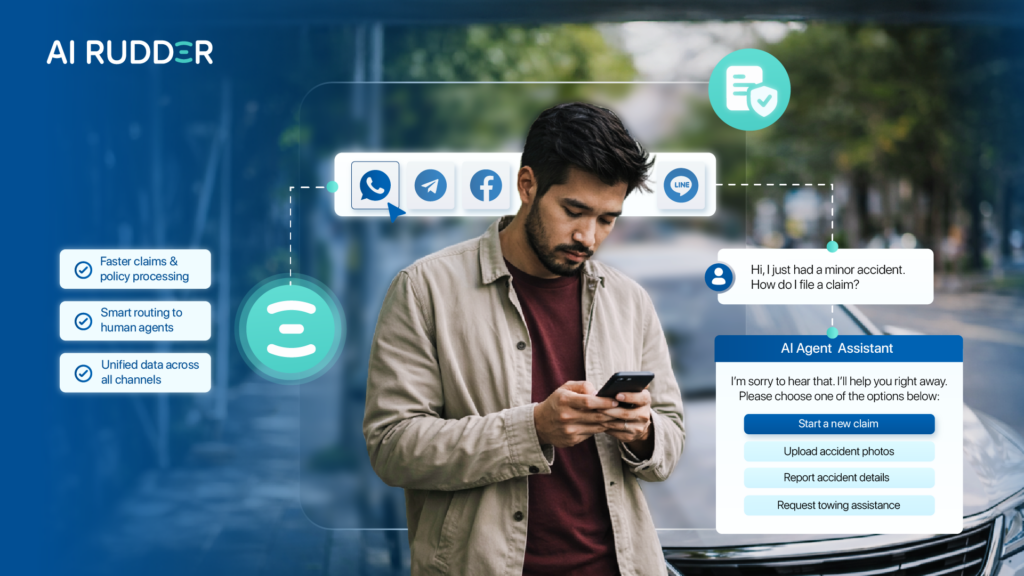
In this digital transformation, customers expect insurers to provide convenient customer service. Most customers interact with insurers through social media, websites, email, or other messaging apps. For insureres, having a strong digital presence and consistent service across all communication channels is crucial. Therefore, AI-driven omnichannel is one of the solutions that insurers can use to support a seamless customer experience.
AI-driven omnichannel is a platform that allows customers to interact seamlessly across various communication channels, from chat, email, SMS, to telephone.
In the voice channel specifically, the implementation of a voicebot for insurance ensures that phone interactions are no longer manual and slow, but automated and intelligent. Powered by AI, omnichannels can deliver consistent, 24/7 service with minimal effort.
Whether a customer starts a conversation through chat and later follows up by phone, the system retains context and history, enabling smoother interactions and faster resolutions. Omnichannel also enables data integration across multiple channels, so that if customers contact a bot on a different channel, customer data will still be recorded and the bot will recall customer conversations on the previous channel.
With AI-driven omnichannel, insurers can deliver faster, more consistent, and more personalized experiences at every touchpoint. Starting with more personalized interactions, AI can help insurers analyze customer behavior and recommend products that align with their preferences. This can help improve customer satisfaction and increase product sales, which can benefit both parties.
Furthermore, with AI-driven omnichannel capabilities, insurers can also answer customer questions 24/7 across all touchpoints. By deploying a voicebot for insurance, companies can handle thousands of simultaneous calls without putting customers on hold. This not only reduces the workload of human agents but also ensures prompt resolution of customer issues, which can increase customer trust in insurers.
With sentiment analysis, AI can detect sensitive language in conversations, allowing the system to determine whether customers are satisfied or dissatisfied with the resolution provided by AI. This can help insurers improve customer retention and loyalty.
In addition to accelerating responses, AI-driven omnichannel can also direct complex inquiries that can’t be resolved by AI agents to the appropriate team. This allows human agents to directly handle cases that require empathy, consideration, or deeper explanation. This collaboration between AI and humans creates a balanced service experience, operationally efficient yet personalized for customers.
When every system and channel works together, customers feel it. A smoother experience and consistent communication across every touchpoint build a sense of trust and reliability. Customers feel valued, gain easier access to information they need, and know their concerns are handled promptly. As a result, policy renewal rates rise, satisfaction grows, and loyalty deepens, forming a strong foundation for sustainable growth in the insurance industry.
AI-driven omnichannel is no longer just an option, it’s becoming the standard in the insurance world.
By adopting a voicebot for insurance as part of an integrated ecosystem, customers receive a more consistent and personalized experience across both voice and text. This approach not only increases customer satisfaction but also reduces operational costs and accelerates claims and policy processing. Amidst this industry evolution, insurers who adopt AI-driven omnichannel are reaping the benefits.
AI Rudder helps insurers create seamless, AI-powered customer journeys by connecting every touchpoint into one unified experience. With intelligent automation, real-time data integration, and multilingual AI agents, insurers can improve response times, reduce costs, and deliver more human, personalized service at scale. Contact us to start your transformation.
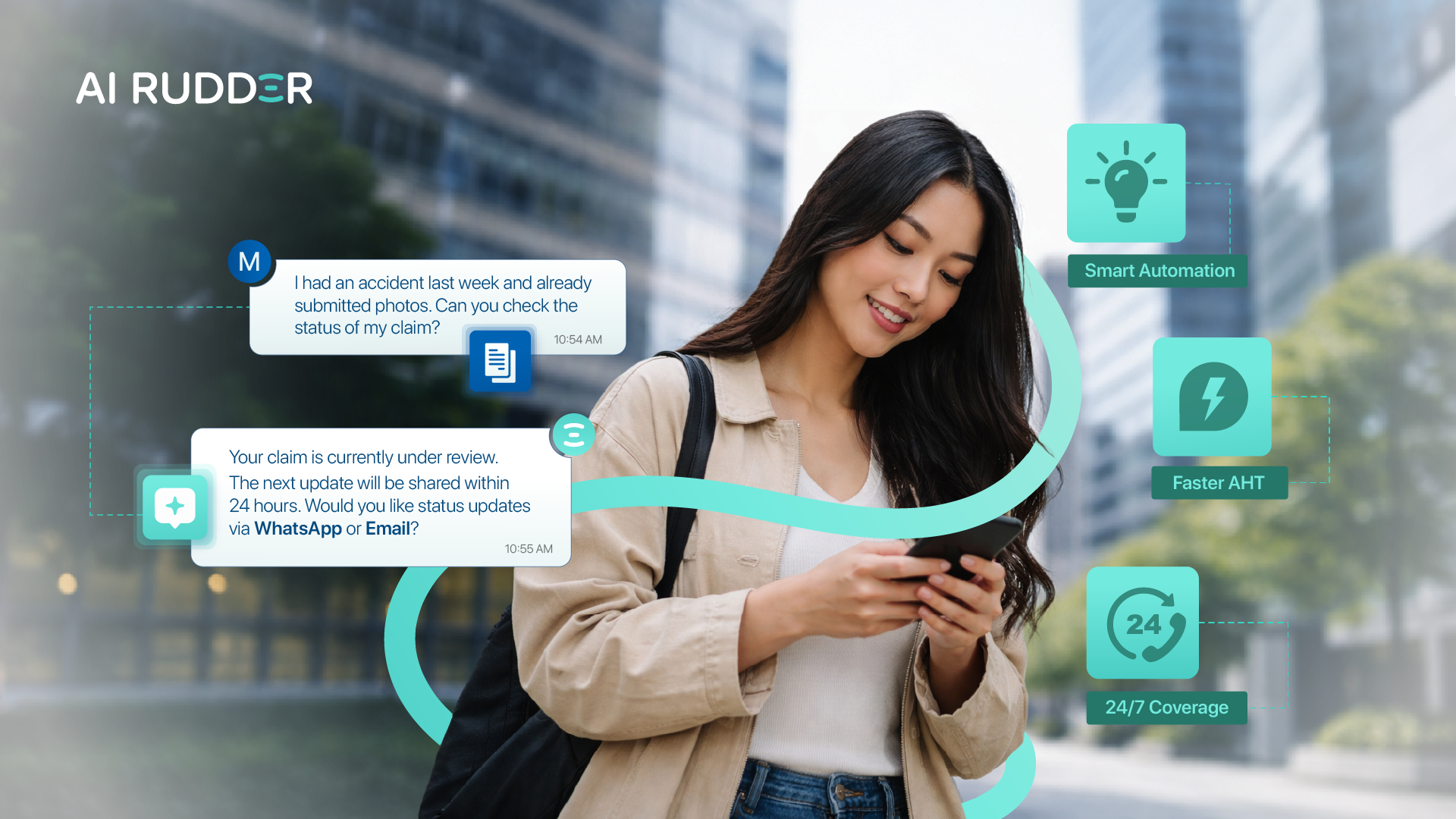
For years, the idea of AI in insurance felt more like hype than reality. Insurers experimented with early chatbots, hoping they would ease the pressure on call centers and improve customer service. But the reality was disappointing. These tools could only follow rigid scripts, struggled with anything beyond simple questions, and often left customers more frustrated than helped. Many insurers gave up with the idea, believing that conversational AI simply wasn’t ready for the complexity of their industry.
That was then. Today, thanks to the rise of large language models (LLMs), the story is very different. Conversational AI in insurance industry is no longer a future vision as it is now here, mature, and transforms how insurers handle claims, renewals, and customer service.
Think back to those first-generation AI agent voicebots and chatbots. They were like call-center interns on their very first day: able to answer a handful of simple questions, but anything more complex, more often than not, left them stuck. Customers asking about policy exclusions, renewal options, or multi-step claim scenarios often hit a dead end.
Integration was another stumbling block. Those AI agents rarely connected well with policy databases or claims systems, forcing agents to step in anyway. And with security frameworks still underdeveloped, insurers hesitated to trust these tools with sensitive data.
The result? Early AI in insurance led to longer processes, not shorter ones. Both customers and insurers lost faith.
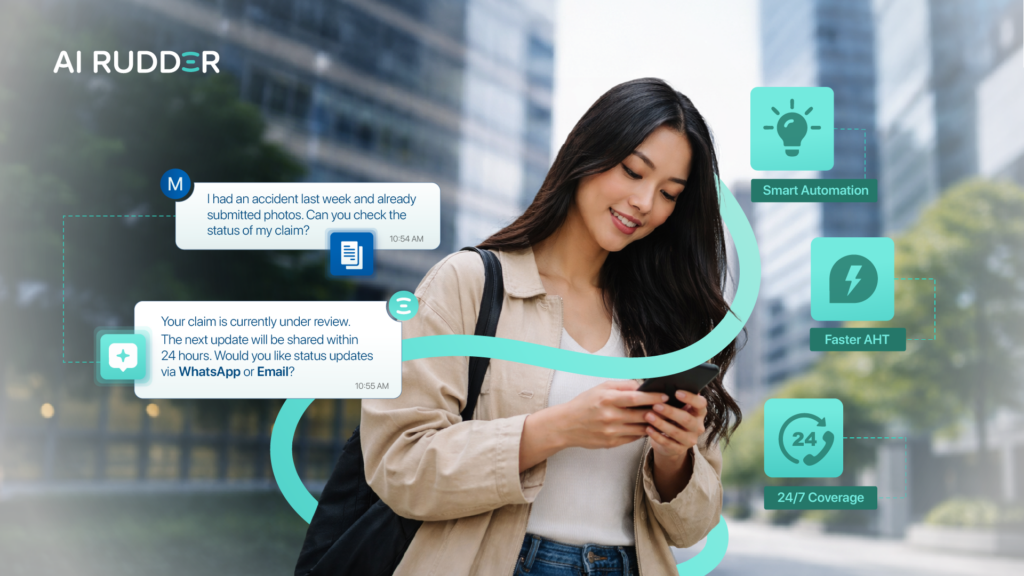
Now imagine a very different picture. A customer asks: “I filed a claim for my car accident last week. I already submitted the photos, so what happens next?”
In the past, AI agents would fail to connect the dots. Today, LLM-powered conversational AI understands the full context, retrieves the claim status, and guides the customer on next steps, even going as far as understanding the claim documents they submit, instantly and accurately.
This leap forward is possible because LLMs can even handle nuance, jargon, and even slang in ways old systems never could. They don’t rely on memorizing every possible phrase. Instead, they learn, adapt, and improve with every interaction. Modern solutions also integrate smoothly with claims management and CRM systems, while encryption and audit trails ensure compliance isn’t compromised.
This evolution is why conversational AI in insurance industry is finally ready for prime time.
For insurers, the timing couldn’t be better. Contact centers are under immense strain: spikes in call volumes during claim surges, long hold times, rising agent turnover, and customers who now expect 24/7 support.
Human agents can only do so much. And when they spend most of their time answering routine questions like “When will my claim be processed?” or “When does my policy expire?”, their capacity for empathy-driven, high-value conversations shrinks.
This is exactly where conversational AI steps in.
In insurance, conversational AI can create value on both outbound and inbound fronts. On the outbound side, it supports telemarketing campaigns, drives smoother onboarding, and even verifies customer information with high accuracy. On the inbound side, it takes pressure off contact centers by handling claims inquiries, resolving complaints, and providing 24/7 customer service that’s consistent and reliable.
Take our insurance clients as an example, AI-powered outreach in telemarketing campaigns boosted conversion rates significantly, turning more conversations into actual policyholders. In another case, conversational AI helped achieve a 90% connect rate, ensuring that almost every prospect reached got the right message at the right time. And in critical processes like policy or claims verification, accuracy in information-checking flows climbed to over 90%, reducing errors and building customer trust.
What makes today’s AI different is its ability to adapt. Ask it a “what if” question like “What if I renew late?” and it gives a contextual answer, not a canned response. That’s the power LLMs bring to the table.
For customers, this means faster answers and less waiting. For insurers, it means agents are freed from repetitive tasks, average handling times drop, and ultimately operational costs shrink. Importantly, AI never sleeps, so customers can get answers at midnight, on weekends, or during peak claim seasons when human agents are swamped.
And unlike the old days, security is not an afterthought. Today’s conversational AI comes with security guardrails like encryption, data masking, and audit trails built in, turning what was once a compliance risk into a compliance advantage.
It’s a question many ask: Will AI replace insurance agents?
As much hype there is around conversational AI in insurance industry, the truth is, no. Conversational AI in insurance is not here to replace people, it’s here to support them. AI takes on the repetitive, high-volume tasks, while human agents focus on what they do best: empathy, negotiation, and handling complex claims.
The future isn’t AI versus humans. It’s AI plus humans. Working together to deliver faster, smarter, and more compassionate service.
After years of trial and error, Conversational AI in insurance industry has finally come of age. Thanks to LLMs, conversational AI can now reduce claims pressure, strengthen compliance, and deliver a customer experience that matches modern expectations.
For insurers, the choice is clear: those who embrace AI today will be the ones leading in efficiency, trust, and customer loyalty tomorrow.
We provide enterprise-ready AI solutions for insurance that are secure, scalable, and proven in real-world use cases.
Reach out today for a consultation to see how conversational AI can transform your claims and customer experience: business@airudder.com
For years, insurers have relied heavily on IT teams or external vendors to automate even the simplest tasks. Every change, no matter how small,…
May 27, 2026
Traditional customer service models are no longer sufficient in this fast-paced era. In the insurance industry, trust is the main foundation that can be…
March 11, 2026
In the insurance industry, time directly impacts customer trust. When customers call to report an accident or inquire about the claim status, long waiting…
March 4, 2026
The gap between insurance services and customer expectations is widening. Long claim processing times and slow responses are no longer minor inconveniences, they are…
February 13, 2026
For years, the idea of AI in insurance felt more like hype than reality. Insurers experimented with early chatbots, hoping they would ease the…
February 5, 2026