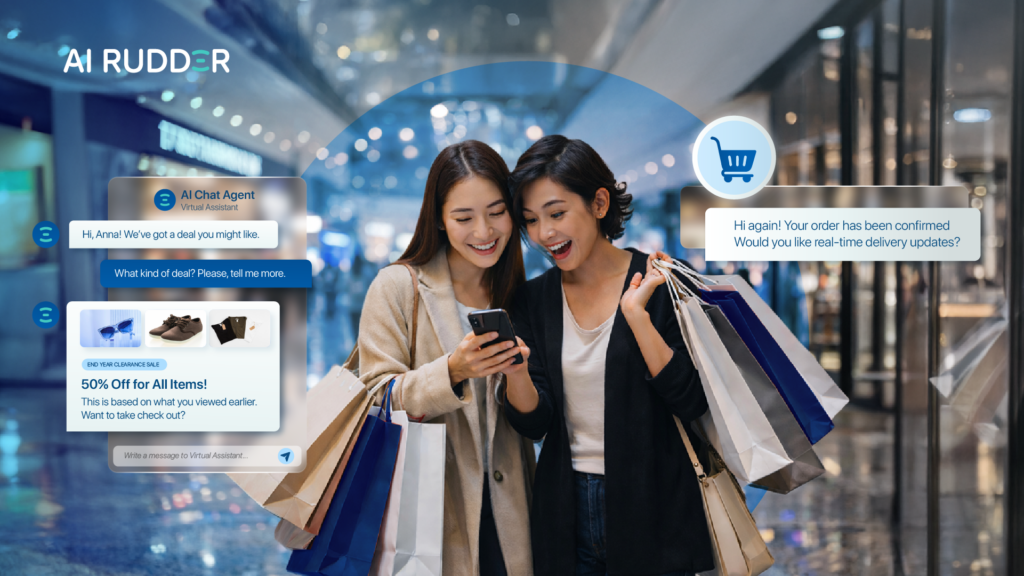
In the Fast-Moving Consumer Goods (FMCG) industry, consumer loyalty is notoriously difficult to secure. Products are purchased frequently, switching costs are practically non-existent, and supermarket shelves are crowded with competitors competing fiercely on price. In this environment, a consumer might buy your brand’s shampoo today but effortlessly switch to a competitor’s promotion tomorrow.
For decades, FMCG brands have relied on points-based loyalty programs to encourage repeat purchases. However, as consumers suffer from “app fatigue” and digital clutter, these traditional programs are losing their impact. True loyalty is no longer built solely on points and discounts; it is built on consistent, personalized, and effortless engagement. This is where AI-powered chat agents are redefining FMCG loyalty, transforming passive buyers into active brand advocates through always-on, conversational interactions.
Why Loyalty is FMCG’s Hardest Problem
The fundamental challenge of FMCG loyalty lies in the nature of the products themselves. Unlike purchasing a car or a smartphone, buying soap, snacks, or beverages is a low-involvement decision. Consumers are driven by convenience, availability, and immediate needs. If a preferred brand is out of stock or a competitor offers an attractive discount, the consumer will switch without hesitation.
Furthermore, FMCG brands traditionally have a disconnected relationship with their end consumers. Because products are primarily sold through third-party retailers and distributors, brands lack direct access to consumer data and purchasing habits. Without this direct line of communication, building a meaningful, personalized relationship that fosters long-term loyalty is incredibly challenging.
The Limitations of Traditional Loyalty Programs
To bridge this gap, many FMCG brands have launched proprietary loyalty apps. The premise is simple: buy the product, scan the receipt, earn points, and redeem rewards. However, the reality is often disappointing.
Consumers are reluctant to download yet another app for a product they buy routinely. Even when they do enroll, engagement drops quickly. The process of scanning receipts or navigating complex redemption portals introduces friction. When the effort required to participate outweighs the perceived value of the rewards, the loyalty program fails to influence purchasing behavior, resulting in low redemption rates and stagnant ROI for the brand.
How AI Chat Agents Power Conversational Loyalty
AI-powered chat agents offer a frictionless alternative by bringing the loyalty program directly to the platforms consumers already use daily, such as WhatsApp, LINE, or Facebook Messenger. There is no app to download and no new interface to learn.
Through conversational AI, loyalty becomes an interactive experience. Consumers can simply send a message to the brand’s verified WhatsApp account to check their points balance, learn about new rewards, or participate in interactive campaigns. The AI agent can handle these inquiries instantly, 24/7.
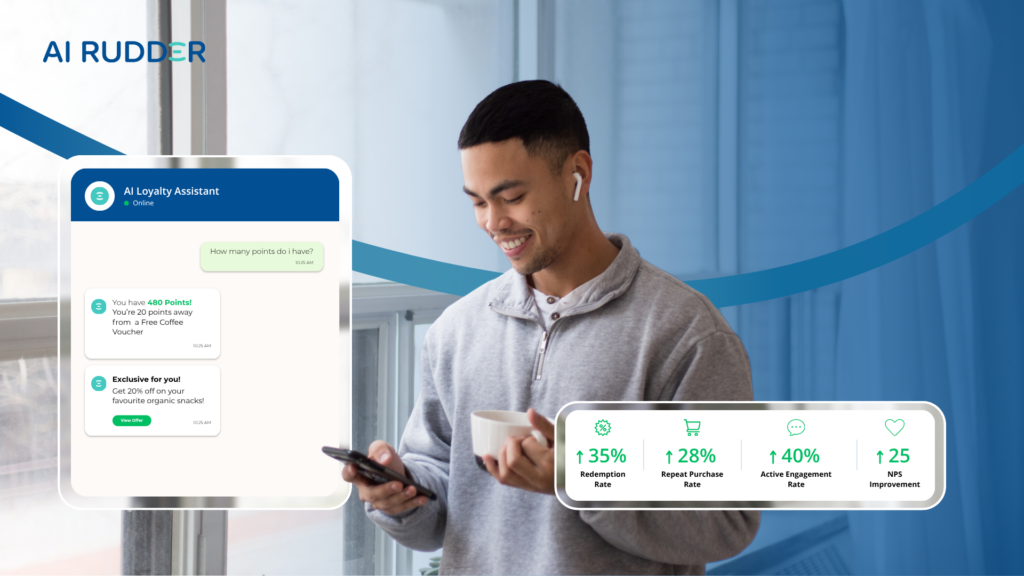
For example, a consumer might message the AI saying, “How many points do I have?” The AI instantly replies with the balance and proactively suggests, “You have enough points for a free coffee voucher. Would you like me to send it to you now?” This seamless, conversational approach removes friction and makes engaging with the loyalty program effortless and rewarding.
Integrating AI with Loyalty Programs for Real-Time Personalization
The effectiveness of conversational loyalty is amplified when the AI chat agent is integrated with the brand’s CRM and backend loyalty platforms. This integration allows the AI to access real-time consumer data, enabling highly personalized interactions.
Instead of generic mass communications, the AI can tailor its messaging based on the consumer’s purchase history and preferences. If the data shows a consumer frequently buys a specific line of organic snacks, the AI can proactively notify them of a relevant promotion or offer double points on their next purchase of that specific item. This level of personalization makes the consumer feel recognized and valued, strengthening their emotional connection to the brand.
Re-Engagement Campaigns: Using AI to Win Back Lapsed Consumers
AI chat agents are also powerful tools for re-engaging lapsed consumers. By analyzing purchase cycles, the system can identify consumers who haven’t interacted with the brand or redeemed points within an expected timeframe.
The AI can then initiate a targeted win-back campaign. It might send a friendly message saying, “We haven’t seen you in a while! Here’s a special 20% discount on your favorite products to welcome you back.” Because the message is delivered via a conversational channel like WhatsApp, it feels more personal and less intrusive than a promotional email, significantly increasing the chances of re-activation.
Measuring Loyalty Program Health
To ensure the success of AI-driven loyalty initiatives, FMCG brands must track metrics that reflect true engagement and behavioral change:
Redemption Rate: The percentage of earned points or rewards that are actually used by consumers. Conversational AI typically drives higher redemption rates by making the process easier.
Repeat Purchase Rate: Tracking whether engagement with the AI chat agent correlates with increased purchase frequency.
Active Engagement Rate: Measuring how often consumers interact with the chat agent beyond simple points inquiries (e.g., participating in polls, asking product questions).
Net Promoter Score (NPS): Gauging overall consumer sentiment and likelihood to recommend the brand based on their conversational experience.
By moving beyond transactional points programs and embracing AI-powered conversational engagement, FMCG brands can build deeper, more resilient loyalty that withstands the pressures of a highly competitive market.
Build Lasting Consumer Loyalty with AI Rudder
AI Rudder is a globally trusted conversational AI platform that helps FMCG brands create meaningful, always-on consumer relationships at scale. Our AI Chat Agent integrates seamlessly with the messaging platforms your consumers already use — including WhatsApp, LINE, and more — making it effortless for them to engage with your loyalty program without downloading a new app or navigating a complex portal.
With deep integration capabilities for CRM and loyalty platforms, AI Rudder enables real-time personalization that makes every consumer feel recognized and valued. Our multilingual support ensures consistent, culturally relevant engagement across all your markets, while our enterprise-grade security certifications — including SOC 2, ISO 27001, GDPR, and PDPA — ensure consumer data is handled with the highest level of protection.
Ready to transform your loyalty program from a passive points system into a dynamic, conversational brand experience? Contact AI Rudder today to schedule a demo and discover how our AI Chat Agent can help you build the consumer loyalty your brand deserves.
In the FMCG industry, the spotlight often falls on the end consumer. Brands invest heavily in optimizing the B2C shopping journey, ensuring products are visible, appealing, and accessible. However, behind every successful consumer purchase is a complex, often invisible B2B supply chain powered by a vast network of distributors, wholesalers, and retail partners.
Managing this network is historically labor-intensive. FMCG brands must coordinate with thousands of trade partners daily to process orders, confirm stock availability, share promotional updates, and manage payments. When this communication relies on manual processes, it creates operational bottlenecks that slow down the supply chain and frustrate trade partners. Today, forward-thinking FMCG brands are turning to AI-powered chat and voice agents to automate distributor communication, transforming their B2B operations from a reactive cost center into a streamlined, proactive engine.
The Complexity of FMCG Distributor Networks
The scale of an FMCG distribution network, particularly in diverse markets like Southeast Asia, is staggering. A single brand might rely on tens of thousands of mom-and-pop shops (warungs, sari-sari stores) alongside large modern retail chains.
Communication within this network is often fragmented. Sales representatives and distributors exchange information across a mix of phone calls, SMS, WhatsApp messages, and emails. This unstructured communication leads to several critical pain points:
Order Processing Delays: Manual order entry is slow and prone to human error, leading to delayed shipments and stockouts at the retail level.
Information Asymmetry: Distributors often struggle to get real-time answers about stock availability or the status of their deliveries, forcing them to constantly follow up with brand representatives.
Sales Rep Burnout: FMCG field sales teams spend an inordinate amount of time acting as customer support for distributors—answering routine queries rather than focusing on strategic relationship building and expanding market share.
What Distributors Actually Need
To streamline the B2B supply chain, it is essential to understand what distributors and trade partners actually need from FMCG brands. Their requirements are highly transactional and time-sensitive:
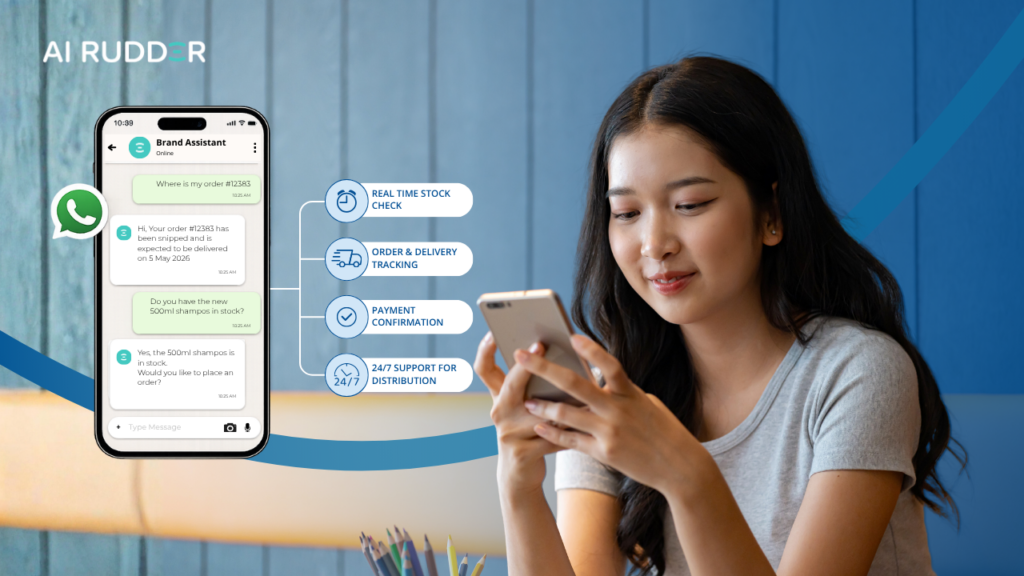
Instant Order Status: They need to know exactly when their inventory will arrive.
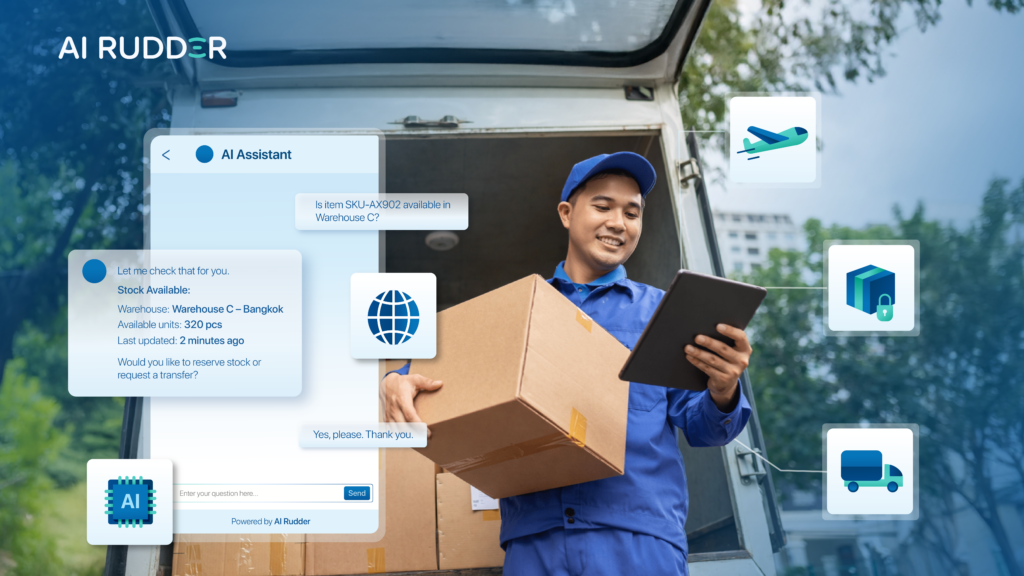
Real-Time Stock Checks: Before placing an order, they need confirmation that the products are available in the warehouse.
Clear Promotional Updates: They need to understand current trade promotions, volume discounts, and how to apply them to their orders.
Payment Confirmations: They require immediate acknowledgment when a payment is received and processed.
When these needs are met quickly and accurately, the distributor can operate more efficiently, which directly translates to higher sales volumes for the FMCG brand.
How AI chat agents handle distributor inquiries 24/7
AI-powered chat agents offer a scalable solution to the distributor communication bottleneck. By deploying an intelligent chatbot on platforms that distributors already use heavily, such as WhatsApp, FMCG brands can provide a 24/7 self-service channel for their trade partners.
Unlike simple, menu-driven bots, advanced AI chat agents use Natural Language Understanding (NLU) to comprehend complex queries. A distributor can simply message the brand’s verified WhatsApp account and ask, “Where is my order #12345?” or “Do you have the new 500ml shampoo in stock?” The AI agent instantly retrieves the information and responds conversationally. This immediate access to information eliminates the need for the distributor to call a sales rep or wait for business hours to get an answer.
Automating Order Confirmation and Delivery Tracking
One of the most impactful use cases for AI in B2B FMCG is the automation of order management workflows. When a distributor places an order, the AI agent can immediately send an automated confirmation message via chat or voice, summarizing the order details and providing an estimated delivery date.
As the order moves through the supply chain, the AI can proactively send tracking updates. If there is a delay due to logistics or weather, the AI can notify the distributor in real-time, managing expectations and preventing frustrated follow-up calls. Furthermore, AI voice agents can be utilized to make automated outbound calls to confirm large or complex orders, ensuring accuracy before the goods are dispatched.
Integrating AI with ERP and Inventory Systems
For an AI agent to be truly effective in a B2B order management, it must be deeply integrated with the FMCG brand’s backend systems, such as their Enterprise Resource Planning (ERP) software and inventory management databases.
This seamless integration is what transforms the AI from a simple answering machine into a powerful operational tool. When a distributor asks about stock availability, the AI queries the ERP system in real-time to provide an accurate answer. If the distributor wants to place a repeat order, the AI can access their purchase history, apply any relevant trade discounts, and inject the new order directly into the ERP system for processing, completely bypassing manual data entry.
Measuring Impact: Efficiency and Satisfaction
FMCG brands that automate distributor communication with AI can measure the impact on their B2B order management performance across several key operational metrics:
Order Processing Time: The speed at which an order moves from placement to fulfillment is significantly reduced when manual entry is eliminated.
Support Ticket Deflection: The volume of routine inquiries handled by the AI, freeing up sales reps and B2B support teams.
Sales Rep Productivity: Tracking the shift in sales reps’ activities from administrative support to proactive selling and account management.
Distributor Satisfaction: Improved NPS and satisfaction scores from trade partners who appreciate the faster, more reliable communication.
By leveraging AI to automate distributor communication, FMCG brands can build a more resilient, responsive supply chain. It empowers trade partners with the information they need instantly, reduces operational friction, and allows the brand’s human workforce to focus on driving growth rather than managing logistics.
Streamline Your Distributor Network with AI Rudder
AI Rudder is a leading conversational AI platform trusted by 500+ enterprises across diverse industries, including FMCG, to automate complex, high-volume B2B and B2C interactions. Our AI Chat Agent and AI Voice Agent seamlessly integrate with your existing ERP, CRM, and inventory systems, enabling real-time, accurate communication with your entire distributor network — 24 hours a day, 7 days a week.
From instant order confirmations and delivery tracking to promotional updates and payment inquiries, AI Rudder empowers your trade partners with the information they need, precisely when they need it. Our multilingual capabilities ensure consistent communication across all markets, while our enterprise-grade security infrastructure — certified under SOC 2, ISO 27001, and PDPA — keeps your business data protected at every step.
Ready to eliminate communication bottlenecks and build a more efficient, responsive supply chain? Contact AI Rudder today to schedule a demo and discover how our AI agents can transform your distributor relationships.
In the era of digital banking, fast service is no longer just a convenience, it has become a key driver of customer trust. When customers face urgent situations such as lost credit cards or detection of suspicious transactions, waiting in the call center queue for several minutes is no longer just a technical issue, but a serious service failure.
Chatbots for banking have emerged as a strategic solution to overcome these challenges. Unlike traditional bots, modern AI chatbots have been integrated with core banking systems to handle complex tasks independently, from instant card blocking, KYC verification, to 24/7 transaction monitoring without waiting time.
By adopting this technology, financial institutions are not only able to significantly reduce operational costs but also provide proactive and secure support. This article will discuss how chatbots are transforming customer service challenges into competitive advantages in the current banking industry.
Streamlining KYC and Onboarding Through Intelligent Chatbots
Opening an account or applying for a loan is often where banks lose potential customers due to lengthy forms and complex KYC (Know Your Customer) procedures. In many cases, customers choose to drop off the process because they feel overwhelmed by the numerous legal documents.
Chatbots for banking simplify this barrier through a conversational onboarding approach. Instead of filling out tedious forms, customers are guided through step-by-step interactive conversations. The chatbot can automatically perform real-time data validation, assist customers in uploading identity document photos, and even conduct basic biometric verification directly within the chat window.
As a result, the bank can significantly increase conversion rates by creating a registration experience that feels more personal and has minimal obstacles. By shifting this administrative process to a chatbot, the bank not only speeds up the account activation time from days to minutes but also ensures that all procedures remain compliant with strict regulatory standards.
Automating Routine Inquiries to Boost Agents’ Productivity
A large portion of banking customer support workload is usually dominated by repetitive transactional inquiries. Questions such as balance inquiries, account mutation confirmations, and credit card bill payment statuses often cause long queues on phone lines. This not only burdens human agents with monotonous administrative tasks but also hinders overall operational efficiency.
Chatbots for banking address this challenge by providing a self-service channel directly connected to the customer transaction database. Through secure integration, chatbots are able to provide instant answers to customer queries within seconds. Customers no longer need to navigate complex application menus or wait for a human agent just to get the details of their last transaction.
The ability of chatbots to handle thousands of requests simultaneously provides a scalability advantage that cannot be achieved by manual labor. Amidst the surge in traffic, the chatbot consistently provides quick responses without experiencing fatigue. This capacity ensures that the quality of service remains maintained even when the volume of interactions suddenly increases sharply.
By shifting transactional inquiries to artificial intelligence, banks can reallocate their human resources to handle more strategic and high-value cases, such as investment consultations or investigations of complex transaction disputes. This transformation not only increases the bank’s internal productivity but also provides a more modern, efficient, and responsive banking experience for customers across all segments.
Accelerating Fraud Mitigation Through Instant Alerts
In the fast-paced banking ecosystem, risk management is no longer just a behind-the-scenes system, but a crucial part of customer service. The biggest challenge for banks today is ensuring that security notifications are not only sent but also understood and acted upon instantly by customers. Conventional notifications often arrive late or get stuck in a full inbox, creating an opportunity for criminals to drain assets before preventive measures can be taken.
Chatbots bridge this security gap by serving as the primary channel for delivering real-time risk alerts. Once the bank’s internal fraud detection system records suspicious activity, the chatbot automatically sends priority notifications through the chat platform most frequently used by customers. This ensures that information regarding potential security threats reaches customers within seconds, much faster than traditional communication methods.
More than just a message sender, the chatbot acts as an independent security protocol that is always on standby. When a threat is detected, the chatbot can immediately execute standard security instructions such as validating additional identities or providing technical details about the suspicious activity to the customer. The speed of delivering risk information through this chatbot becomes a determining factor in minimizing potential financial losses due to cyberattacks or identity theft.
Ultimately, the effectiveness of chatbots in handling fraud notifications and risks strengthens the bank’s layer of protection without adding to the burden on the security operation center (SOC) team. By ensuring that customers always receive the most relevant security information in a timely manner, banks can create a more resilient digital ecosystem. The integration of chatbots in risk management proves that AI technology is a vital instrument for maintaining customer trust amidst increasingly complex digital security threats.
Building Trust through Robust Integration and Compliance
Data security is a top priority in the financial industry, so the implementation of chatbots for banking must meet strict encryption and regulatory standards. The main concern of banking institutions usually lies in how sensitive customer data is managed when it passes thru third-party platforms. Therefore, modern banking chatbots are designed with high-level security architecture, including end-to-end encryption and compliance with international standards to ensure the privacy of every transaction.
Seamless integration with the Core Banking System is the key factor that enables the chatbot to function beyond just an automated answering machine. Through a secure API connection, the chatbot can access customer data in real-time to provide accurate information regarding balances, credit limits, and transaction histories. Without deep integration, the chatbot will only become a static FAQ tool that does not provide significant added value to digital banking operations.
In addition to data security, the chatbot must also be integrated with the existing bank authentication system to ensure user validity. Processes such as biometric verification, Multi-Factor Authentication (MFA), and the delivery of OTP (One-Time Password) directly within the conversation flow ensure that only legitimate account owners can access sensitive information. This synchronization ensures that the convenience offered by the chatbot does not compromise the security protocols established by the bank.
This integration aspect also includes the ability for a seamless handoff to a human agent if the customer’s issue requires further handling. When the transition occurs, the chatbot will forward the entire conversation history and relevant data to the bank staff’s Customer Relationship Management (CRM) system. With this comprehensive integration, the bank can provide consistent and secure services, while ensuring that chatbot technology becomes an integral part that strengthens the overall digital banking infrastructure.
Defining the Next Era of Banking Customer Experience
The implementation of chatbots for banking is no longer just an addition, but a strategic necessity to meet the demands of customers who want instant and secure services. By integrating AI into the core banking system, financial institutions can transform operational hurdles, such as call center queues and administrative complexities, into a seamless and efficient digital experience.
In the end, banks that can maximize the use of this technology will not only win cost efficiency but also build stronger customer loyalty through the availability of round-the-clock services. The future of banking depends on the balance between stringent security and ease of access, where chatbots become the key to setting new standards in customer service in the digital economy era.
Scale Your Banking Excellence with a Globally Trusted AI Partner
As a trusted partner that has handled over 500 enterprises across various industries, AI Rudder is here to help banking institutions implement intelligent and scalable conversational AI solutions. We understand that security is a key pillar in banking, therefore, AI Rudder’s infrastructure has met leading international standards, including SOC 2, ISO 27001, GDPR, PDPA, IMDA, and CSA. These certifications guaranty full compliance and ongoing data protection for each of our partners.
Ready to transform your bank’s customer experience with world-class security standards? Contact our team at AI Rudder today to discuss how our chatbots for banking solutions can enhance operational efficiency while maintaining your customers’ trust in every interaction.
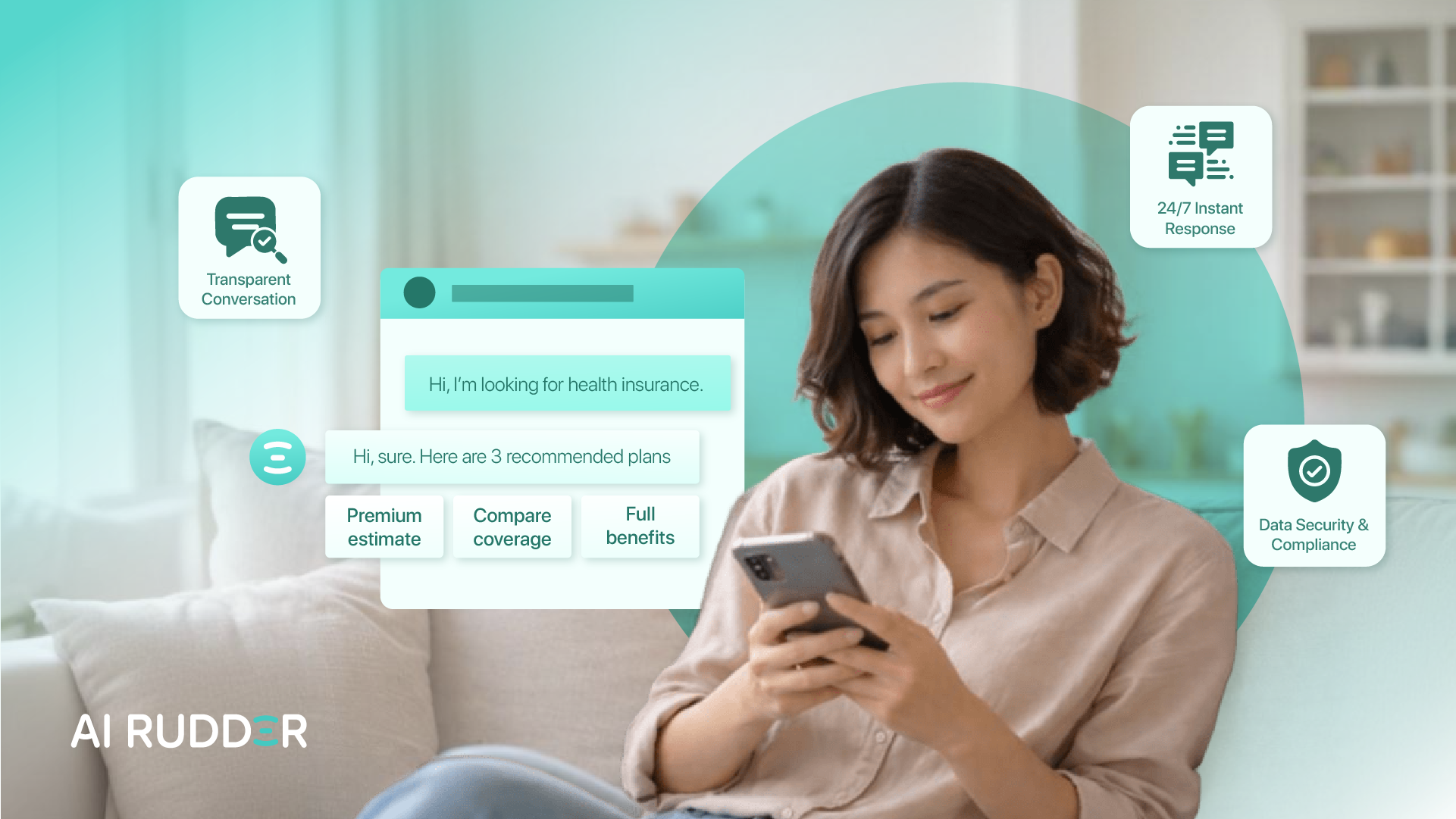
Traditional customer service models are no longer sufficient in this fast-paced era. In the insurance industry, trust is the main foundation that can be built through speed and accuracy. Customers no longer tolerate long wait times for basic answers. Therefore, the implementation of an insurance chatbot becomes crucial to ensure the company remains available around the clock and provides the instant responses needed by policyholders.
Depending solely on human labor has significant disadvantages, particularly in terms of scale and consistency. Human agents have limited working hours, are at risk for human error, and can easily become overwhelmed during simultaneous claim surges. By integrating AI, insurance companies can cover these operational gaps while maintaining stable service quality without the slow bureaucratic hurdles.
Why Transparency is the Backbone of Insurance
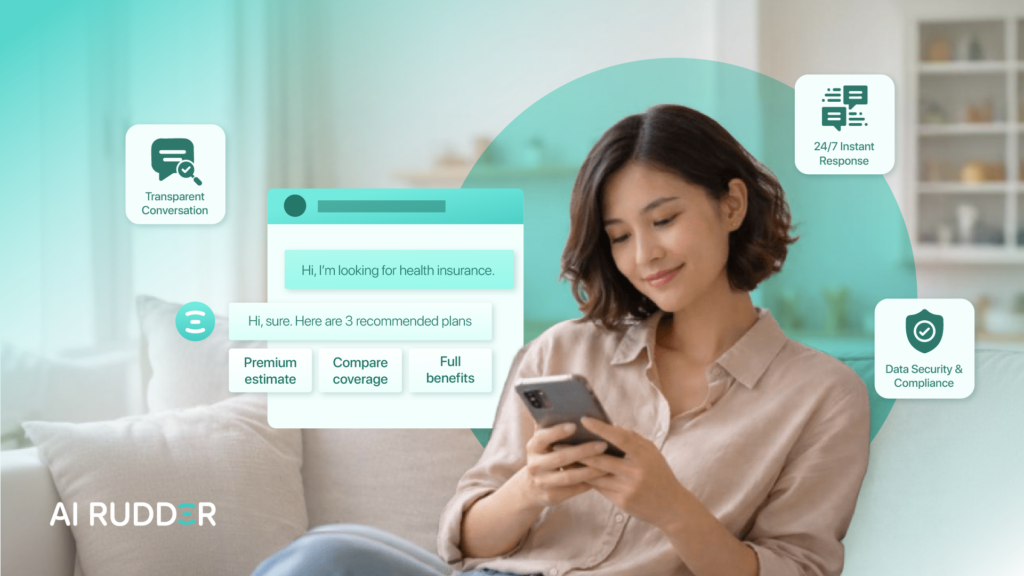
Beyond trust, transparency remains a core pillar of the insurance industry. In this case, AI chatbot for insurance plays an important role in building transparency by serving as an information bridge, translating complex language into simple explanations that policyholders can understand.
Insurance chatbot can explain and answer the details of their protection coverage. AI chatbot’s explanations are consistent and accurate without missing any information. This transparency ensures that there are no traps or unpleasant surprises during the claims process. With open access to information, customers feel they have full control over their insurance, which automatically strengthens the foundation of trust in the company.
Transparency extends beyond information clarity to data security. A trusted AI partner must demonstrate that every interaction and data is protected by high-level encryption. When insurance companies are open about how they protect policyholder privacy in those conversations, it will eliminate their doubts about sharing sensitive information.
How an Insurance Chatbot Builds Trust Across the Policy Lifecycle
Insurance chatbot can build policyholder trust throughout the entire policy process. Starting from easy access at the initial stage of protection search, which can instantly answer basic FAQs, gather basic customer needs, and assist in the self-service quotation process, customers feel they are receiving transparent information without pressure. The speed of the bot in processing personal data, addresses, and health information systematically gives an image of professionalism and shows the company’s readiness to serve potential customers from the very beginning.
Next, transparency in policy management reinforces policyholders’ confidence that they have full control over their accounts. Through AI chatbot for insurance, customers can easily change beneficiaries, switch payment methods, and check premium payment status independently. The ease of updating customer information such as residential address or contact details in real-time ensures that there are no communication barriers between the company and the policyholders.
Trust is most critical during the claims process, and this is where AI chatbot plays the role of a loyal companion. The bot provides clear instructions, facilitates the submission of necessary documents, and even helps with claim calculations. With the claim status check feature that can be accessed anytime, customers no longer feel left in the dark by uncertainty, which is a key factor in maintaining loyalty and trust.
Lastly, insurance chatbot maintains long-term relationships through responsive complaint handling. With Customer Sentiment Analysis technology, AI chatbot can accurately understand the level of customer satisfaction or disappointment. When issues become complex, the system seamlessly escalates conversations to human agents in real-time, ensuring that the customer’s complaint is heard and taken seriously. The synergy between the speed of the bot and the empathy of the human agent is what creates a new standard in maintaining customer trust in the digital era.
The Best Insurance Chatbots Know When to Step Back
The technology that customers trust the most is not the one that tries to do everything, but the one that knows its limits. In the insurance industry, there are sensitive moments where human empathy cannot be replaced by algorithms, such as during the claims process (e.g. accidents or natural disasters) and policy renewals. An AI insurance chatbot must have protocols to automatically step back when detecting complex issues or high emotional load from customers.
Through the real-time transfer feature, AI chatbot for insurance ensures a seamless transition from bot to human agent. Customer trust will increase when AI chatbot performs a smart hand-off, where the entire conversation history and collected data are directly forwarded to the agent. That way, customers do not need to repeat their explanations from the beginning, which often becomes a major source of frustration.
This approach demonstrates that insurance chatbots are not replacing human roles, but rather to support them. By assigning administrative and repetitive tasks to bots, human agents have more time to focus on providing deep emotional and technical solutions for critical cases.
Building Enduring Trust in the Digital Age
In the digital era, trust is no longer built on promises alone, it is built on responsiveness, clarity, and consistency. AI chatbots have transformed the service paradigm from being rigid and slow to a dynamic and transparent conversation. By providing instant answers, simplifying complex policy language, and accompanying the claims process in real-time, insurance companies demonstrate their commitment to always being on the side of customers without bureaucratic obstacles.
However, this technology is not about replacing the role of humans, but rather optimizing every interaction point in the policyholder’s lifecycle. Enduring trust is born from the synergy between the efficiency of machines that know their limits and the empathy of human agents who are ready to take over in critical moments. By adopting this strategy, insurance companies not only enhance operational efficiency but also build a reputation as a reliable, transparent brand that truly cares about the needs of its customers.
Transform Your Insurance Experience Today
AI Rudder helps insurers implement advanced insurance chatbot solutions across the entire policy lifecycle, from quotation automation to intelligent claims support and proactive customer engagement. Our conversational AI is designed to understand human needs with precision, AI Rudder ensures that every interaction with your customers is fast, accurate, and still retains a personal touch.
To support this excellence, AI Rudder’s infrastructure meets leading international standards, including SOC 2, ISO 27001, GDPR, PDPA, IMDA, and CSA, ensuring full compliance and continuous protection for sensitive data.
Contact AI Rudder to transform your operations into a more efficient and trustworthy system in the eyes of policyholders with insurance chatbot.
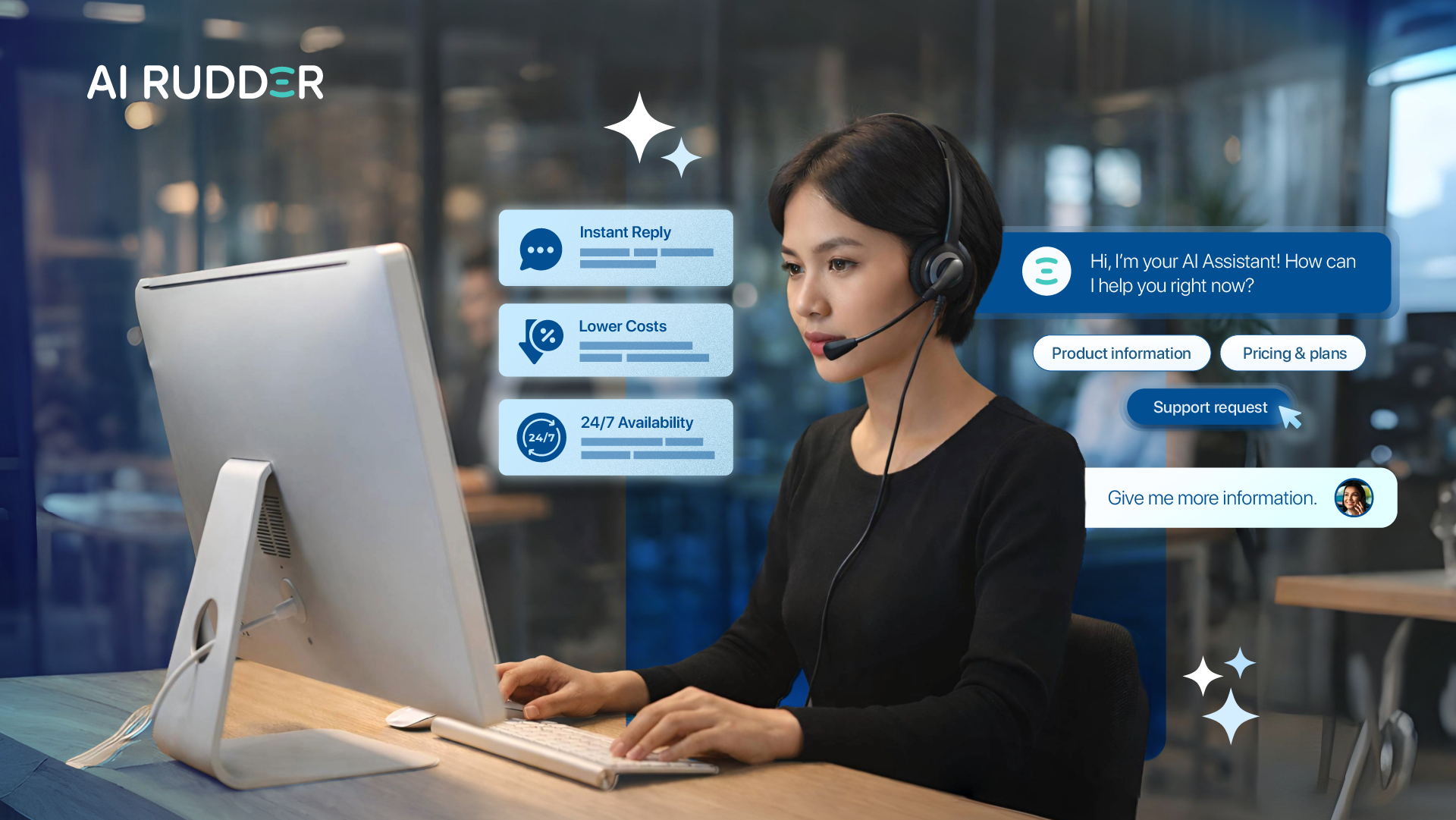
As technology continues to evolve, customer expectations are rising faster than ever. Customers now expect instant responses, 24/7 availability, and personalized customer support across multiple channels. However, it becomes increasingly difficult to do all of this manually. Human agents can’t operate around the clock, and maintaining a large customer support team leads to high operational costs.
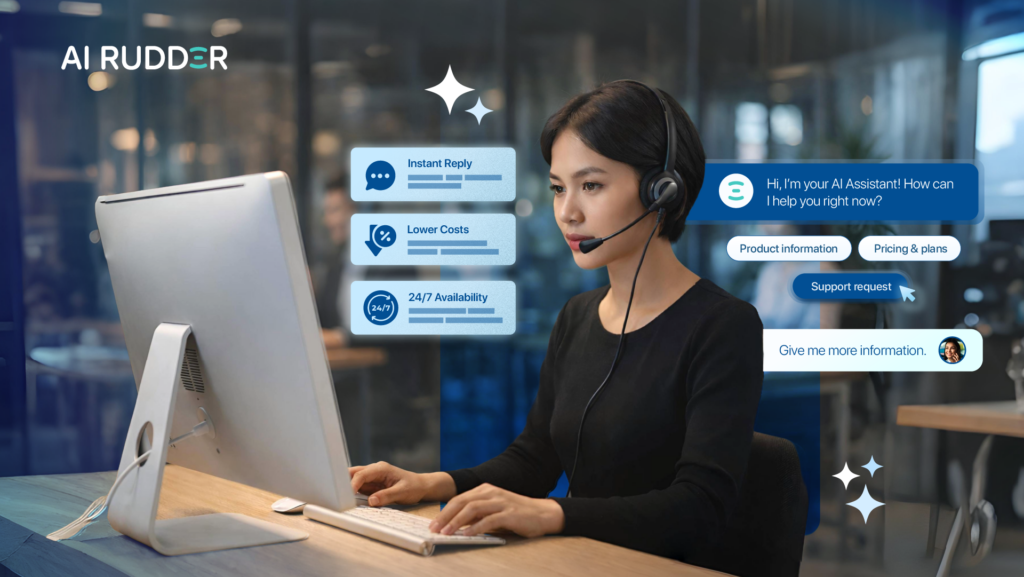
To address these challenges, many companies are adopting AI-powered chatbots to support their customer service. By automating repetitive tasks and providing instant responses, chatbots reduce operational costs by 30%, improve response times, and maintain a consistent customer experience without replacing human agents.
Why Traditional Customer Support Models are No Longer Scalable
As customer expectations continue to rise, the traditional model of manual customer support is becoming increasingly ineffective. Customers today demand real-time responses, personalized support, and seamless omnichannel experiences. Unfortunately, human-only teams often struggle to keep up, both in terms of speed and scalability.
Expanding a customer service team requires ongoing recruitment, training, and management, which can add to your operating budget. Even if you have enough agents, manual processes often result in slow response times, especially during peak seasons. As a result, customers have to wait longer for answers, which increases the risk of dissatisfaction and turnover rates.
Beyond financial costs, there are also human limitations. High ticket volumes can cause agent fatigue, inconsistent responses, and burnout. Traditional systems only react after problems arise, rather than anticipating customer needs. In other words, manual methods cannot keep up with the speed, quality, and convenience expected by digitally-oriented consumers.
Where Chatbots Deliver Cost Savings
a. Labor and Training Costs
Customer support is not only about employee salaries, but also about training, onboarding, supervision, and turnover. Chatbots handle high-volume, repetitive tasks, such as FAQs and basic troubleshooting, allowing human agents to focus on complex and high-value conversations.
b. 24/7 Availability Without Overtime
Chatbots can answer customer questions 24/7 without having to pay additional salaries for overtime or international teams. This significantly affects a company’s operating costs.
c. Scalable Support During Peak Demand
When peak seasons hit, support volume spikes fast. AI Chatbots can scale instantly, handling thousands of conversations simultaneously without additional hiring. That flexibility keeps operations lean and efficient.
How Chatbots Maintain Service Quality While Cutting Costs
Chatbots deliver instant responses, eliminating long wait times and improving customer satisfaction. Common inquiries and recurring issues can be resolved within seconds, creating a faster and smoother customer journey.
When conversations become more complex, chatbots can seamlessly handoff to human agents without disrupting the customer experience. This hybrid approach allows customers to receive the empathy and detailed assistance that only humans can provide, while allowing chatbots to reduce operational costs by handling repetitive and time-consuming tasks. This hybrid human-AI approach combines efficiency with emotional intelligence.
Another key advantage lies in consistency and continuous improvement. Unlike humans who can have bad days or inconsistencies, chatbots always deliver the same tone, accuracy, and professionalism. Over time, as they process more interactions, AI chatbots learn and adapt, improving their ability to understand intent, provide appropriate responses, and anticipate user needs. In other words, service quality doesn’t just stay the same, it gets better as costs go down.
Empowering Human Agents Through Intelligent Automation
With chatbots in the game, human agents no longer need to deal with repetitive questions or inquiries outside of business hours, but they can handle questions that require empathy, judgment, and relationship-building. This balance makes service more personal while also improving operational efficiency. Chatbots also help maintain the mental health of human agents, reducing the risk of burnout. In other words, AI doesn’t replace humans, it lightens their workload.
Smart Efficiency Is the New Standard
Chatbots prove that cost reduction does not require sacrificing service quality. By automating repetitive and time-consuming tasks, companies can enable human agents to focus on what really matters: building meaningful relationships with customers. The balance between efficiency and empathy not only makes customer service faster and more consistent, but also creates a truly personalized customer service model.
The future of customer experience lies in collaboration between humans and AI. By leveraging technology while putting people at the center, chatbots reduce operational costs and help companies maintain long-term budget management without losing the human touch.
Want to Save Operational Costs Without Sacrificing Quality?
Empower your business with AI chat agent that delivers measurable results. Contact AI Rudder to learn how our AI-driven chatbots reduce operational costs for enterprises while significantly enhancing the customer experience.
The retail landscape is changing rapidly, along with digital transformation. With more online shopping platforms popping up, customers expect faster responses, smoother experiences, and instant support at every stage of their journey. E-commerce as an online shopping platform is required to respond anytime and instantly. This is where chatbots step in as a key player in the digital shift.
More than just answering FAQs, AI-powered e-commerce chatbots support customers across the entire purchase journey, from checkout to post-purchase care. With the ability to understand context and detect emotions, their interactions feel increasingly human-like. Chatbots are now more than just automation tools: they are digital assistants that help make the customer experience smoother, smarter, and more connected.
Why E-Commerce Needs Chatbots More Than Ever
E-commerce, once celebrated for bringing convenience to shopping, now faces a new challenge, managing massive volume of repetitive customer inquiries at scale. Questions about order status, refunds, ongoing promotions, and product availability often flood customer service channels, slowing response times and stretching support teams thin.
Chatbots step in as powerful assistants to manage these repetitive interactions efficiently. By automating routine responses, they help reduce the workload on human agents while maintaining consistent, on-brand communication across every touchpoint.
Beyond efficiency, e-commerce chatbots offer reliability that human teams can’t always sustain. They operate around the clock, even during holidays or peak seasons, ensuring that customers receive instant answers anytime, anywhere. In doing so, they don’t just make support faster, but also make the overall shopping experience smoother and more dependable.
Enhancing Pre-Purchase Shopping Experience
Chatbots play a critical role in improving the pre-purchase experience acting as a reliable shopping companion. Before customers decide to check out, they often seek clarification about product details, stock availability, payment options, or shipping policies. Chatbots can instantly respond to these questions, helping shoppers make informed decisions without the frustration of waiting for human assistance.
Beyond answering queries, e-commerce chatbots can deliver personalized product recommendations based on customer preferences, browsing patterns, or purchase history. This personalized guidance makes customers feel more confident about their choices and less likely to abandon their carts. By blending convenience with relevance, chatbots help e-commerce companies build trust and drive higher conversion rates.
Supporting Seamless Post-Purchase Journey
Chatbots aren’t just transforming how customers shop, they’re also reshaping what happens after a purchase is made. Beyond assisting in the pre-purchase stage, chatbots play a key role in supporting the post-purchase journey, where speed and clarity matter most.
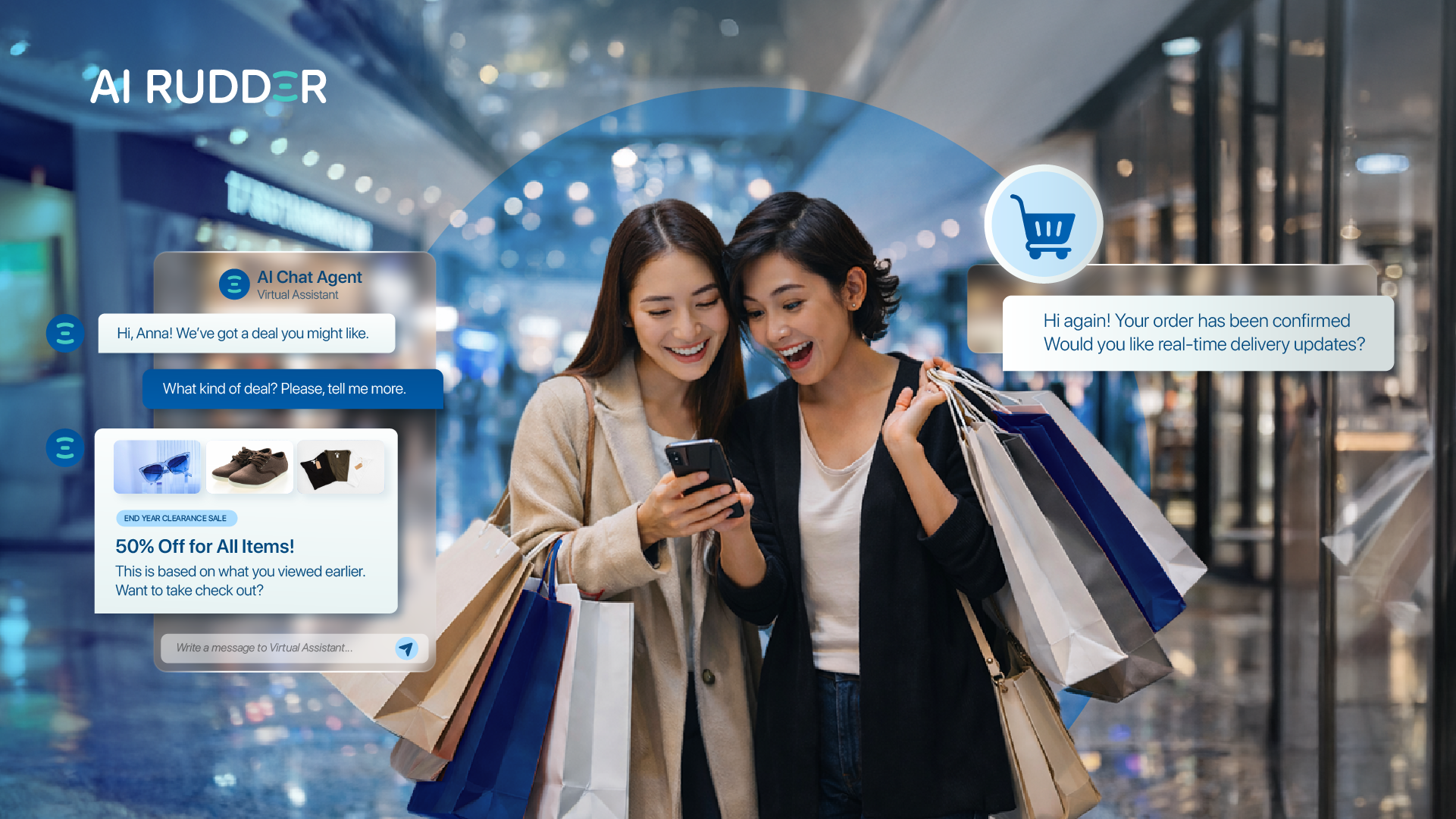
From providing real-time order tracking and refund updates to answering questions about delivery status, chatbots ensure that customers stay informed at every step. Instead of waiting in long queues for human agents, shoppers can get immediate responses within seconds, directly through the e-commerce platform.
This level of instant accessibility not only enhances customer satisfaction but also builds trust. When customers feel supported and informed even after checkout, they’re more likely to return, turning one-time buyers into loyal, repeat customers
Building Trust and Loyalty Through Always-On Support
With 24/7 availability, e-commerce chatbots ensure customers always feel heard and supported, no matter the time or place. From answering repetitive questions to handling basic complaints, chatbots provide instant assistance that helps maintain customer trust and loyalty. This constant accessibility reinforces the idea that the brand is always present and ready to help, creating a more reliable shopping experience.
When a question becomes more complex, chatbots can seamlessly transfer the conversation to a human agent for deeper, personalized assistance. This collaboration between AI and human support shows that technology is not here to replace people, but to empower them by taking over repetitive tasks and freeing up time for more meaningful interactions. As a result, customers receive faster, more accurate responses, ultimately boosting satisfaction and strengthening their confidence in the e-commerce brand.
Personalization Without Pressure
Chatbots enable a level of personalization that feels natural rather than intrusive. By greeting customers by name, recalling their purchase history, or recognizing their browsing patterns, chatbots can create interactions that feel tailored and human-like. This subtle approach helps customers feel understood, not monitored. It’s a key difference that defines trust in digital experiences.
Instead of aggressive hard-selling, chatbots can share relevant promotions or updates that align with each customer’s interests. Whether it’s a reminder about items left in the cart or a limited-time offer based on previous purchases, the experience feels more like helpful guidance than marketing pressure. As a result, every interaction becomes smoother, more meaningful, and more likely to drive long-term engagement.
The Bigger Picture: From Efficiency to Experience
For e-commerce companies, chatbots are no longer just customer service tools, they’ve become a core part of the overall customer experience strategy. Beyond handling inquiries, chatbots help ensure that every interaction reflects the brand’s tone, efficiency, and commitment to customer satisfaction. They play a vital role in creating seamless, responsive experiences that make online shopping feel effortless and human-centered.
More importantly, chatbots serve as a bridge between customers and data. Through every conversation, they provide valuable insights into customer preferences, behaviors, and concerns. When combined with AI-driven analytics and human empathy, these insights form the foundation for the future of e-commerce, one that’s smarter, more personalized, and deeply attuned to what customers truly need.
The Future of E-Commerce Is Conversational
Chatbots are redefining what good service means in online shopping. They’re not just tools to sell products, but a bridge that connects brands and customers through fast, personal, and effortless interactions. With their ability to provide instant responses, personalized support, and consistent service, chatbots help e-commerce companies build stronger emotional connections with their customers. In the end, it’s not just about completing transactions, it’s about creating meaningful experiences that make every customer feel valued and understood.
Optimize Your E-commerce Strategy with AI Rudder
Increase your conversions and customer loyalty with an e-commerce chatbots that truly understands. Contact us to schedule a free demo and see how our solutions can turn your data into a competitive advantage.
Behind every successful delivery is a complex logistics operation involving customer awaiting updates, warehouse teams preparing shipments, and driver navigating last-mile routes.
However, one of the biggest challenges in modern logistics operations lies in customer and internal communication.
As logistics network scale, fragmented communication leads to slower response times, inconsistent delivery updates, and operational inefficiencies. In an industry driven by speed and precision, this gap has become a costly roadblock.
This is where an “AI Chatbot for logistics” plays a critical role in enabling smarter, more connected delivery operations.
Turning Conversations Into Seamless Deliveries with Logistics Chatbots
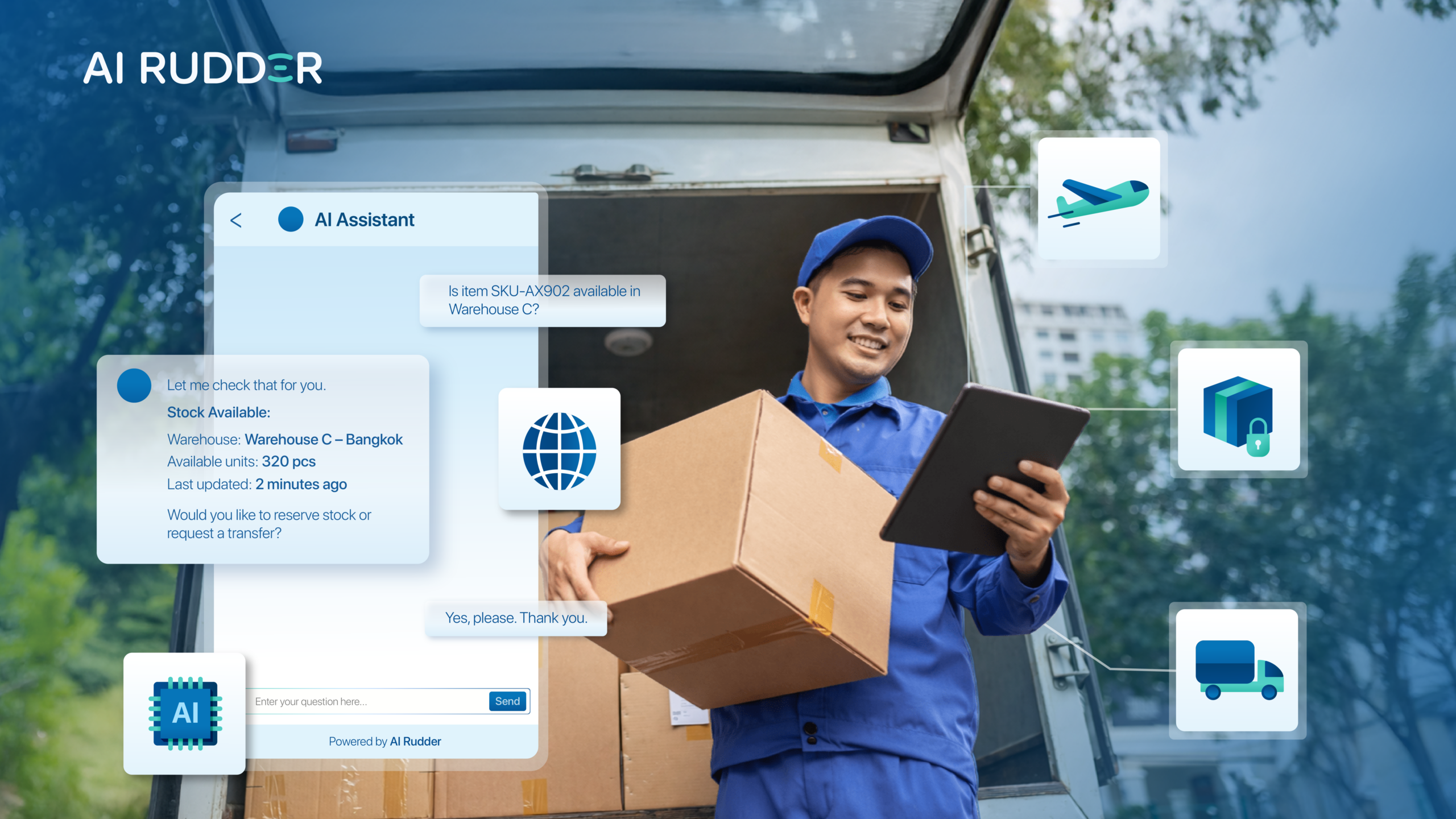
One of the benefits of AI chatbots in the logistics industry is that customers can get real-time updates on their package deliveries. Customers can also track their packages simply by asking the chatbot. Chatbots can also notify customers if their delivery is delayed or disrupted, so customers are not clueless about the whereabouts of their packages.
Chatbots also allow customers to ask questions at any time, because they are available 24/7 and will answer customer questions, from FAQs to simple questions, quickly and accurately. This can make customers feel more valued and heard. If a customer’s question is complex, the chatbot will transfer the chat to a human agent.
What makes chatbots so valuable in the logistics industry is not only their ability to respond to chats, but also their ability to integrate with company systems. When integrated with ERP, CRM, and delivery-tracking platforms, chatbots can access real-time data from multiple departments. This means that customers can see accurate delivery updates instantly, and internal teams can also monitor delivery progress without having to manually switch between dashboards.
Chatbots Improve Logistics Productivity and Decision-Making
Implementing AI chatbots in the logistics industry can significantly reduce human error and shorten response times. Furthermore, chatbots can reduce data entry and routine processing errors to near zero compared to manual methods. This minimizes routine workload and frequent operational errors.
It also contributes to increased transparency and customer satisfaction. Because chatbots can be programmed to provide real-time shipping updates and answer customer questions at any time, customers feel more engaged and the information they receive is more accurate. For example, research shows that adopting AI chatbots in logistics leads to significant improvements in delivery performance and customer satisfaction. With greater transparency and faster responses, customers tend to have more positive experiences, which ultimately strengthens customer loyalty and the company’s reputation.
With AI Rudder’s AI Chat Agent, logistics companies may implement these benefits at scale. AI Chat Agent seamlessly integrates with existing logistics systems to handle high-volume inquiries such as shipment tracking, delivery status, and order confirmation in real-time, without adding operational burden. This ensures consistent and accurate communication across various channels while maintaining full visibility into customer interactions and operational data.
As a result, internal teams can focus more on strategic decision-making rather than routine tasks. Because repetitive requests are handled automatically, human agents can focus their attention on higher-impact activities such as resolving complex shipping issues, optimizing logistics networks, and analyzing operational trends. This shift not only improves daily efficiency but also strengthens the organization’s ability to adapt, grow, and make data-driven decisions in an increasingly dynamic logistics environment.
The Future of Smart Logistics is AI-Powered and Real-Time
AI chatbots are now a key transforming force in the logistics industry, providing customers with more efficient and convenient shipping processes. Through messaging platforms like WhatsApp or other chat apps, customers can now schedule or change deliveries, alter destinations, and even place bulk orders with just a few clicks.
For logistics companies, the presence of chatbots not only helps speed up service but also streamlines operations and improves customer service quality. Interactions that previously required time and effort can now be automated, allowing internal teams to focus on strategic decision-making and improving the customer experience.
As the logistics industry continues to evolve toward a fully digital and real-time ecosystem, AI chatbots will play a crucial role in shaping the future of smarter, faster, and more connected last-mile delivery. Chatbots are not just tools, but a strategic part of the smart logistics ecosystem.
Make Logistics Simpler, Smarter, and More Connected
AI Rudder helps logistics companies automate customer communication, streamline delivery workflows, and improve real-time visibility across operations.
Contact us to see how AI Rudder empowers logistics teams to automate workflows, improve efficiency, and keep customers informed in real time.
In the Fast-Moving Consumer Goods (FMCG) industry, consumer loyalty is notoriously difficult to secure. Products are purchased frequently, switching costs are practically non-existent, and…
In the FMCG industry, the spotlight often falls on the end consumer. Brands invest heavily in optimizing the B2C shopping journey, ensuring products are…
Traditional customer service models are no longer sufficient in this fast-paced era. In the insurance industry, trust is the main foundation that can be…
As technology continues to evolve, customer expectations are rising faster than ever. Customers now expect instant responses, 24/7 availability, and personalized customer support across…
The retail landscape is changing rapidly, along with digital transformation. With more online shopping platforms popping up, customers expect faster responses, smoother experiences, and…
Behind every successful delivery is a complex logistics operation involving customer awaiting updates, warehouse teams preparing shipments, and driver navigating last-mile routes. However, one…
January 28, 2026
We use cookies to improve your experience. By continuing to browse, you agree to our Privacy Policy.