
Will AI Agent Builders Redefine the Way Insurance Work?
For years, insurers have relied heavily on IT teams or external vendors to automate even the simplest tasks. Every change, no matter how small,…
May 27, 2026
May 29, 2026 posted by dike rani
Legacy Interactive Voice Response (IVR) systems remain one of the single biggest sources of customer frustration in the telecommunications industry. For decades, telecom companies have relied on these rigid, menu-driven systems to route calls and manage high-volume inquiries — yet as customer expectations for fast, seamless, and personalized service continue to rise, the limitations of traditional IVR have become impossible to ignore. Today, replacing legacy IVR with AI voice agents is no longer an optional upgrade; it is a strategic imperative for telcos aiming to reduce churn, improve customer satisfaction, and lower operational costs. This article examines why legacy IVR is failing, how conversational AI transforms the customer experience, and how telecom companies can navigate the transition without disrupting operations.
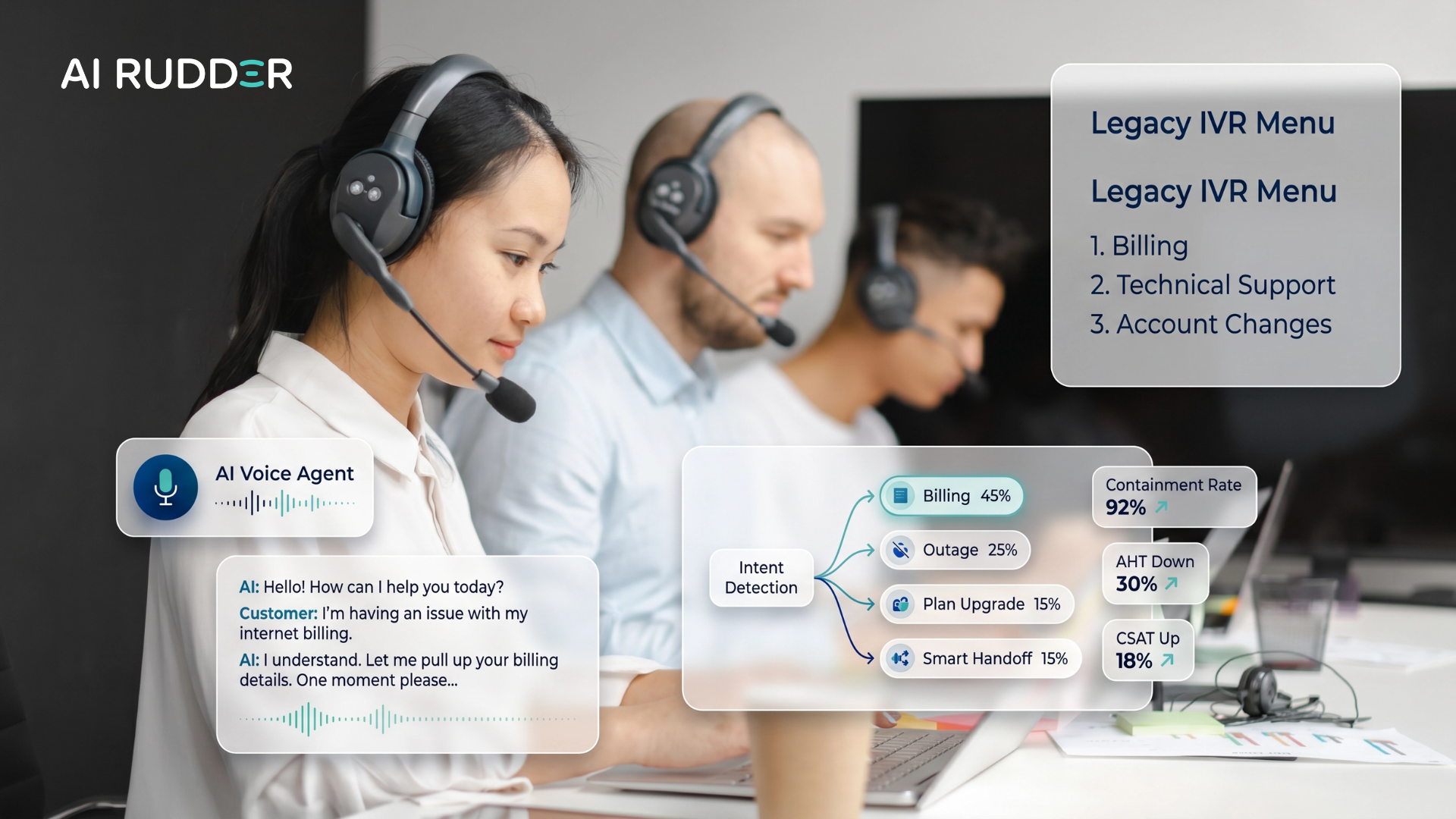
The traditional IVR experience is widely regarded as one of the most frustrating touchpoints in customer service. Callers are forced to navigate complex, multi-layered menus (“Press 1 for billing, Press 2 for technical support…”), sitting through irrelevant options before finding what they need. When a mistake is made or when an issue doesn’t fit a predefined category — customers are either disconnected or trapped in an endless loop, ultimately demanding to speak to a live agent.
This frustration has a direct financial impact on telecom companies. When customers cannot resolve their issues quickly, they become dissatisfied, leading to lower Net Promoter Scores (NPS) and higher churn rates. In a highly competitive market where switching providers is easier than ever, poor customer service is a primary driver of customer attrition. Furthermore, the inefficiency of IVR means that a significant percentage of calls still end up being routed to live agents, defeating the purpose of automation and driving up call center operational costs.
The fundamental difference between legacy IVR and modern AI voice agents lies in how they understand and interact with the caller. Traditional IVR is rules-based and relies on DTMF (Dual-Tone Multi-Frequency) tones or simple keyword recognition. It forces the customer to adapt to the machine’s structure.
In contrast, an AI voice agent leverages advanced Natural Language Understanding (NLU) and speech recognition to facilitate open-ended, human-like conversations. Instead of presenting a menu, the AI simply asks, “How can I help you today?” The customer can speak naturally, explaining their issue in their own words. The AI understands the intent, context, and sentiment behind the query, allowing it to provide immediate, relevant assistance or route the call accurately without the need for complex menus.
When evaluating AI voice agent solutions to replace legacy IVR, telecom companies should prioritize several critical capabilities:
AI voice agents excel at automating the high-volume, routine inquiries that typically overwhelm telecom call centers:
Replacing a core piece of infrastructure like an IVR system can seem daunting, but a phased approach minimizes risk and ensures a smooth transition. Telecom companies should avoid a “rip-and-replace” strategy.
Instead, start by deploying the AI voice agent alongside the existing IVR to handle a specific subset of calls or a particular use case, such as billing inquiries. This allows the organization to test the system, gather data, and refine the AI’s conversational flows in a controlled environment. As confidence in the system grows and performance metrics are validated, the AI can gradually take over more call types and routing responsibilities, eventually phasing out the legacy IVR entirely.
To measure the success of migrating from IVR to an AI voice agent, telecom companies should monitor key performance indicators (KPIs) that reflect both operational efficiency and customer satisfaction:
By replacing legacy IVR with intelligent AI voice agents, telecom companies can transform their customer service from a point of friction into a competitive advantage, delivering the fast, personalized experiences that today’s consumers demand.
AI Rudder is a globally trusted conversational AI partner purpose-built for enterprise-scale deployments. With a proven track record of handling over 80 million interactions across 500+ enterprises in 20 languages, AI Rudder’s AI Voice Agent delivers ultra-low latency, human-like responses in under one second — ensuring every customer interaction feels natural, fast, and personal.
Whether you are looking to replace a legacy IVR system, automate high-volume inbound inquiries, or create a seamless omnichannel experience for your subscribers, AI Rudder provides the technology and expertise to make it happen. Our infrastructure meets leading international security standards, including SOC 2, ISO 27001, GDPR, and PDPA, so you can modernize your customer service with full confidence.
Ready to leave IVR behind and deliver the intelligent voice experience your customers deserve? Contact AI Rudder today to schedule a demo and see how our AI Voice Agent can transform your telecom operations.
For years, insurers have relied heavily on IT teams or external vendors to automate even the simplest tasks. Every change, no matter how small,…
May 27, 2026

Understanding consumer behavior and preferences is no longer just a competitive advantage in the FMCG industry, it is a must. Every day, consumers leave…
May 25, 2026
The telecommunications industry is currently at a critical point of transformation. Competition is intensifying, customers demand fast, personalized, and consistent service, while digital services…
May 22, 2026