
Beyond the Model: Building a Harness for a Voice Agent
Start with a failed call, identify the missing state, add a control, and test whether it earns its place Our results on τ-voice τ-voice…
September 26, 2026
May 15, 2026 posted by dike rani
In the fast-paced digital world, the number of telecom customers is growing, along by a wider variety of packages and products to suit user needs and characteristics. Furthermore, telecom companies also offer various payment methods. This monthly payment model ensures that telco customers receive clear and timely reminders, especially at an early stage, namely a few days before the bill is due.
While traditional collections teams are crucial for managing payment processes, many still grapple with manual, inefficient methods. This often leads to inconsistent or delayed reminders, allowing minor payment delays to escalate into significant delinquencies. Such inefficiencies not only strain operational resources but also contribute to increased bad debt.
This is why AI automation is a relevant solution. AI enables the collection process to be automated from the earliest stages, even before the bill is due, allowing companies to reduce the risk of delinquency and maintain stable cash flow.
Previously,early-stage reminders in telecom relied on manual billing processes, such as phone calls or SMS. This approach made it challenging to deliver reminders with the necessary frequency and effectiveness. Constrained by human capacity, these early reminders were frequently inconsistent, some customers received notifications too late or not at all. This inconsistency made it challenging for telecom companies to maintain proactive engagement, resulting in many customers being missed because reminders were not sent at the appropriate time.
Furthermore, manual early-stage outreach also lacked structure and strategy. Agents were unable to scale their efforts to match the volume of postpaid customers, and there was no data-driven prioritization to decide who to contact first. Without segmentation based on payment history or risk levels, the early-stage process became slow, repetitive, and inefficient. These gaps significantly reduced the impact of early reminders, allowing small delays to escalate into delinquencies, increasing operational workload, and ultimately creating avoidable financial risk for telecom companies.
The early stage is the most effective phase for preventing bills from aging and ultimately becoming difficult to collect. At this stage, communication remains light, so customers tend to be more responsive because the interaction doesn’t feel like an aggressive collection effort. This phase offers a vital window of opportunity for telecom companies to proactively address potential payment delays before they escalate into formal delinquencies.
By implementing automation, large-scale outreach can also be executed quickly and consistently without increasing operational workload. AI-driven workflows enable highly personalized and relevant communications, moving away from generic, one-size-fits-all templates. As a result, customers receive timely and contextual reminders, significantly increasing the chances of on-time payments.
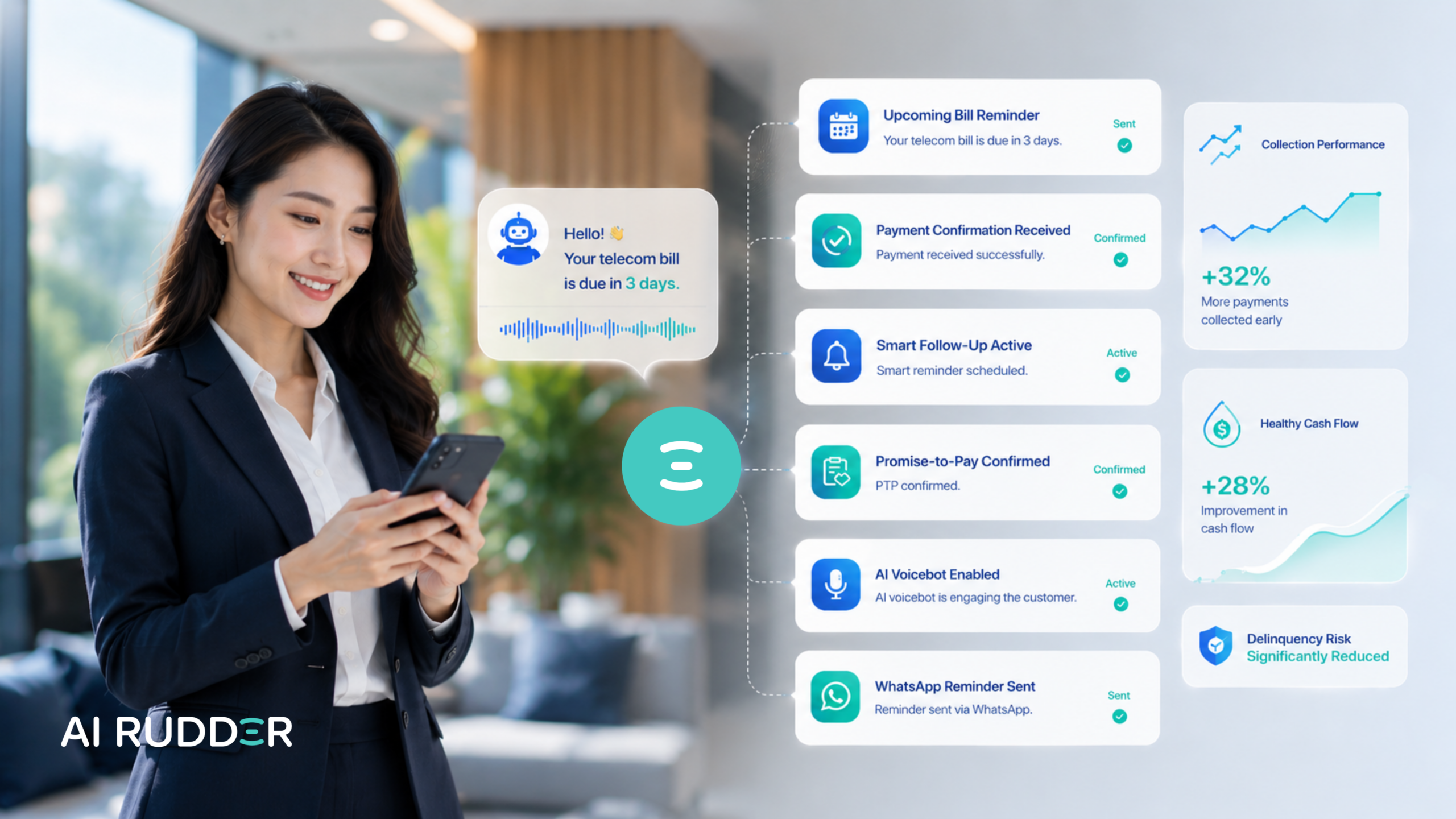
In the early stages, the collection process can be fully automated without agent intervention. Telecom companies can send pre-due reminders via WhatsApp, SMS, or voice bots a few days before the due, ensuring customers always remember their bills. The system can also run smart follow-ups that adjust the next steps based on customer responses. For instance, upon receiving a payment confirmation, subsequent reminders are automatically halted.
Furthermore, conversational AI empowers customers to independently inquire about billing details, payment methods, or monthly usage without having to speak with a human agent. Critical processes like promise-to-pay (PTP) confirmations can also be handled automatically, including seamless recording and scheduling. Through risk-based segmentation, the system prioritizes customers with a history of late payments, allowing for more strategic outreach. If a customer still doesn’t respond, automated escalation ensures the process moves to the next stage without delay. All of this makes early-stage collections faster, more measurable, and more scalable, while significantly reducing the burden on the collections team.
The adoption of early-stage billing automation has profoundly impacted telecom operations. The automation enables billing to be done before the due date, by helping customers remember their bills. As a result, overdue bills, which are more than 30 days old, have drastically decreased. Furthermore, automation has significantly reduced the workload of collections teams, which have shifted from manual to automated.
AI automation also makes the billing process much more consistent, resulting in a more professional and structured message. Customers also experience a smoother and more comfortable experience for the customer, ultimately enhancing brand loyalty.
Effectively preventing bad debt in telecom extends beyond merely accelerating collections, it requires a process that is fully automated, consistent, and rigorously data-driven. With large customer volumes and recurring monthly postpaid payment patterns, telcos need a system that can remind customers early, without relying on slow and inconsistent manual efforts.
With early collection, companies can initiate engagement from before a bill is issued until a few days before it’s due. This approach has proven to be the most effective way to prevent bad debts, as customers tend to be more responsive when communications are informative, rather than aggressively soliciting. Telecoms that adopt automation early on will be much better equipped to maintain cash flow, reduce the risk of delinquency, and provide a smoother, more professional, and more human-centric customer experience.
Transform your telecom collection workflow, from early reminders to smart follow-ups, with AI-powered agents. Partner with AI Rudder to build a scalable, intelligent collection ecosystem designed to protect your revenue streams and enhances customer relationships.
Start with a failed call, identify the missing state, add a control, and test whether it earns its place Our results on τ-voice τ-voice…
September 26, 2026

CALL-E, AI Rudder’s newest goal-based voice AI agent, is designed to do more than simply connect a call. To complete a task, CALL-E must…
September 11, 2026
For Business Process Outsourcing (BPO) companies, Quality Assurance (QA) is not just an internal metric; it is a contractual obligation. BPOs manage diverse portfolios…
June 29, 2026