
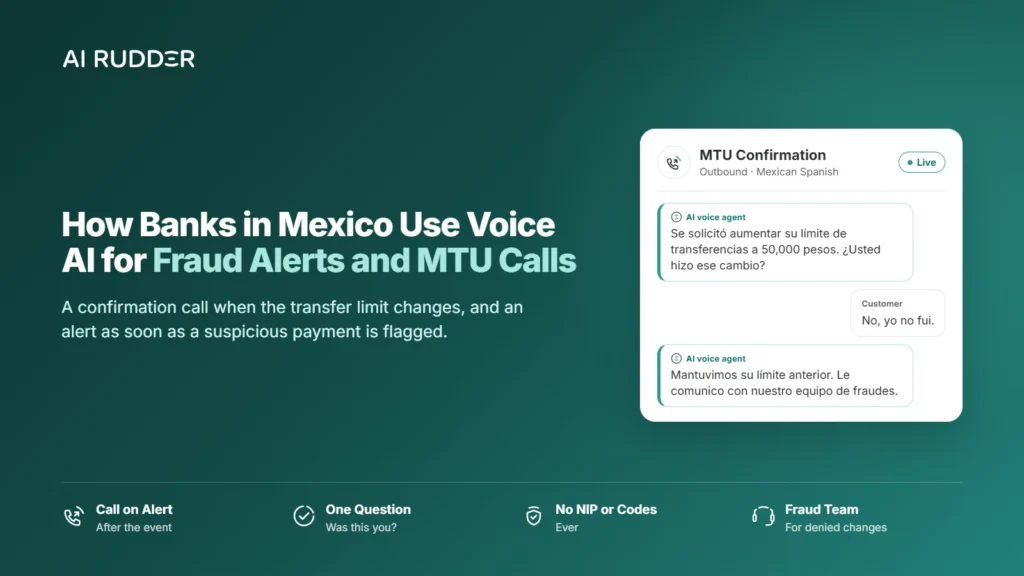
How Banks in Mexico Use Voice AI for Fraud Alerts and MTU Calls
Banks in Mexico use AI voice agents to call customers as soon as a suspicious card payment or transfer is flagged, and to confirm…
November 10, 2026
Oct 20, 2026 posted by Ming
A telco cuts repetitive billing and verification calls by moving them to AI voice agents: payment reminders, billing confirmations, detail checks and satisfaction surveys. These calls follow a pattern, come in volumes that rise and fall with billing cycles and rarely need a person. Customers who dispute a bill, want to cancel or ask for a person are transferred, so the human team spends its time on the calls that decide whether a customer stays.
A telco or internet provider makes the same few calls over and over: a bill is due, a payment is late, a customer’s details need confirming, a survey needs answering. Each call is simple. Together they tie up a team of human agents that a growing subscriber base keeps making bigger.
The last point rules out the simplest fixes. A telco can’t trade accuracy for speed on billing calls, because a wrong amount or a wrongly confirmed address creates a complaint and often a second call to correct it.
Calls to customers with bills due or overdue, asking when they will pay and recording the answer. CBN started here. On its case-study page, it reports handling 150,000 to 200,000 customer records a month, with 6–10% of connected customers completing the intended collection outcome.
Calls that confirm a bill, a plan change or an upcoming charge. The agent reads the amount and date from the billing system and confirms the customer understands it.
Calls that confirm a customer’s details, such as an installation address or a registered ID. The agent checks each answer against the records and transfers the call when something doesn’t match.
Short, structured calls that collect feedback across the customer base, which a human team rarely has time to run at full scale. CBN runs its surveys this way.
Step 1: Count the calls. Pull last month’s outbound calls and group them by reason.
Step 2: Start with the largest repetitive group, usually payment reminders.
Step 3: Connect billing data. Give the agent read access to amounts, dates and plan details, and a way to write back outcomes.
Step 4: Write and approve the scripts in the languages your customers use.
Step 5: Define the handoffs. Disputes, cancellation intent, complaints and requests for a person go to a human agent.
Step 6: Run beside a control group for a month, then add the next call type.
Telcos share the profile that makes AI voice agents useful: a large subscriber base, recurring billing, regular verification needs and a steady flow of routine questions. The same patterns apply to logistics companies confirming deliveries and addresses. In both industries, the human team’s time is better spent on the calls that need judgement, such as a disputed bill or a customer considering cancelling.
On its case-study page, CBN, PT Cyberindo Aditama, reports:
A billing confirmation call is short. The agent greets the customer, names the telco and says the call is recorded. It confirms it is speaking to the account holder using a detail from the record. It states the bill amount and due date, or the plan change and its start date, and asks the customer to confirm. If the customer agrees, it records the confirmation and offers to send the details by message. If the customer says the amount is wrong, it doesn’t argue: it logs the dispute and transfers the call to a person, or books a callback.
A verification call follows the same shape. The agent asks for each detail, such as the installation address, compares it with the record and marks each one as matched or not. Two mismatches end the verification politely and route the account for follow-up.
| Measure | What it tells you |
|---|---|
| Connection rate | Share of customers reached, by call type |
| Completion rate | Share of connected calls that finish the intended outcome |
| Transfer rate | Calls passed to people, and why |
| Accuracy | Mismatches found on review, which should be close to zero |
| Agent hours freed | Time your team now spends on retention and complex cases |
Starting with complex calls. Retention and cancellation calls need people. Start with reminders.
Stale billing data. If the agent reads yesterday’s balance, customers who already paid get chased.
No route for disputes. A customer who disputes a bill must reach a person quickly.
Ignoring survey fatigue. Limit how often each customer is surveyed.
Call data is personal data. In Indonesia it falls under the PDP Law (Law No. 27 of 2022). AI Rudder is built to meet SOC 2 and ISO 27001, alongside GDPR and PDPA requirements, and has worked in Indonesia since 2019, with speech models adapted to Bahasa Indonesia and regional accents.
Which calls should a telco automate first?
The highest-volume, most repetitive ones, such as billing reminders and payment follow-ups, then information verification.
How do we keep verification calls accurate?
Check answers against your own records, test on real call samples before launch and review every call with automated Quality Assurance.
Can the AI voice agent run satisfaction surveys too?
Yes. CBN uses AI voice agents for surveys alongside its payment reminders.
What happens when a customer needs a person?
The call flow transfers the customer to a human agent, with the conversation so far.
Count how many of your agents’ calls last month were payment reminders, billing confirmations, information checks or surveys. Get a Demo and we’ll show you how an AI voice agent would handle them.
Banks in Mexico use AI voice agents to call customers as soon as a suspicious card payment or transfer is flagged, and to confirm…
November 10, 2026
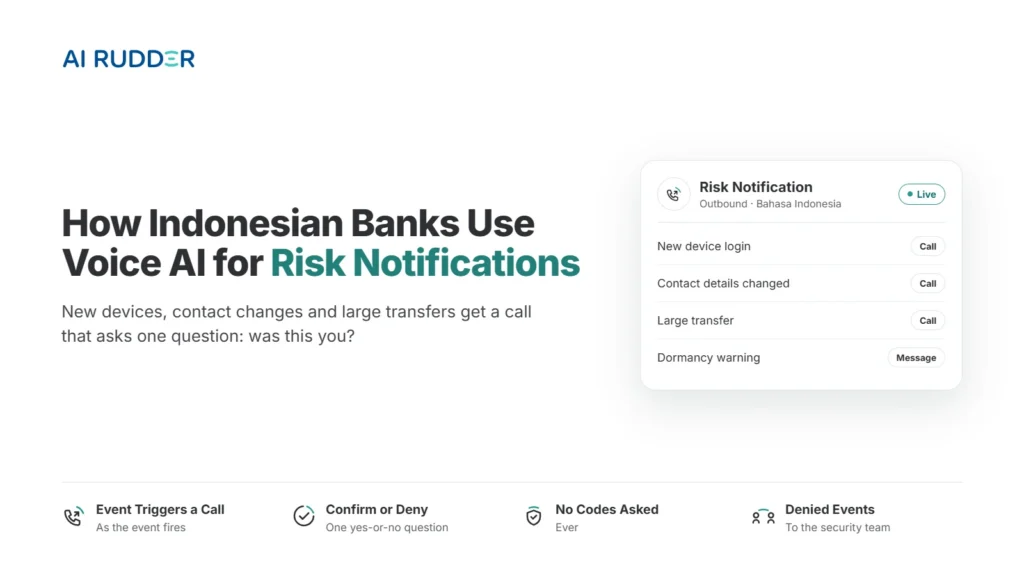
Banks in Indonesia use AI voice agents to call customers about account risks, such as a new device login or a large transfer. The…
November 10, 2026
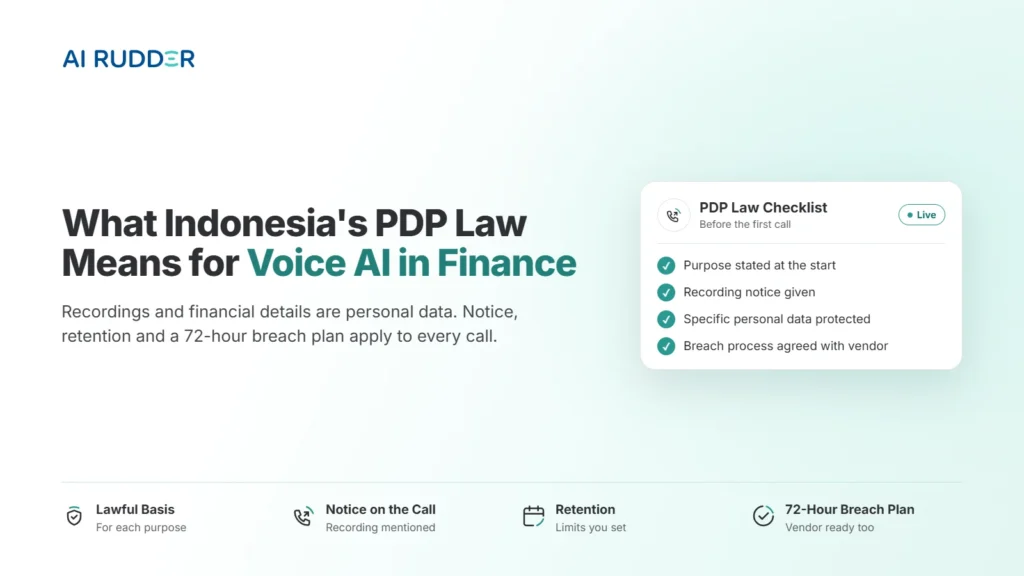
Indonesia's Personal Data Protection Law, Law No. 27 of 2022, applies to every call an AI voice agent makes or takes for banks and…
November 10, 2026