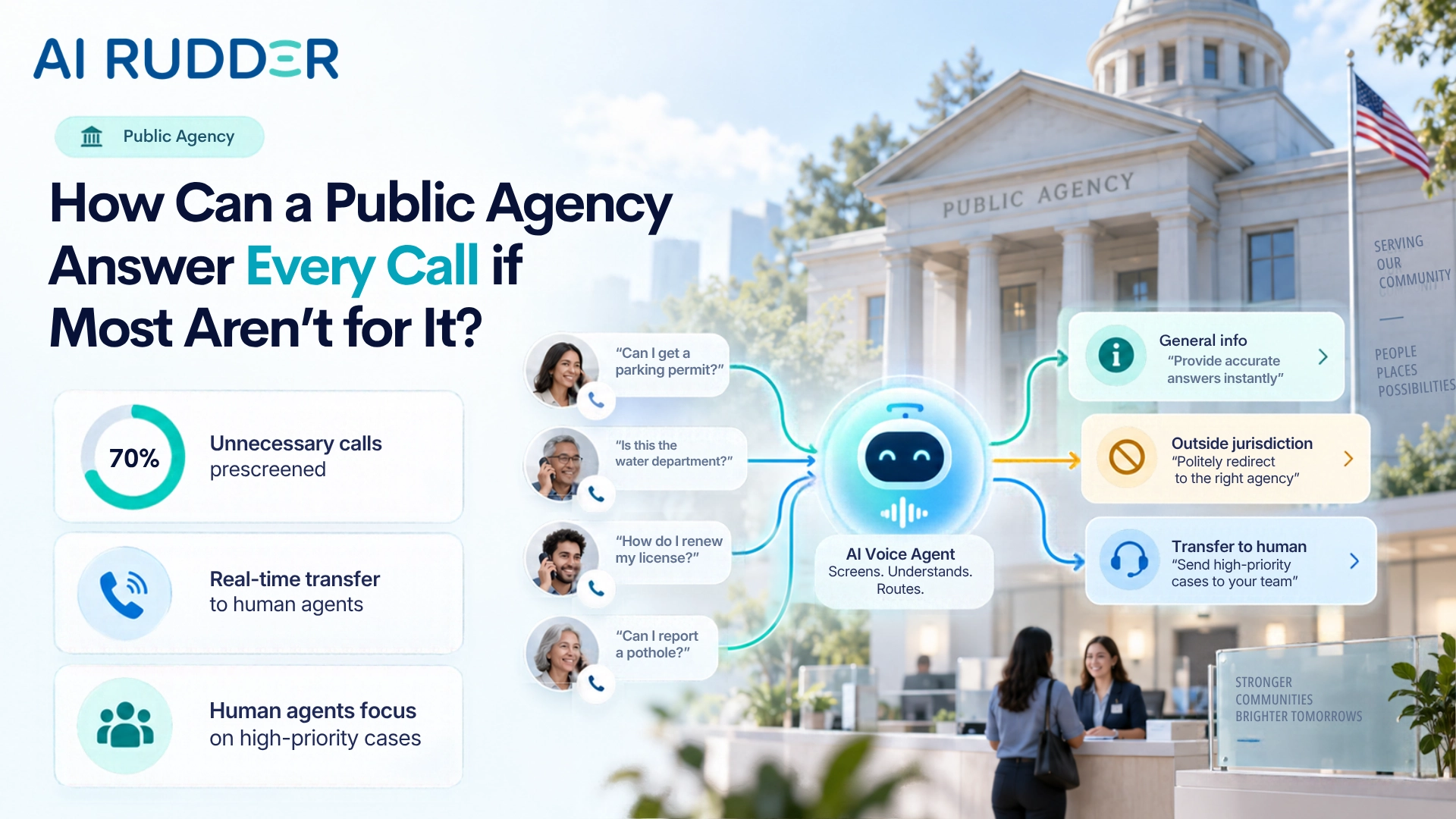
A public agency can answer every call by putting an inbound AI voice agent on the first part of each one. The agent answers immediately, finds out what the caller needs, answers general questions, redirects issues that belong to another authority and transfers genuine reports to a human agent in real time, with the context attached. The people who handle serious cases then spend their time on them.
Agencies with a clear mandate attract calls from people who aren’t sure what that mandate is. Some callers have a genuine report. Others want general information, or have a problem that belongs to a different authority. Every one of those calls takes a human agent’s time, and when volume rises, real reports wait in the same queue as everything else.
The Problem With an Inbound Line Everyone Can Call
An agency’s hotline usually faces two pressures at once. It receives requests for information and complaints by phone, and some callers aren’t fully aware of the agency’s role or the cases it handles. That leads to reports outside its jurisdiction, and those calls take time away from the cases that are.
The human agents who should be taking down serious reports end up explaining what the agency does and redirecting callers elsewhere. At peak times, a caller with an urgent report may give up before reaching anyone.
How the Inbound AI Voice Agent Works
The setup is an inbound, LLM-powered AI voice agent, integrated with AI Rudder’s AI Contact Center (AICC), that handles the first part of each call.
- Answer. The agent picks up immediately, in the caller’s language.
- Understand. It asks what the caller needs and lets them explain in their own words.
- Resolve or redirect. General questions get answers from approved information. Issues outside the agency’s remit get a clear explanation and the right place to go.
- Transfer. Calls that need a person go to a human agent in real time, with AICC passing the context so the caller doesn’t start over.
- Record. Every call is recorded and transcribed, with its reason and outcome.
Because the agent runs on a large language model, it can follow a complex question in natural conversation. Because it is a voice agent, it takes many calls at once, so busy periods don’t build a queue in front of the human team.
Prerequisites
- A list of call reasons. Grouped from recent call logs.
- Approved answers. What the agency does, what it doesn’t, and where to send each out-of-scope issue.
- Transfer rules. Which reasons always go to a person, such as a report of a serious case.
- Escalation cover. Human agents available during the hours the line runs.
Setting Up Prescreening, Step by Step
Step 1: Group last month’s calls by reason. Mark each as answerable, redirectable or needing a person.
Step 2: Write the answers and redirections. Keep them short and specific.
Step 3: Set the transfer rules. When in doubt, transfer.
Step 4: Test with real callers’ language. Include regional accents and callers who are upset.
Step 5: Launch on part of the traffic. Compare against calls handled the old way.
Step 6: Review transcripts weekly. Add answers for new reasons and tighten the transfer rules.
What to Measure
| Measure | What it tells you |
|---|---|
| Calls resolved or redirected | The share that never needed a person |
| Transfer quality | Whether calls reached the right team, with context |
| Wait time for genuine cases | How long a caller with a real report waits for a person |
| Peak handling | How many calls the line takes at once in its busiest hour |
| Caller satisfaction | A short survey at the end of resolved calls |
Where Else This Pattern Fits
Any inbound line where a large share of calls can be resolved or redirected without a person benefits from the same setup: the service lines of banks, insurers, telcos and property companies. Travelio, a property management company in Indonesia, runs an AI voice agent with AI Rudder’s inbound AICC for guest questions, check-in help and rental information, in Bahasa Indonesia, seven days a week.
What a Good Prescreening Call Sounds Like
A caller rings the hotline to report a problem with a local permit. The agent answers at once, introduces itself as the agency’s virtual assistant and asks how it can help. The caller explains in their own words. The agent recognises that permits are handled by a different office, says so clearly, gives that office’s name and number and offers to send the details by message. The call ends in under two minutes.
The next caller wants to report possible misconduct by an official. The agent recognises that this is exactly what the agency handles, says it will connect them to an officer, and transfers the call in real time. The officer sees a short summary of what the caller has already said and picks up from there, without asking the caller to start again.
Designing for Trust
Callers to a public agency may be anxious, angry or reporting something sensitive. Three design choices keep their trust:
- Be clear that it’s an AI agent, and that a person is available.
- Never make a caller work to reach a person when they have a genuine report. Transfer at the first clear signal.
- Protect what callers say. Recordings and transcripts may contain sensitive information about the caller and others, so restrict access and set retention limits.
Common Failure Points
Trying to resolve everything. Some calls must reach a person. Over-automating a hotline harms trust in the agency.
Vague redirections. “Contact the relevant authority” leaves callers stuck. Name the authority and how to reach it.
Cold transfers. A caller who has to repeat a sensitive report to a human agent loses confidence.
No review loop. New call reasons appear. Review transcripts weekly.
Practical Considerations
Public-sector call data is sensitive. AI Rudder is built to meet SOC 2 and ISO 27001, alongside GDPR and PDPA requirements and relevant IMDA and CSA standards. Its agents are live in 22 markets, with offices in 11 countries, and government and public services is one of the industries it works with.
Frequently Asked Questions
Can the AI voice agent tell which calls need a person?
Yes. You define the conditions, and the agent transfers calls that meet them to a human agent in real time.
Does the caller have to repeat themselves after transfer?
No. AICC passes the context to the human agent at transfer.
Can it handle many calls at once?
Yes. An AI voice agent takes calls in parallel, so the queue doesn’t grow at peak times.
What languages can it handle?
The languages you configure and test. AI Rudder’s speech models are built in-house and adapted to local languages and accents.
Next Step
Look at last month’s inbound calls and estimate how many your team redirected or answered with general information. Get a Demo and we’ll show you how an inbound AI voice agent would prescreen them.