
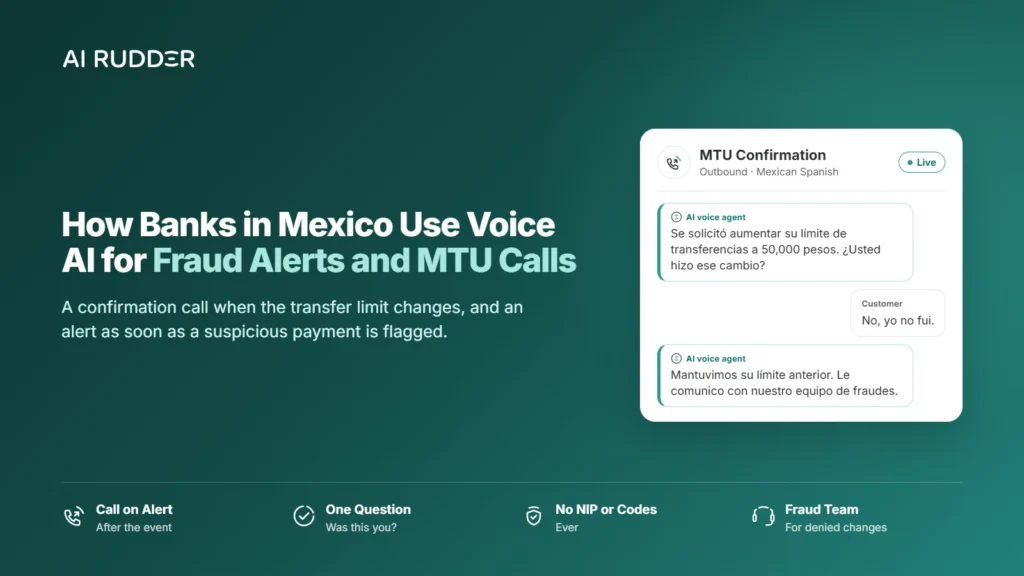
How Banks in Mexico Use Voice AI for Fraud Alerts and MTU Calls
Banks in Mexico use AI voice agents to call customers as soon as a suspicious card payment or transfer is flagged, and to confirm…
November 10, 2026
Oct 20, 2026 posted by Ming
Each collections call should go to the cheapest channel that can handle it well. One-way IVR notifications carry simple reminders. A collections AI voice agent handles conversations that follow a pattern, such as pre-due reminders and early overdue calls. Human agents take the calls that need judgement: disputes, hardship, broken promises and anyone who asks for a person. The lender’s own collection strategy decides which account goes where, and can change it at any time.
A collections operation that puts every call through people runs out of people. One that puts every call through AI loses the customers who need a person. Most lenders end up somewhere in between, and the useful question is where to draw the lines.
Growth is hard on collections. The number of accounts due each month grows with the loan book, and most of the new calls are routine reminders. If every reminder and early overdue call needs a human agent, headcount has to grow in step with the book. If the lender cuts back to automated messages only, it reaches fewer customers in a way they respond to. The fix is to stop treating collections as one kind of call.
One-way IVR notifications carry simple, one-directional messages: a reminder that a payment is due, with no conversation needed. They are the cheapest contact and work best for customers who usually pay on time.
The collections AI voice agent handles conversations that follow a pattern. It confirms the customer, explains what is owed, asks when they can pay, handles common objections and records the commitment. These calls come in the largest volumes and gain the most from automation.
Human agents on predictive dialing take the conversations that need judgement: disputes, hardship cases, customers who have broken earlier promises, or anyone who asks for a person. Predictive dialing dials ahead automatically so agents spend their time talking. In AI Rudder’s AI Contact Center this is the Agent Dialing System, which also supports progressive and manual dialing.
| Stage | Default channel | Move to a person when |
|---|---|---|
| Pre-due (3–5 days before) | IVR or AI voice agent | Customer asks a question the script can’t answer |
| Due date and 1–7 days late | AI voice agent | Dispute, hardship or request for a person |
| 8–30 days late | AI voice agent, then human agent | Second broken promise or no contact after several attempts |
| 31+ days late | Human agent | Default for negotiation and restructuring |
Step 1: Segment by stage and risk. Use days past due, balance and payment history.
Step 2: Write a script per stage. A friendly pre-due reminder reads very differently from a call on day 30.
Step 3: Set the transfer rules. Define the signals that move a call to a person.
Step 4: Enforce the rules in the system. Calling hours, contact caps and identity-first openings apply to every channel. In Indonesia, POJK 22/2023 allows collection Monday to Saturday, 08:00 to 20:00, and only with the consumer.
Step 5: Share one history. Every channel writes to the same account record, so a human agent sees what the AI and IVR already did.
Step 6: Review and rebalance monthly. Move segments between channels based on results.
NEOKARYA, a BPO company in Indonesia’s Mega Group that runs collections for Megafinance portfolios, works this way. On its case-study page, NEOKARYA reports that its AI voice agent handles 600,000 to 1 million customer records a month, alongside about 4 million automated IVR reminder calls, with an average reach rate of 18.31% over a recent three-month period. Human agents take the conversations the AI voice agent hands over.
A generic reminder script treats every customer the same. A tailored one reflects the lender’s products and customers, and changes with the stage of the debt. AI Rudder’s in-market teams configure the agents to each client’s call flows and rules, and the client’s team can then adjust scripts and campaigns themselves. Years of collections calls in Indonesia and other Southeast Asian markets show up in how the conversation is ordered, how the agent responds when a customer pushes back and when it hands over.
The handoff from the AI voice agent to a human agent is where most mixed collections setups succeed or fail. A good handoff has four parts.
A clear trigger. The call flow names the signals that move a call to a person: the customer disputes the amount, mentions job loss or illness, has broken a promise before, or simply asks for someone.
Context that travels. The human agent sees who the customer is, what was said, which identity checks passed and why the call was transferred, before they say hello.
A short wait. Transfers go to agents on the same platform, so the customer isn’t put back in a queue. If nobody is free, the agent books a callback at a time the customer chooses.
An outcome written back. Whatever the human agent agrees, such as a revised date or a restructuring request, goes back to the same account record, so the next call from any channel starts from the latest position.
| Measure | Why it matters |
|---|---|
| Contact rate by channel and stage | Shows whether each channel reaches the customers it should |
| Promise-to-pay and kept-promise rates | The outcome that matters most |
| Transfer rate and reasons | Shows whether the AI is handing over the right calls |
| Roll rate between buckets | Shows whether early contact keeps accounts from getting worse |
| Cost per contact | Across IVR, AI and human agent time |
Routing by channel capacity. Sending calls to whichever team has time ignores what the customer needs.
Separate systems. If IVR, AI and human agents keep separate records, contact limits break and customers repeat themselves.
Late-stage accounts on AI. Negotiation and restructuring need people.
A split that never changes. Customer behaviour shifts. Review the routing monthly.
Which collections calls should go to an AI voice agent first?
High-volume, rule-based calls, such as pre-due reminders and early overdue follow-ups.
How does a call move from the AI voice agent to a person?
Transfer conditions are part of the call flow the lender defines, such as a dispute or a request to speak to someone.
Do we need new dialing software for the human agents?
AI Rudder’s AI Contact Center includes the Agent Dialing System, so AI and human channels run on one platform.
Does AI Rudder work in Indonesia?
Yes. AI Rudder has worked with lenders in Indonesia since 2019 and has an office there.
Map your collections process by stage. Get a Demo and we’ll show you how the AI voice agent, human agents and IVR would split your portfolio.
Banks in Mexico use AI voice agents to call customers as soon as a suspicious card payment or transfer is flagged, and to confirm…
November 10, 2026
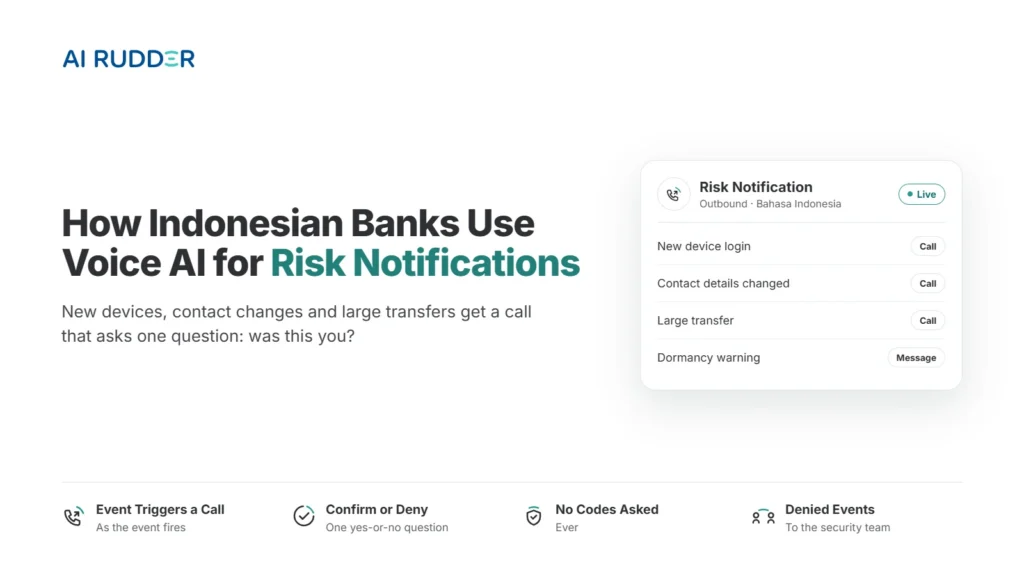
Banks in Indonesia use AI voice agents to call customers about account risks, such as a new device login or a large transfer. The…
November 10, 2026
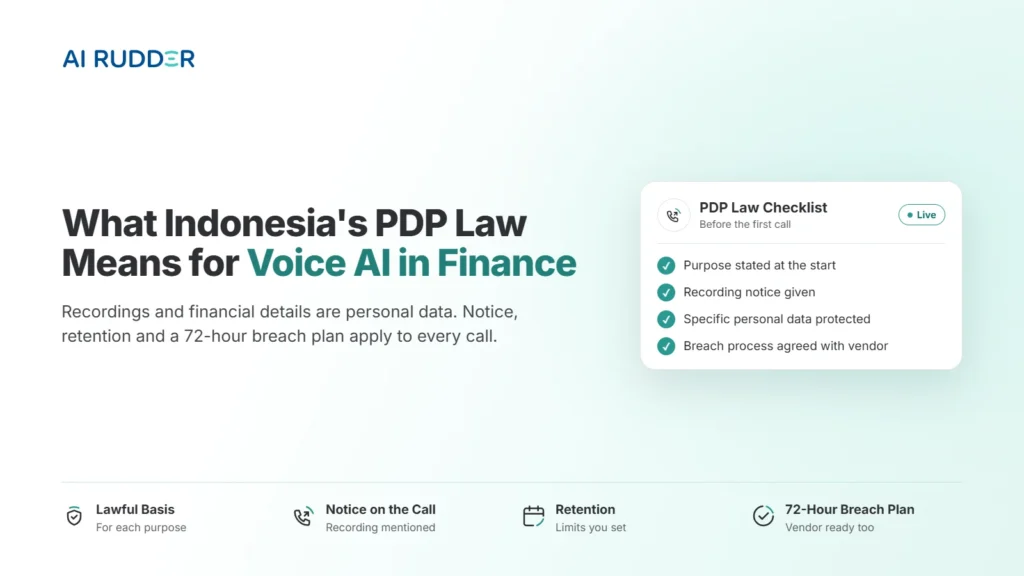
Indonesia's Personal Data Protection Law, Law No. 27 of 2022, applies to every call an AI voice agent makes or takes for banks and…
November 10, 2026