

What Does an Agent Copilot Actually Do During a Live Call?
An agent copilot works beside the agent on a live call, listening and helping in real time. It suggests answers from the company's approved…
October 20, 2026
Sep 04, 2025 posted by dona pramana

The customer experience in banking is undergoing one of the most profound transformations in decades. Customers no longer accept long wait times, generic responses, or rigid service hours. They expect seamless, personalized, and always-on support across every channel.
At the same time, rising costs, stricter regulations, and competition from digital-first challengers are forcing traditional banks to rethink their strategies. In this new landscape, banking customer experience is not just a support function, it has become a core driver of competitiveness and loyalty.
And increasingly, AI is at the center of this change.
Traditional banking contact centers are like using a flip phone in the era of smartphones: they still work, but they can’t keep up with what customers expect. Calls handled by human agents cost up to 10 times more than those managed by AI. Compliance errors continue to rack up billions in fines. And employees burn out from handling the same repetitive questions day after day.
This model is stretched thin. To deliver the kind of banking customer experience people now demand a fast, personalized, and always-on. This makes banks need a different approach.
AI is like having a digital co-pilot in every customer interaction. Instead of forcing human agents to answer “What’s my balance?” hundreds of times a day, AI handles the routine tasks instantly and accurately. That frees up people to focus on what really matters: empathy, complex problem-solving, and building relationships.
It’s not just about efficiency. With conversational AI, banks can sound more human than ever, responding in natural language, picking up on customer emotions, and tailoring interactions in real time. And because AI can review every single conversation (not just a small sample), it strengthens compliance and reduces risk.
In other words, AI doesn’t just make banking faster, it makes it feel more personal and trustworthy.
Forward-thinking banks are already proving the value of AI in customer experience in banking:
These results show that AI doesn’t just optimize processes, it elevates banking customer experience as a whole.

The most successful banks are not replacing humans with AI, they are empowering them. While AI takes care of repetitive tasks, human agents can focus on what truly matters: empathy, relationship-building, and complex problem-solving.
As a result, customer experience in the banking industry evolves into something faster, smarter, and more human.
The future of customer experience in banking will be defined by agility, intelligence, and personalization. Banks that act now, embracing AI as a strategic enabler, will set the standard for tomorrow’s market, while those that delay risk being left behind.
AI isn’t just the next step in banking customer experience. It’s the new baseline.
An agent copilot works beside the agent on a live call, listening and helping in real time. It suggests answers from the company's approved…
October 20, 2026

In most contact centers, quality assurance means listening to a sample. When every call is recorded and transcribed, then checked automatically, that changes.
October 20, 2026
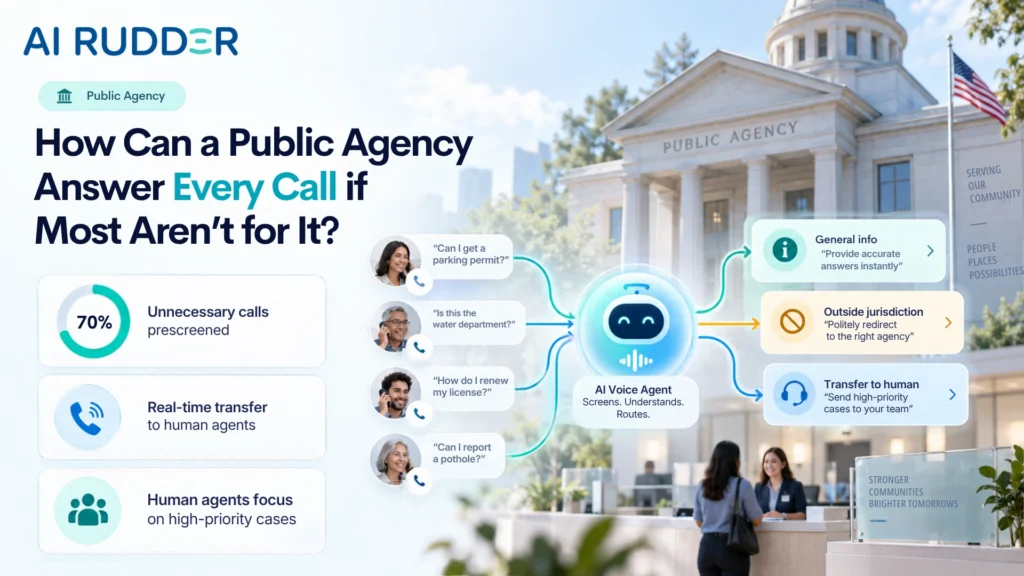
KPK, Indonesia's Corruption Eradication Commission, uses an inbound AI voice agent integrated with AI Rudder's AI Contact Center to sort calls first. KPK reports…
October 20, 2026