
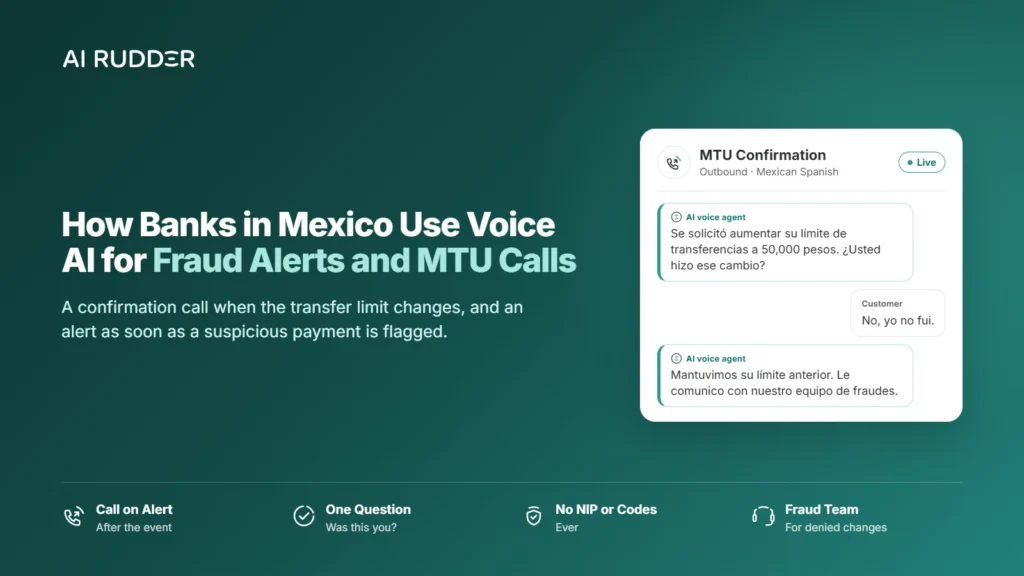
How Banks in Mexico Use Voice AI for Fraud Alerts and MTU Calls
Banks in Mexico use AI voice agents to call customers as soon as a suspicious card payment or transfer is flagged, and to confirm…
November 10, 2026
Oct 20, 2026 posted by Ming
A collections call is one of the most sensitive conversations a bank has. The customer is behind on a payment, the bank wants its money back, and a regulator has a view on how that conversation should go. So the question a bank asks before handing these calls to AI is whether it can stay in control of what the AI says, and prove it afterwards.
A bank gets comfortable when it can answer yes to the three principles AI Rudder works to: the AI follows the bank’s own rules in every market the bank lends in, and every call it makes can be checked.
Most of a collections conversation is routine: confirm the customer, state the amount and due date, ask when they can pay, record the answer. That routine part is exactly why banks want to automate it. Pre-due reminders and early-stage overdue calls come in huge volumes, and they rarely need a person’s judgement.
The difficult part sits around the routine. The agent has to use the right greeting and level of politeness for the market. It has to avoid saying anything that could read as a threat. It has to know when a customer disputes the debt or asks for a hardship arrangement, and when they simply want a person, and hand over cleanly when that happens. Those rules differ by country and product, and each bank adds its own policy on top, and human agents need training on all of them before they take a single call.
When a bank evaluates an AI voice agent, this is where the conversation goes. The deciding question is whether the agent behaves the way the bank’s best collector would, every single time.
AI Rudder builds its voice agents around the client’s call flow. The script, the order of the conversation, what the agent may and may not say, and the moments it must transfer to a human agent are set from the bank’s own collection policy. Our in-market teams configure the agents to those flows, and the bank’s team can change scripts and campaigns afterwards without waiting on us.
In practice, that usually means splitting the work by channel. A collections AI voice agent takes the routine reminders and early overdue calls, with a script and interaction strategy built for the bank’s customers. Human agents on predictive dialing take the conversations that need judgement, and one-way IVR notifications carry simple reminders. Each channel has a defined job in the collection process. That structure is what lets a bank hand the routine calls to AI while people keep the conversations that need them.
A regional lender rarely has one collections operation. It has one per market, each with its own language and regulator, and with customers who expect different things. A collections call in Jakarta doesn’t sound like one in Kuala Lumpur.
AI Rudder’s agents are live in 22 markets, and its in-house speech recognition, text-to-speech and language understanding are adapted to local languages and accents, so one agent can serve customers who switch between Malay and English mid-call. For a bank expanding across Southeast Asia or Latin America, the useful question to ask any vendor is where its agents are already making these calls today, and in which languages.
Compliance and risk teams usually decide whether a voice AI project goes ahead. Their concern is simple to state: if the AI says something it shouldn’t, will anyone know?
With an AI voice agent, every call is recorded and can be turned into text and reviewed. AI Rudder’s Quality Assurance checks conversations against the client’s SOPs, with sentiment analysis and multilingual support, so a bank can look at every call. A human QA team only has time for a small sample.
That record changes the compliance conversation. The bank can show what was said on every call and confirm that agents followed the script.
NEOKARYA, a BPO company in Indonesia’s Mega Group that runs collections for Megafinance portfolios, is one example on AI Rudder’s case-study page. It reports that its AI voice agent handles 600,000 to 1 million customer records a month, alongside about 4 million automated IVR reminder calls, with an average reach rate of 18.31% over a recent three-month period.
Results depend on the portfolio, the market and how the program is set up, so ask any vendor for figures from customers who have published them, with the period and base they cover.
Can the AI voice agent hand a call to a human agent? Yes. Transfer to a human agent is part of the call flow, triggered by the conditions the bank sets, such as a dispute or a request for a person.
Who writes the script? The script is built from the bank’s own collection policy. AI Rudder’s team configures the agent, and the bank can adjust scripts and campaigns itself afterwards.
How is security handled? AI Rudder is built to meet SOC 2 and ISO 27001 standards, alongside GDPR and PDPA requirements and relevant IMDA and CSA standards.
How long has AI Rudder worked on these calls? AI Rudder has worked on AI for customer calls since 2019, and has executed 80+ billion AI calls.
If you’re weighing which collections calls to hand to AI first, start with one portfolio and one market, and map the rules the agent must follow. Get a Demo and we’ll walk through how an AI voice agent would handle that portfolio’s calls.
Banks in Mexico use AI voice agents to call customers as soon as a suspicious card payment or transfer is flagged, and to confirm…
November 10, 2026
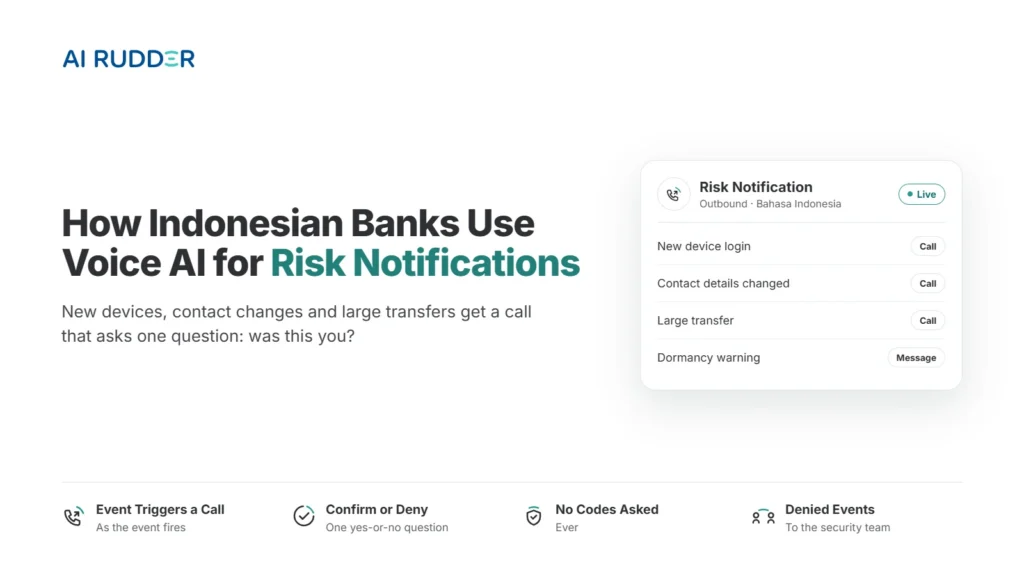
Banks in Indonesia use AI voice agents to call customers about account risks, such as a new device login or a large transfer. The…
November 10, 2026
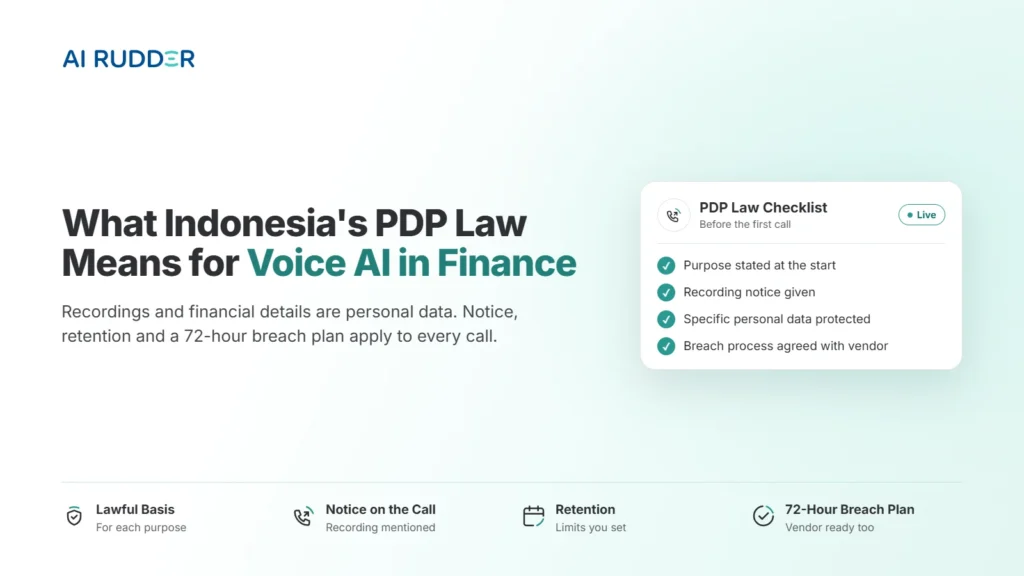
Indonesia's Personal Data Protection Law, Law No. 27 of 2022, applies to every call an AI voice agent makes or takes for banks and…
November 10, 2026