
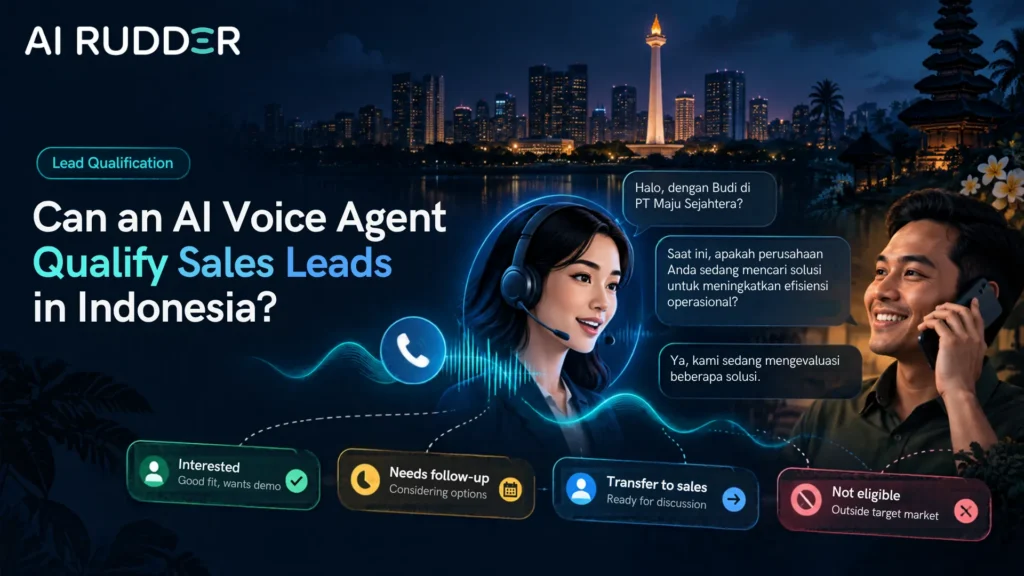
Can an AI Voice Agent Qualify Sales Leads in Indonesia?
An AI voice agent can call leads, confirm their interest, ask the questions your sales team needs answered and pass the ready ones to…
October 27, 2026
Oct 27, 2026 posted by Ming
How does an AI voice agent handle a call with a customer whose payment is due? It holds a phone conversation with that customer.
The agent listens, works out what the customer means, decides what to do under the rules the business has set, and answers in a natural voice. When the conversation needs a person, it transfers the call.
That description covers a lot of ground, so this post follows one ordinary call through eight steps. The call is a lender’s payment reminder to a customer whose instalment is due in three days.
Before anything is dialled, the business decides who gets called and when. It also sets the reason for each call.
For a payment reminder, that means a list of accounts due this week and the hours calls are allowed. It also means how many attempts each customer can receive and what the agent may and may not say.
These rules matter more than the voice. In collections, the calling window and the number of attempts are often set by regulation. So is what can be said to someone who isn’t the borrower.
An AI voice agent follows the rules it is configured with on every call, which is why lenders can use one at all.
The customer picks up and says, in Bahasa Indonesia, that they’re at work and can’t talk long.
Automatic speech recognition (ASR) converts that audio into text, in real time, while the customer is still speaking. Accents and background noise make this harder, and so do people switching between two languages in one sentence.
AI Rudder builds its speech recognition in-house and adapts it to local languages and accents. A reminder call in Jakarta doesn’t sound like one in Kuala Lumpur or Mexico City.
“Saya lagi kerja” (I’m at work) could mean “call me later” or “I’m not paying”. Natural language understanding (NLU), now usually combined with a large language model, identifies the intent behind the words. It also picks out anything specific the customer said, such as a date or an amount.
AI Rudder’s agents run on Voyager-1.5, its own large language model, built for enterprise operations. A model built this way understands the process it’s operating in: what it is allowed to say and what actions it can take. It also knows when it has to hand over.
The agent works inside a call flow the business has defined. It confirms the person’s identity, states the amount and due date, asks when they can pay, records the answer and offers a payment link. The language model handles the conversation inside that structure.
If the customer goes off-script (“Is this the same loan I took for my motorbike?”), the agent can answer from approved information. Then it returns to the flow.
Some topics need a person: a dispute, hardship, a complaint or a request to speak to someone. When the customer raises one, the agent hands over.
Many calls need data the conversation doesn’t contain, such as the outstanding balance and the last payment date. The agent may also need to know whether a promise to pay was already made.
An AI voice agent can integrate with the business’s own systems when the call needs it. It can then read that information during the call and write the result back afterwards.
For the reminder call, that means logging the promise-to-pay date the customer gave.
The reply is generated as text and converted to speech. Text-to-speech (TTS) is what makes the call sound like a conversation or like a recording.
AI Rudder’s TTS adapts voice and accent to the local market, and it adapts tone as well. That affects whether customers stay on the line long enough to hear the reminder.
Steps 2 to 6 repeat for every turn of the conversation, fast enough that the customer doesn’t notice a gap.
When a call needs a human agent, the AI voice agent transfers it. In a contact center that runs AI and human agents on one platform, the context goes with the call. The customer doesn’t have to start again.
KPK, Indonesia’s Corruption Eradication Commission, uses an inbound LLM-powered AI voice agent integrated with AI Rudder’s AI Contact Center (AICC) this way. In its approved case study, KPK reports 70% of unnecessary calls prescreened and 100% efficient real-time transfer to human agents.
After the call, the recording and transcript are stored, and the outcome goes back to the business’s systems. Here an AI voice agent differs most from a human team at the same volume. Every call can be reviewed against the rules it was meant to follow.
The highest-volume uses are calls that follow a pattern: collections and payment reminders, telemarketing, customer service questions and information verification. CBN, an Indonesian telco and internet provider, uses AI voice agents for collection reminders, billing confirmation, information verification and satisfaction surveys. CBN reports +28% connection rate and 50% less human follow-up.
AI Rudder has worked on AI for customer calls since 2019. Today its AI voice agents are live in 22 markets, with 80+ billion AI calls executed.
Is an AI voice agent the same as an IVR? No. An IVR plays recorded menus and waits for key presses. An AI voice agent holds a two-way conversation in natural language and can handle questions in the customer’s own words.
Can an AI voice agent handle complex questions? Within the knowledge and call flow it’s given, yes. A large language model makes it far better at unexpected phrasing. Anything outside that scope should go to a person.
Does it work in more than one language? It can. AmBank’s AI voice agents are bilingual in Malay and English.
How does it know when to transfer? Transfer conditions are part of the call flow the business defines. Examples are a dispute, hardship, a complaint or a customer asking for a person.
Pick one call type your team makes thousands of times a month. Get a Demo and we’ll walk you through how an AI voice agent would handle it, step by step.
An AI voice agent can call leads, confirm their interest, ask the questions your sales team needs answered and pass the ready ones to…
October 27, 2026
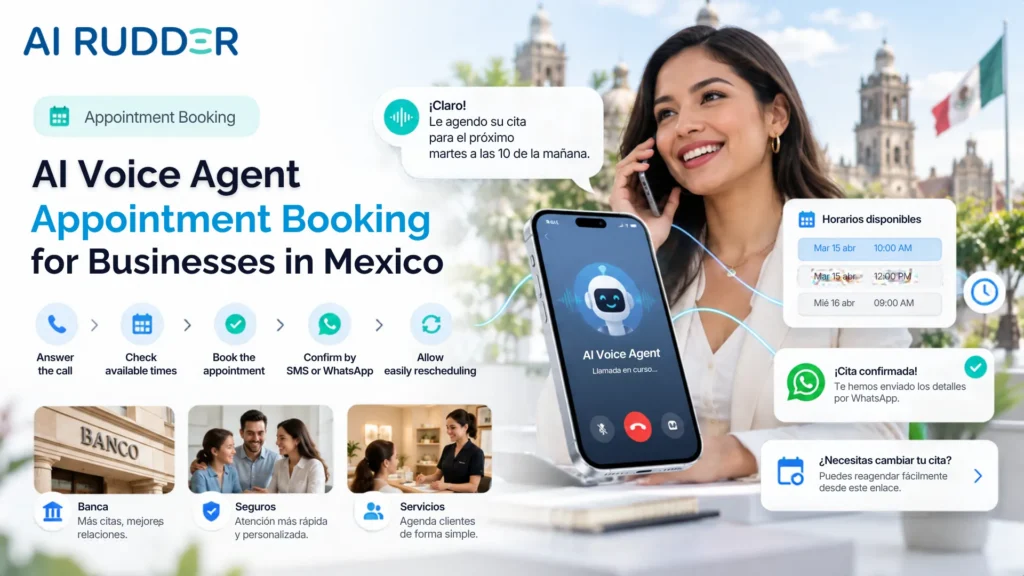
Yes. An AI voice agent can take a call, find a free slot, book it and confirm it. Later, it can call back to…
October 27, 2026
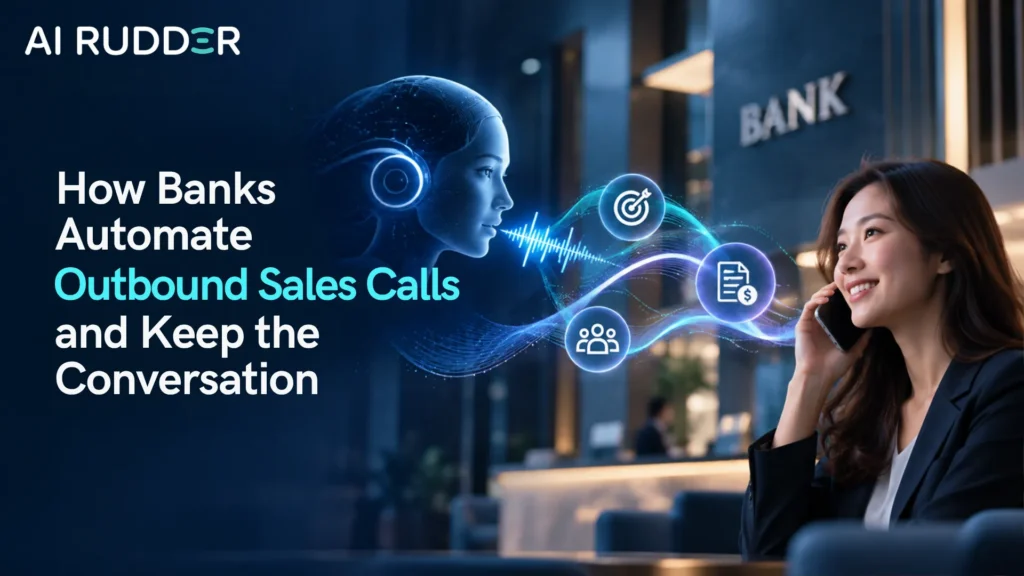
An AI voice agent holds a real sales conversation: it answers questions, handles "not now", qualifies interest and passes warm leads to a person.
October 27, 2026