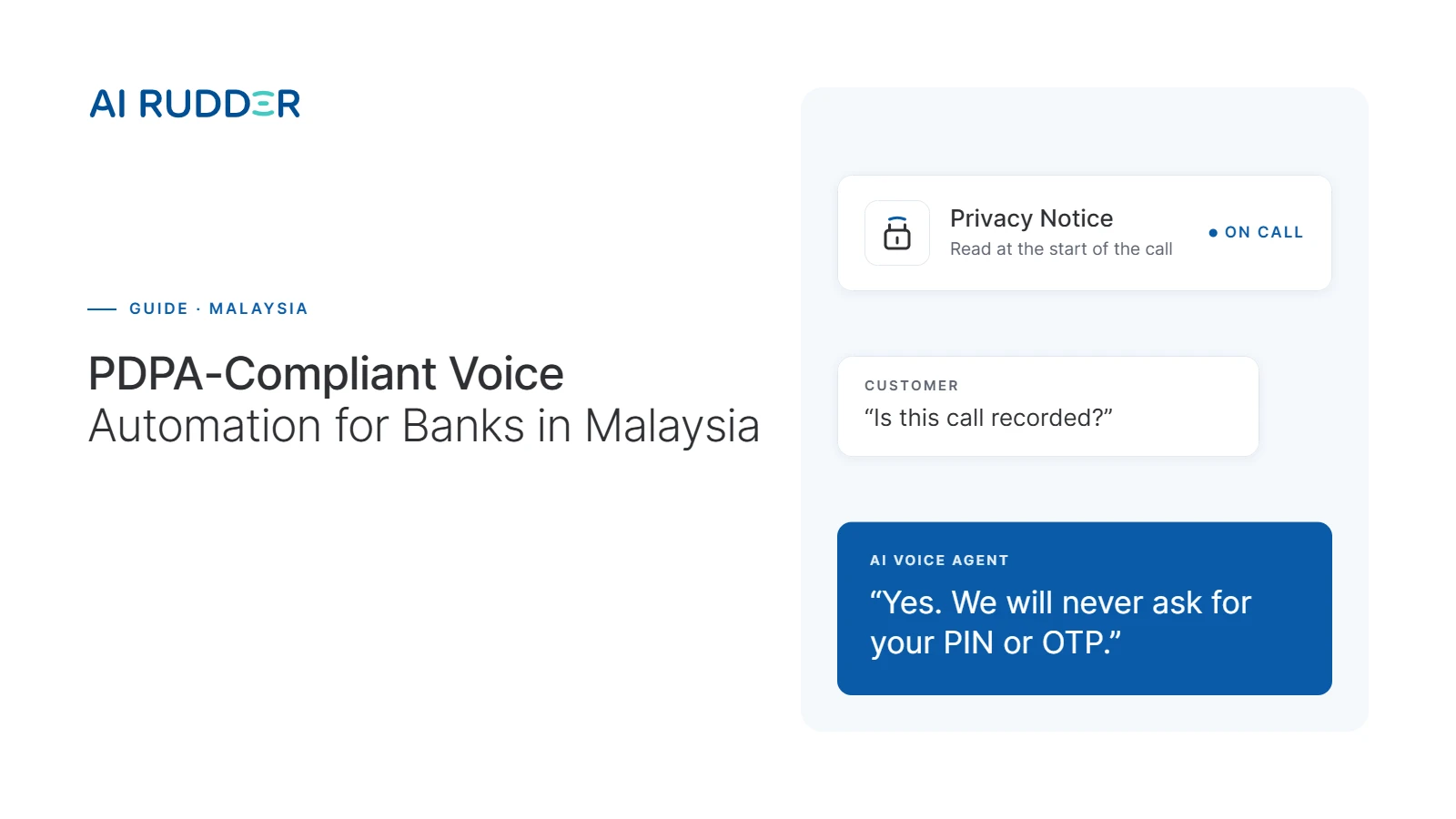
PDPA-compliant voice automation is the use of AI voice agents in a way that meets Malaysia’s Personal Data Protection Act 2010, as amended in 2024. For a bank, that means telling customers why they’re being called and that the call is recorded, processing only the data the call needs, keeping recordings secure and for a set period, treating any voiceprints as sensitive data, and being ready to report a breach to the Commissioner within 72 hours.
The 2024 amendments came into force in stages from 1 January to 1 June 2025, so most bank voice deployments need a fresh review.
This article summarises published regulation and commentary. It is not legal advice. Confirm current requirements with your legal and compliance teams.
What Changed Under the Amended PDPA
The Personal Data Protection (Amendment) Act 2024 came into force in stages, according to DFDL:
1 April 2025. Biometric data became sensitive personal data. Fines for breaching the data protection principles rose to up to RM1,000,000, and data processors gained their own security duties.
1 June 2025. Data controllers and processors must appoint a data protection officer where the guidelines require one, and data breaches must be reported.
What the Breach Rules Mean for Voice AI
Under the Commissioner’s guidelines, summarised by DLA Piper:
To the Commissioner. As soon as practicable and within 72 hours, for breaches that cause or are likely to cause significant harm, or that affect more than 1,000 people.
To affected customers. Without unnecessary delay, and within seven days of notifying the Commissioner, where significant harm is likely.
Data protection officer. Required where processing involves more than 20,000 people’s data, sensitive data, including financial information, of more than 10,000 people, or regular and systematic monitoring. Banks with large customer bases are likely to meet at least one of these thresholds.
A PDPA Checklist for Bank Voice Automation
Notice at the start of every call. Name the bank, the purpose and that the call is recorded.
Purpose limits. A collections call shouldn’t become a sales call without the right basis.
Data minimisation. The agent reads and records only what the call needs.
Security. Encrypt recordings and transcripts, restrict access and log who listens.
Retention. Delete recordings when your policy says so.
Processor terms. Your voice AI vendor is a data processor with its own security duties. Put them in the contract.
Biometrics. If you use voiceprints, treat them as sensitive data with a clear basis and strong protection.
Quality Assurance. Automated checks confirm the notice was given and verification happened before any account detail was shared.
What a PDPA-Ready Call Opening Sounds Like
AI voice agent: Selamat pagi. Saya pembantu maya dari bank anda. Panggilan ini dirakam untuk tujuan perkhidmatan dan pematuhan. Saya menghubungi anda berkenaan bayaran kad kredit anda. Adakah saya bercakap dengan Encik Faizal?
How Local Rules Compare With US and EU Guidance
Buyers often ask how local rules compare with US and EU guidance. These references help.
GDPR Article 22. In the EU, people have the right not to be subject to decisions based solely on automated processing that significantly affect them. It is a useful benchmark for when a person should review an AI outcome.
NIST SP 800-63B. NIST’s US digital identity guidelines class one-time codes sent by SMS or voice call as a “restricted” authenticator, because phone numbers can be hijacked through SIM swaps. They also say biometrics shouldn’t be used alone. A voiceprint can support a check, and it should sit alongside something the customer has, such as an approved device.
Common Failure Points
Notices buried in terms and conditions. Say it on the call.
Vendors without a breach timeline. Your 72 hours start when you become aware. The vendor must tell you faster.
Unlimited retention. More data kept means more data at risk.
Voiceprints by default. Collect biometrics only with a clear reason.
Practical Considerations
A bank in Malaysia already runs AI voice agents with AI Rudder for telemarketing and collections in Malay and English. AI Rudder has an office in Malaysia and is built to meet SOC 2 and ISO 27001, alongside GDPR and PDPA requirements and relevant IMDA and CSA standards. AI Rudder is named in Tech in Asia’s Singapore’s Top Fintech Companies 2027 list, in the Enterprise Fintech category.
Frequently Asked Questions
What is PDPA-compliant voice automation?
Voice AI calls that give notice, limit data to the purpose, keep recordings secure for a set period and support breach reporting under Malaysia’s PDPA.
Are voiceprints sensitive data in Malaysia?
Yes. Biometric data has been sensitive personal data under the amended PDPA since 1 April 2025.
How fast must a bank report a breach?
To the Commissioner within 72 hours, and to affected customers within seven days of that notice where significant harm is likely.
Does a bank using voice AI need a data protection officer?
Many will, given the number of customers and the financial data involved. Check the thresholds with your compliance team.
Next Step
Check your current call opening against the checklist above. Get a Demo and we’ll show you an AI voice agent built to meet PDPA requirements, in Malay and English.