
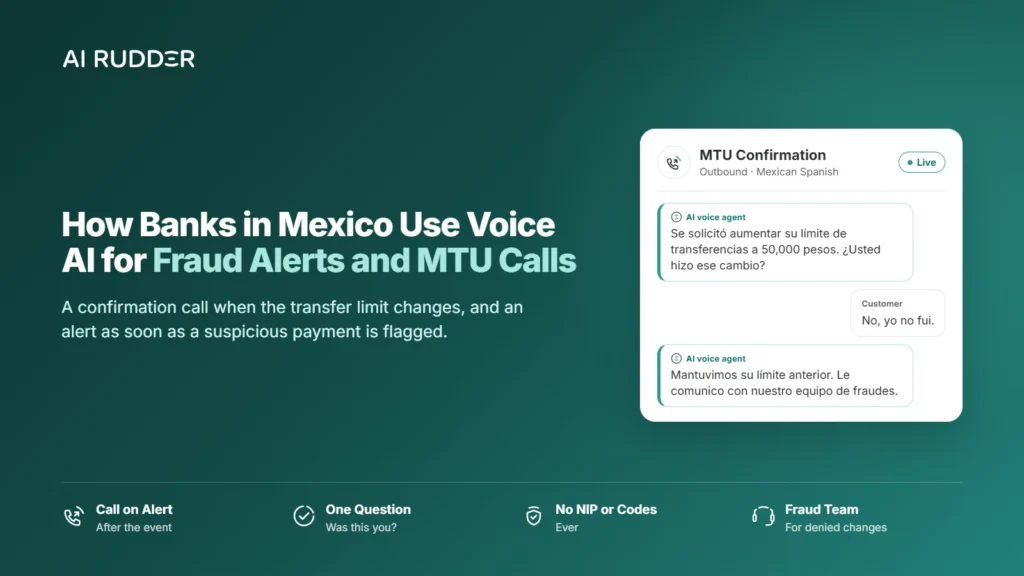
How Banks in Mexico Use Voice AI for Fraud Alerts and MTU Calls
Banks in Mexico use AI voice agents to call customers as soon as a suspicious card payment or transfer is flagged, and to confirm…
November 10, 2026
Nov 04, 2026 posted by Ming
Voice AI is compliant when the personal data each call creates is handled under the data protection law of every market you operate in, and when your vendor can show independently audited security controls. In practice that means a lawful basis and notice for recording, extra care for voiceprints, processor contracts, retention limits, breach processes and evidence such as a SOC 2 report or ISO 27001 certificate.
A voice AI deployment creates more personal data than most teams expect. Every call produces a recording, a transcript, customer details pulled from your systems, an outcome written back and sometimes a voiceprint. The vendor processing it becomes part of your compliance story. This guide covers the laws and standards that come up most often when banks, lenders and service teams in Asia, Latin America and Europe evaluate voice AI.
This is a summary for orientation. It is not legal advice. Confirm your obligations with your legal and compliance teams.
Call recording. Voice is personal data, and recordings often contain account details.
Transcript. Searchable text of everything said, including anything volunteered.
Customer record lookups. Balances, due dates and addresses pulled during the call.
Call outcome. Promises to pay, complaints and disputes written back to your systems.
Voiceprint, if used. Biometric data, a special or sensitive category under most laws below.
GDPR applies when you process personal data of people in the EU. For voice AI the articles that matter most:
Singapore’s Personal Data Protection Act 2012 requires consent and notification of purpose, reasonable security arrangements and limits on how long data is kept. Since February 2021, organisations must notify the PDPC of notifiable breaches within three calendar days of assessing that a breach is notifiable.
Malaysia’s Personal Data Protection Act 2010 was amended in 2024, with changes in force during 2025. From 1 April 2025, data processors became directly subject to the security principle and maximum penalties rose. From 1 June 2025, data controllers must appoint a data protection officer, notify the Commissioner of breaches and support a data portability right. Biometric data is now sensitive personal data, which needs explicit consent.
Law No. 27 of 2022 on Personal Data Protection was enacted on 17 October 2022, with a transition that ended on 17 October 2024. According to PwC’s overview, controllers must notify data subjects and the authority of a breach in writing within 3 × 24 hours, biometric and personal financial data are “specific” personal data, some controllers must appoint a data protection officer, and fines can reach 2% of annual revenue.
Mexico published a new Federal Law on the Protection of Personal Data Held by Private Parties on 20 March 2025, in force the next day, with oversight moving to the Secretaría Anticorrupción y Buen Gobierno. It updates privacy-notice content and gives people the right to object to automated processing that significantly affects them, according to Hogan Lovells’ summary.
SOC 2 is an attestation report issued by an independent auditor under the AICPA’s Trust Services Criteria: security, availability, processing integrity, confidentiality and privacy. A Type I report checks that controls are designed properly at a point in time. A Type II report checks that they operated effectively over a period. Ask for the report and read the scope and exceptions.
ISO 27001 is the international standard for an information security management system. Certification means an accredited body has audited the organisation’s system against the standard. Ask which entities, locations and services the certificate covers.
Step 1: Map the data. List what each call creates, where it is stored and who can see it.
Step 2: Set the notice. Tell customers at the start of the call that it is recorded, and why.
Step 3: Decide on biometrics. If you use voiceprints, capture explicit consent and protect them as sensitive data.
Step 4: Sign the processor agreement. Define what the vendor may do with call data, including model training.
Step 5: Set retention. Keep recordings and transcripts only as long as your policy and the law require.
Step 6: Rehearse the breach process. Make sure you and the vendor can meet the shortest deadline that applies to you.
Assuming the vendor handles compliance. The controller stays responsible. The vendor’s controls support your obligations; they don’t replace them.
Unlimited retention. Recordings kept forever become a liability.
Voiceprints without consent. Biometric data needs explicit consent in most of these markets.
Fully automated decisions. Keep a person in the loop where a decision significantly affects the customer.
AI Rudder is built to meet SOC 2 and ISO 27001, alongside GDPR and PDPA requirements and relevant IMDA and CSA standards. Its agents are live in 22 markets, with offices in 11 countries including Singapore (headquarters), Indonesia, Malaysia, Vietnam and Mexico.
How do you make voice AI GDPR compliant?
Establish a lawful basis, tell customers about recording and AI use, sign a processor agreement, run a DPIA where needed, set retention limits, keep people in the loop for significant decisions and have a 72-hour breach process.
What is PDPA compliant voice automation?
Voice automation that meets the consent, purpose, security, retention and breach-notification duties of Singapore’s or Malaysia’s PDPA, depending on where you operate.
What is the difference between SOC 2 and ISO 27001?
SOC 2 is an auditor’s report on specific controls. ISO 27001 certifies a management system for information security. Many enterprise buyers ask for both.
Can voice AI handle sensitive financial data securely?
Yes, with encryption, access logging, retention limits, regional storage and an audited security programme. Ask for evidence of each.
Send us your security questionnaire. Get a Demo and we’ll walk your compliance team through how call data is handled in your markets.
Banks in Mexico use AI voice agents to call customers as soon as a suspicious card payment or transfer is flagged, and to confirm…
November 10, 2026
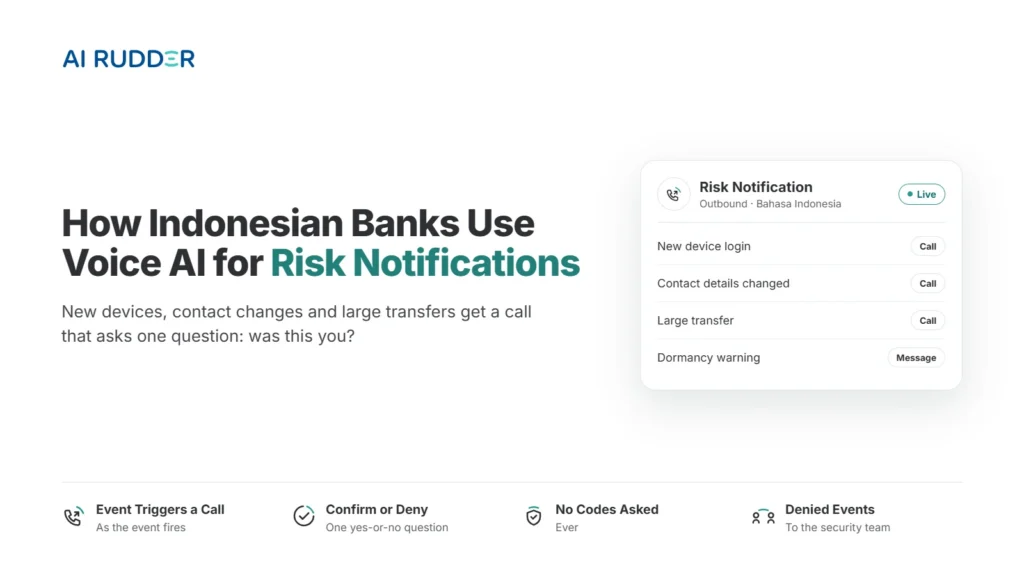
Banks in Indonesia use AI voice agents to call customers about account risks, such as a new device login or a large transfer. The…
November 10, 2026
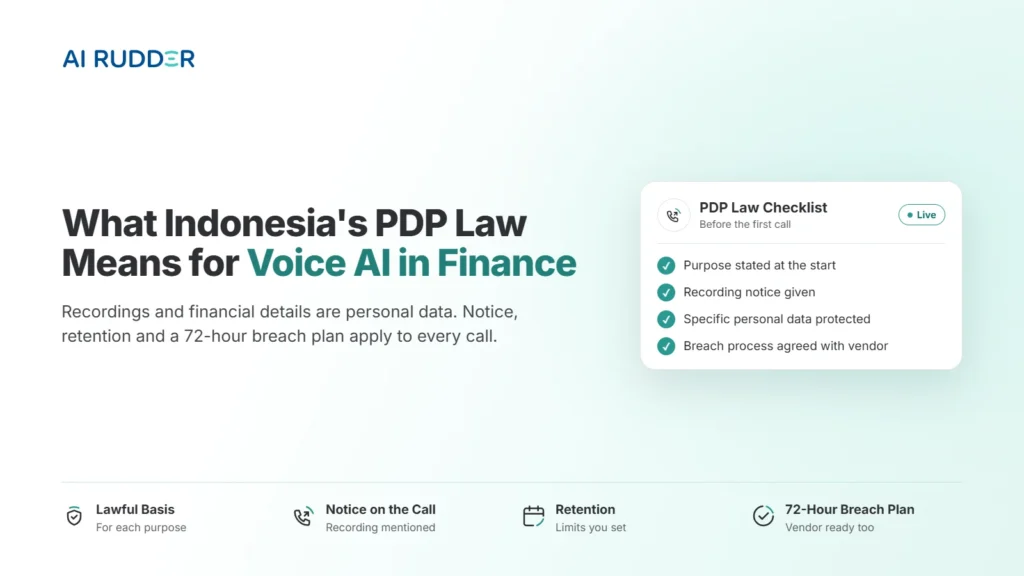
Indonesia's Personal Data Protection Law, Law No. 27 of 2022, applies to every call an AI voice agent makes or takes for banks and…
November 10, 2026