The best voice AI for a bank is the one that handles the bank’s high-volume calls in its customers’ languages, verifies callers without asking for secrets, follows the regulator’s rules inside the system, passes complex and sensitive cases to people with context, and gives risk and compliance teams a record of each call. Banks choose among contact-centre suites, conversational AI platforms, developer-first voice AI and voice AI built for regulated banking calls. The right type depends on which calls you start with and how much your team wants to build.
AI Rudder publishes this guide. We build AI voice agents for lenders, including banks, and for collection agencies, and we say below where we fit.
Updated November 2026. This guide is not legal advice. Confirm current requirements with your legal and compliance teams.
Which Bank Calls Suit Voice AI First
Payment reminders. Pre-due calls for cards and loans that give the amount and due date, then explain how to pay.
Early collections. First missed payments, with a route to a person for hardship.
Fraud and transaction checks. “Was this you?” calls about card payments and transfers, and about new devices.
Balance and account questions. Inbound calls answered after an identity check.
Application and onboarding updates. Status and welcome calls, and calls about missing documents.
Verification calls. Confirming customer details for know-your-customer checks.
Start with one of these. Hardship, complaints, disputes and advice stay with trained people.
The Four Types of Voice AI for Banks
Contact-centre suites. Platforms that run the bank’s queues and human agents, with AI voice added. Best for banks that want one vendor across the contact centre. Watch out for banking rules that need configuring and testing in each flow.
Conversational AI platforms. Tools for building AI conversations across channels. Best for banks with a digital team that designs many journeys. Watch out for voice quality in local languages and for outbound calling rules.
Developer-first voice AI. APIs for engineers to build calling agents. Best for banks with strong engineering teams. Watch out for the work around the call: verification design, recordings, quality checks and evidence for regulators.
Voice AI built for regulated banking calls. Providers whose main work is collections, reminders and banking service calls, with a contact centre platform around the AI. Best for banks that want rules, verification and evidence set up from the start. Watch out for fit if you mainly need open-ended chat. AI Rudder sits in this group.
How We Compared Them
Verification. Knowledge checks the bank’s systems can confirm, approval in the bank’s app for higher-risk requests, and no requests for PINs, passwords or one-time codes.
Regulatory rules. Each market’s rules on calling hours and identification are set in the system, and so are its third-party rules.
Integration. Reading account details (balances and due dates) and case status from core systems, and writing outcomes back.
Handover. Hardship, fraud, complaints and disputes passed to a person with a summary.
Language. Natural speech in the languages and mixes your customers use.
Evidence. Calls are recorded and transcribed, with automated quality checks against your SOPs.
Security. Named security standards, data location, access controls and incident reporting.
How to Run a Fair Evaluation
Step 1. Pick one call type. Pre-due reminders or balance questions are good starts.
Step 2. Test on your own recordings. Real customers sound different from staff reading a script.
Step 3. Involve risk and compliance early. Agree the scripts and verification steps before the first live call. Settle the evidence you need at the same time.
Step 4. Run on live accounts. Compare reach, completion, complaints and handover quality with your current process.
Step 5. Review the calls. Listen to a sample and read the automated quality-check results.
Step 6. Expand only what worked. Add the next call type once the first one is stable.
Market Guides
Rules and languages differ by market. Our market guides cover them in detail:
Indonesia. OJK’s consumer protection rules, the PDP Law and Bahasa Indonesia: How to Choose Voice AI for Financial Services in Indonesia.
Malaysia. Bank Negara Malaysia’s expectations, the amended PDPA and Malay-English code-switching: How to Choose Voice AI for Financial Services in Malaysia.
Mexico. CNBV, CONDUSEF and Mexican Spanish: What Is AI Voice Automation for Banking in Mexico?
For budgeting, see what drives the cost of voice AI for banks.
What a Good Bank Call Sounds Like
AI voice agent: Good morning, this is your bank’s virtual assistant. I’ll never ask for your PIN or any password or one-time code. Am I speaking with Ms Tan?
Customer: Yes.
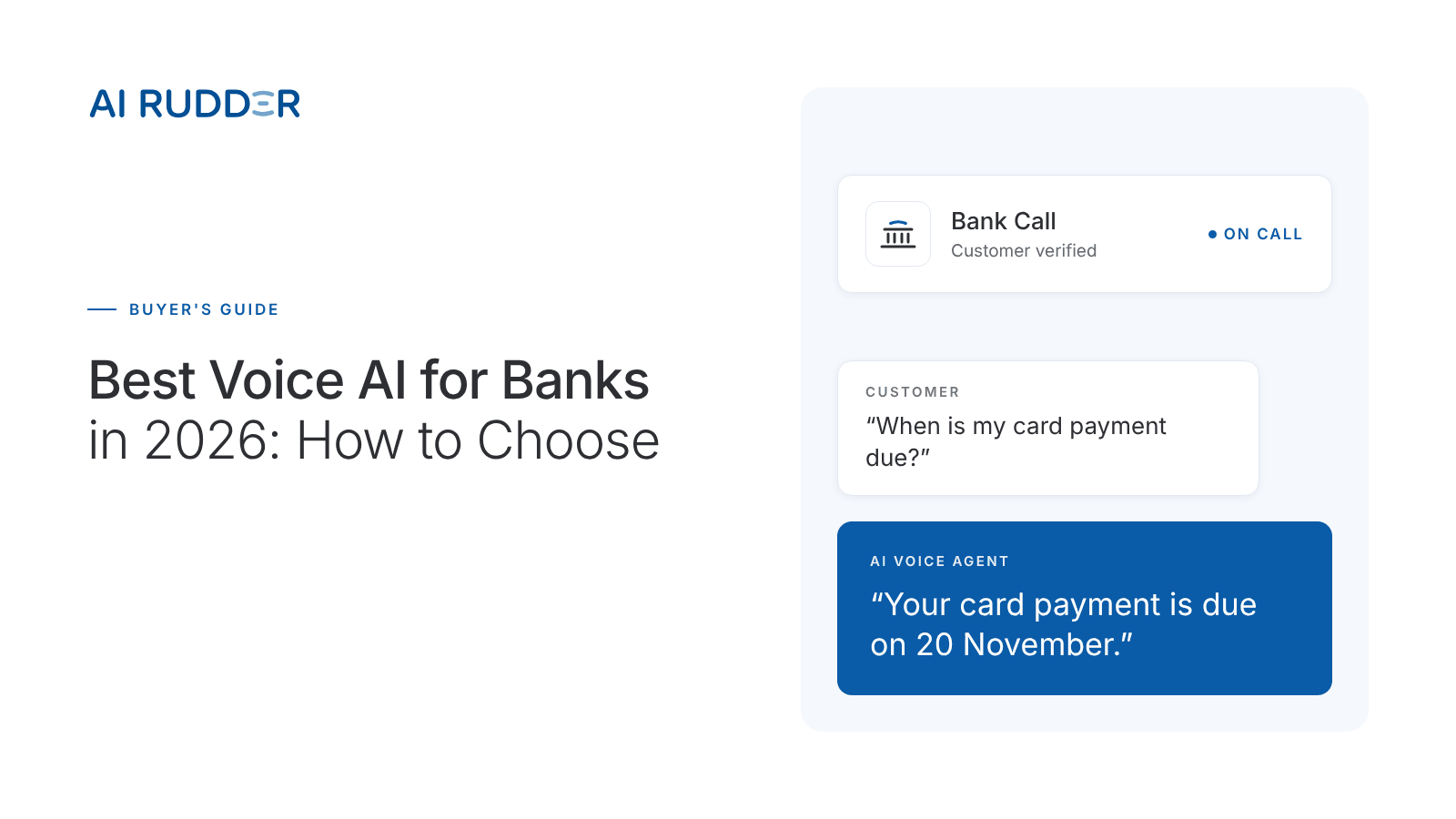
AI voice agent: Thank you. Your credit card payment of RM 1,240 is due on 15 November. Would you like the payment details by WhatsApp?
How Local Rules Compare With US and EU Guidance
Buyers often ask how local rules compare with US and EU guidance.
NIST SP 800-63B. NIST’s US digital identity guidelines class one-time codes sent by SMS or voice call as a “restricted” authenticator, because phone numbers can be hijacked through SIM swaps. They also say biometrics shouldn’t be used alone.
PCI SSC guidance on telephone payments. The PCI Security Standards Council’s information supplement on protecting telephone-based payment card data (PCI SSC, 2018) says sensitive authentication data, such as the CVV, must not be stored after authorisation, and that includes call recordings and transcripts.
Where AI Rudder Fits
AI Rudder runs AI voice agents in 22 markets, with 80+ billion AI calls executed for 500+ clients. It has offices in Indonesia, Malaysia and Mexico. A bank in Malaysia already runs AI voice agents with AI Rudder for telemarketing and collections in Malay and English. NEOKARYA, an Indonesian BPO running collections for Megafinance’s MAF and MCF portfolios, uses an AI voice agent on 600,000 to 1 million customer records a month. AI Rudder is built to meet SOC 2 and ISO 27001, alongside GDPR and PDPA requirements and relevant IMDA and CSA standards. See our banking and finance solutions. AI Rudder is named in Tech in Asia’s Singapore’s Top Fintech Companies 2027 list, in the Enterprise Fintech category.
Another type may suit you better if your bank wants to build every call flow in code, or mainly needs chat for digital journeys.
Frequently Asked Questions
What is the best voice AI for banks?
The one that handles your high-volume calls in your customers’ languages, verifies callers safely, follows your regulator’s rules in the system and keeps a record of each call.
What is AI voice automation for banking?
AI voice agents that handle bank calls such as reminders, early collections, fraud checks and account questions, following the bank’s rules and passing complex cases to people.
Which calls should a bank automate first?
Pre-due payment reminders or common inbound questions.
Should a bank’s AI voice agent ask for an OTP?
No. Use approval in the bank’s app for higher-risk requests.
How do banks evaluate voice AI vendors?
On their own recordings and live accounts, with risk and compliance involved from the start.
Next Step
Pick the one call type you’d evaluate first. Get a Demo and we’ll show you how an AI voice agent would handle it in your customers’ language.