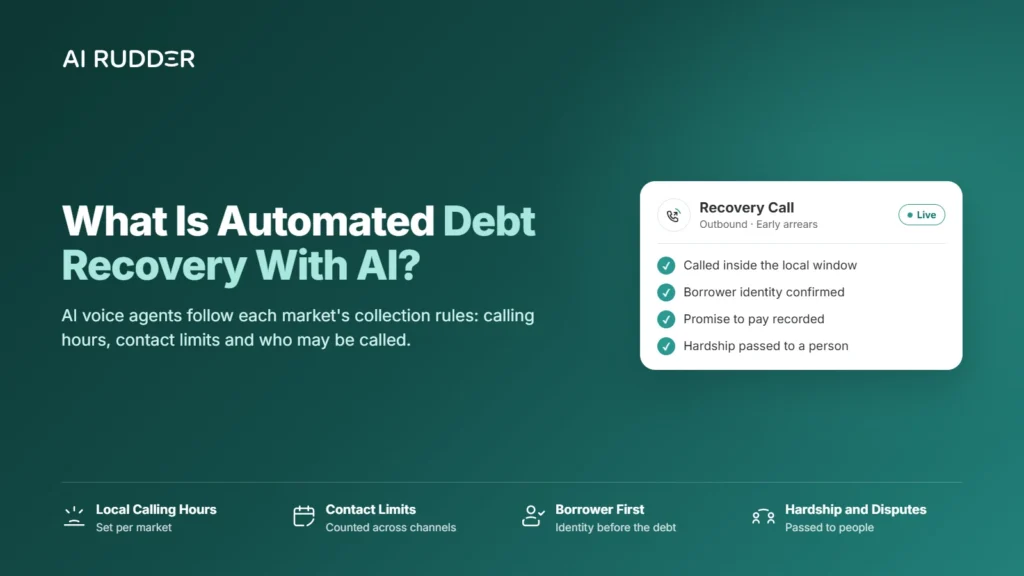
What Is Automated Debt Recovery With AI?
Automated debt recovery with AI is the use of AI voice agents and messaging to contact borrowers about overdue payments, agree a payment date…
November 9, 2026
Nov 09, 2026 posted by Ming
An AI voice agent can help a customer pay by phone, but the card details should never pass through the AI, the call recording or the transcript. Under PCI DSS, card verification codes may not be stored after authorisation, even in an audio recording. The safe designs either send the customer a secure payment link through a channel they trust, or hand the card entry to a separate, PCI-compliant payment system that masks the digits.
For lenders, insurers and retailers in Mexico and across Latin America and Asia, payment by phone is common. So are fines and breach costs when card data ends up in call recordings.
This article summarises published guidance. It is not legal or compliance advice. Confirm requirements with your Qualified Security Assessor.
No storage of sensitive authentication data. PCI DSS Requirement 3.3.1 bans keeping sensitive authentication data, such as the card verification code, after authorisation. A PCI SSC FAQ (1210) confirms this applies to audio recordings too, according to this summary of PCI DSS call-recording rules. The priority is to stop the data being captured at all, and to delete it securely if prevention fails.
PCI DSS v4.0 deadlines. Requirements that were future-dated in v4.0 became mandatory on 31 March 2025.
Telephony is in scope. Phone lines and VoIP systems that carry card data fall under PCI DSS controls.
Option 1: Payment link. The AI voice agent confirms the amount and the customer’s preferred channel, then the customer receives a secure link from your payment provider. The card details never enter the call.
Option 2: Masked keypad entry. The call transfers to a PCI-compliant payment system where the customer types the card number on the keypad. The tones are masked, so neither the AI, the agent nor the recording receives them. Check how your telephony provider handles both the audio tones and the digital signals.
Option 3: Existing payment channels. The agent reminds the customer of the amount and due date and points them to the payment channels they already use, such as bank transfer, convenience stores or the lender’s app.
What the AI voice agent should never do is ask the customer to read their card number or security code aloud.
Step 1: Map your payment channels. List every way customers pay today.
Step 2: Choose the design. Payment link, masked entry or existing channels, with your Qualified Security Assessor’s input.
Step 3: Write the script. The agent says it will never ask for card numbers or codes.
Step 4: Exclude payment segments from recordings. If customers pay during the call, make sure that segment is never recorded or transcribed.
Step 5: Test the failure paths. Check what happens if the transfer fails or the customer starts reading digits aloud.
Step 6: Review calls. Automated Quality Assurance flags any call where card data may have been spoken.
Call recordings and transcripts in Mexico also fall under the Federal Law on the Protection of Personal Data Held by Private Parties (LFPDPPP), issued in a new version in 2025. Check retention and consent with your legal team.
AI voice agent: Good afternoon, this is the virtual assistant from your lender. Your payment of 1,450 pesos is due tomorrow. Would you like to pay now?
Customer: Yes, with my card.
AI voice agent: I’ll send you a secure payment link by message right now. Please don’t read your card number to me. The link comes from our payment provider and you can check it in our app.
Customer: Got it.
AI voice agent: Thank you. Once you’ve paid, you’ll receive a confirmation.
The card details never enter the call, the recording or the transcript.
Card data in the call. Payment link: None. Masked keypad entry: Masked from AI and recording. Existing channels: None.
Customer effort. Payment link: Opens a link. Masked keypad entry: Types on the keypad. Existing channels: Pays later through their usual channel.
Payment during the call. Payment link: Yes. Masked keypad entry: Yes. Existing channels: No.
PCI scope for the voice system. Payment link: Smallest. Masked keypad entry: Depends on the masking design. Existing channels: Smallest.
Customers reading digits aloud. The agent should stop them and switch to the safe method.
Recordings that keep running. Payment segments end up in archives that are hard to clean.
Transcripts and logs. Text logs can capture card numbers even when audio is masked.
Assuming the vendor is compliant. Ask for PCI attestation for the payment component.
AI Rudder has an office in Mexico, runs AI voice agents in 22 markets and is built to meet SOC 2 and ISO 27001, alongside GDPR and PDPA requirements. Card payment handling should sit with a PCI-compliant payment provider.
Is voice AI safe for card payments? It is when card details never pass through the AI or the recording. Use payment links or masked keypad entry.
Can call recordings contain the card security code? No. PCI DSS bans storing it after authorisation, including in audio.
What is DTMF masking? A method that hides the keypad tones customers type, so card numbers don’t reach agents or recordings.
Should an AI voice agent ask for card numbers? No. It should send the customer to a secure payment step.
List how your customers pay today. Get a Demo and we’ll show you how an AI voice agent fits your payment flow, in Spanish.
Automated debt recovery with AI is the use of AI voice agents and messaging to contact borrowers about overdue payments, agree a payment date…
November 9, 2026
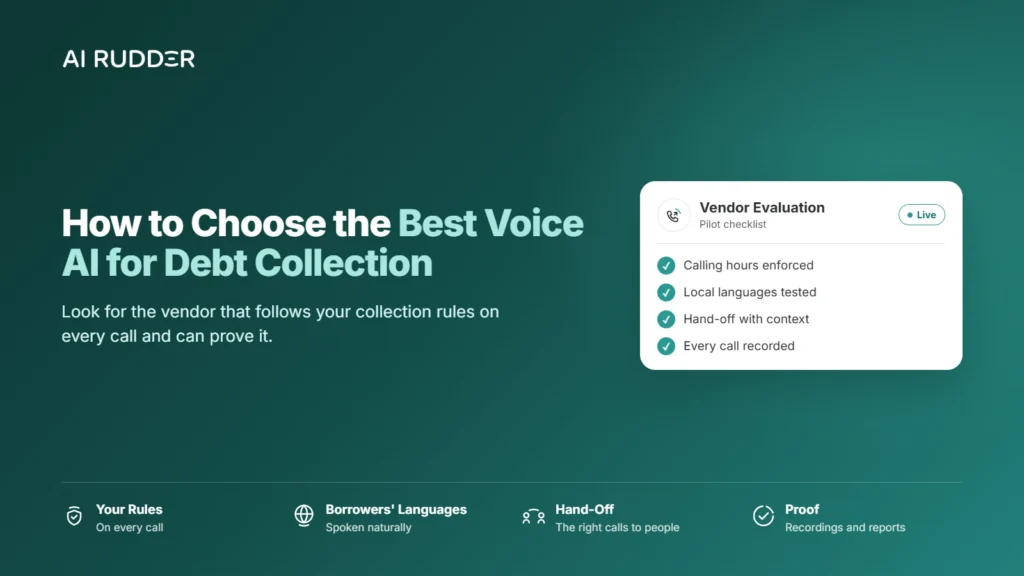
The best voice AI for debt collection is the one that follows your collection rules on every call, speaks your borrowers' languages naturally, hands…
November 9, 2026
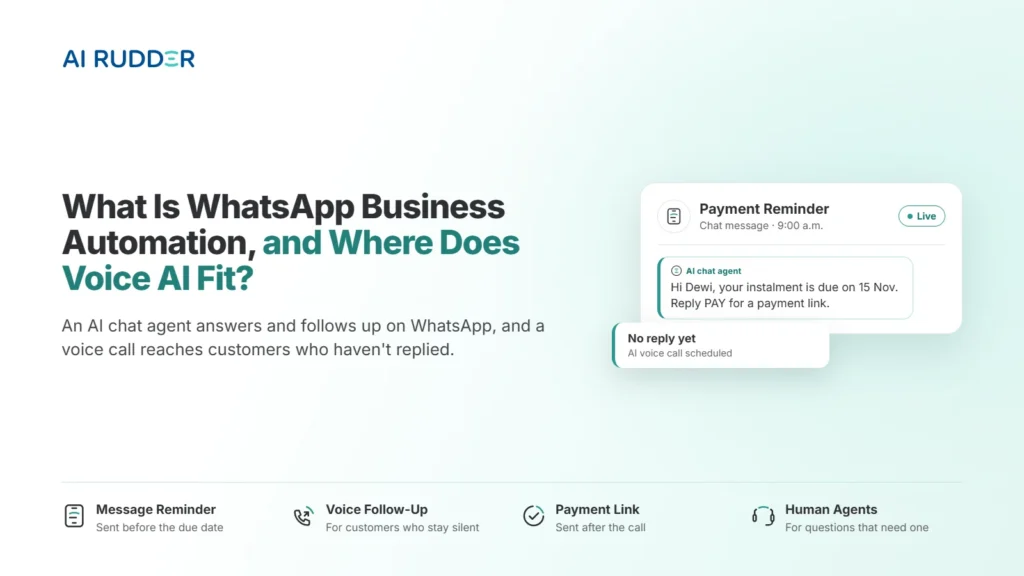
WhatsApp business automation is the use of software, usually an AI chat agent, to answer customers, send reminders and follow up on WhatsApp without…
November 9, 2026