
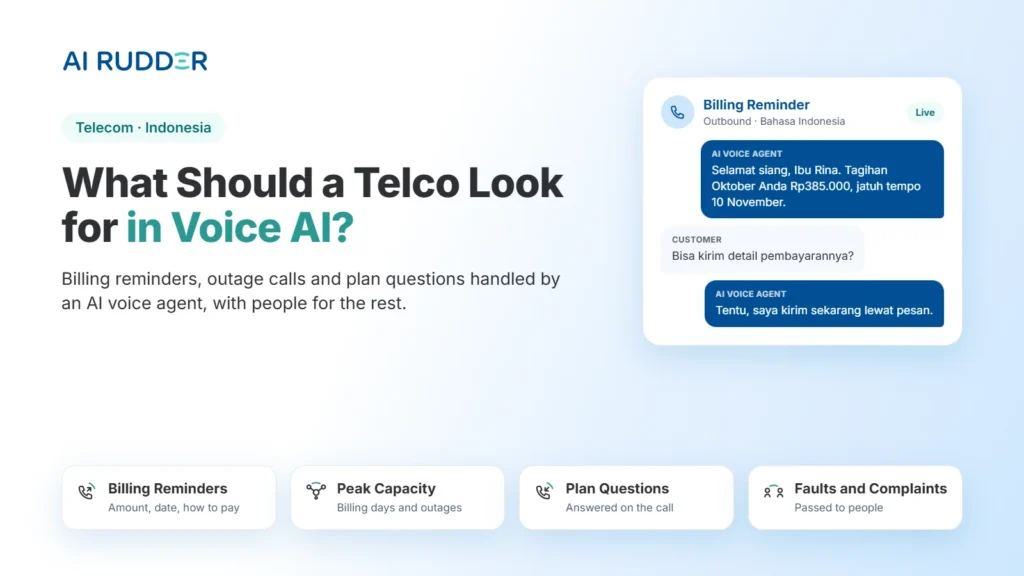
What Should a Telco Look for in Voice AI?
A telco should look for voice AI that handles its high-volume, repetitive calls end to end, such as billing reminders, payment confirmations, service updates…
November 4, 2026
Nov 03, 2026 posted by Ming
Yes. Voice AI can handle most loan recovery calls: pre-due reminders, early overdue calls, promise-to-pay follow-ups and payment confirmations, with disputes, hardship and late-stage negotiations passed to human agents. Lenders automate collection calls by connecting an AI voice agent to their loan system, setting the rules for each stage of the debt and checking every call against those rules.
Loan recovery is a volume problem. A growing loan book means more accounts due every month, and most of the calls they need are routine: a reminder, a confirmation of the amount, a question about when the customer can pay. Human teams spend most of their day on those calls, which leaves less time for the conversations that actually need a person.
Before launching AI recovery calls, a lender needs four things in place:
Step 1: Segment the portfolio by stage. Split accounts into pre-due (a few days before the due date), early overdue (1 to 30 days), mid-stage and late-stage. Start the AI on pre-due and early overdue, where conversations follow a pattern.
Step 2: Write a script for each stage. A pre-due reminder is friendly and short: confirm the customer, state the amount and date, explain how to pay. An early overdue call asks when the customer can pay and records the commitment. Have compliance approve every script.
Step 3: Confirm identity first. The agent confirms it is speaking to the borrower before mentioning the debt. If someone else answers, it ends the call politely without disclosing anything, as third-party rules in all three markets require.
Step 4: Set the rules in the system. Calling windows by the borrower’s local time, holiday blocks and daily contact caps are configured in the campaign, so they hold at any volume.
Step 5: Define the handoffs. A dispute, a hardship claim, signs of distress or a request for a person transfers the call to a human agent with the context attached. On AI Rudder’s AI Contact Center, AI and human agents run on one platform, and human agents work on the Agent Dialing System with predictive, progressive or manual dialing.
Step 6: Follow up in writing. A promise to pay triggers a message with the amount, date and payment details. A missed call can trigger a WhatsApp or SMS reminder that counts toward the same contact limit.
Step 7: Review every call. Automated Quality Assurance checks every conversation against your SOPs, flags breaches and shows which objections the script handles badly.
Step 8: Tune weekly. Use the transcripts to adjust wording, timing and handoff rules, then add the next stage once the first one is stable.
Starting with late-stage accounts. Late-stage recovery needs negotiation and judgement. Starting there sets the AI up to fail and hands customers a poor experience.
One script for every stage. A customer who is two days early and one who is 60 days late need different conversations.
Rules that live only in a document. Calling hours and contact limits written into a policy will be broken at volume unless the dialing system enforces them.
Ignoring language. Borrowers who hear a voice that sounds foreign hang up. Test with recordings of your own customers in Bahasa Indonesia, Malay and English, or Mexican Spanish.
No baseline. Measure contact rate, promise-to-pay rate and kept promises before launch, so you can compare.
Scale. NEOKARYA, a BPO company in Indonesia’s Mega Group that runs collections for Megafinance portfolios, reports on its case-study page that its AI voice agent handles 600,000 to 1 million customer records a month, alongside about 4 million automated IVR reminder calls, with an average reach rate of 18.31% over a recent three-month period.
Outcomes. CBN, an ICT provider in Indonesia, reports an average 27% connection rate across its collection activities, with 6–10% of connected customers completing the intended collection outcome, and manual workloads and operational costs down 50–70%.
Accountability. Regulators in Indonesia, Malaysia and Mexico hold lenders responsible for what collectors say on their behalf. A recording and transcript of every AI call is stronger evidence than occasional audits of a human agency.
Security. Call data is personal data. AI Rudder is built to meet SOC 2 and ISO 27001, alongside GDPR and PDPA requirements and relevant IMDA and CSA standards.
Agree these measures with your collections and finance teams before the first call, and track them by stage:
| Measure | What it tells you |
|---|---|
| Contact rate | Share of accounts reached, compared with your human team |
| Promise-to-pay rate | Share of reached customers who commit to a date |
| Kept-promise rate | Share of promises paid on time, the number that matters most |
| Roll rate | Share of accounts moving to the next overdue bucket |
| Transfers | How many calls go to a person, and for what reason |
| Compliance flags | Calls that broke a rule, found by Quality Assurance |
| Cost per contact | Across AI calls, messages and human agent time |
Report them weekly for the first quarter. If the contact rate rises but kept promises don’t, the script is getting commitments the customer can’t keep, and the conversation needs adjusting.
Can voice AI handle loan recovery?
Yes, for the high-volume stages: pre-due reminders, early overdue calls and promise-to-pay follow-ups. Late-stage negotiation and hardship cases stay with people.
How do you automate loan collection calls with AI?
Connect an AI voice agent to your loan data, write a script for each stage, set calling hours and contact limits in the system, define handoffs to human agents and review every call.
Are AI collection calls legal?
Yes, in Indonesia, Malaysia and Mexico, provided they follow the same rules as human collectors. In the US, AI-generated voices also need consent under the TCPA.
What happens when a borrower disputes the debt?
The agent stops collecting and transfers the call to a human agent, or records the dispute for follow-up, according to your policy.
Map your recovery stages and the rules for each. Get a Demo and we’ll show you how an AI voice agent would run the first two stages on your portfolio.
A telco should look for voice AI that handles its high-volume, repetitive calls end to end, such as billing reminders, payment confirmations, service updates…
November 4, 2026
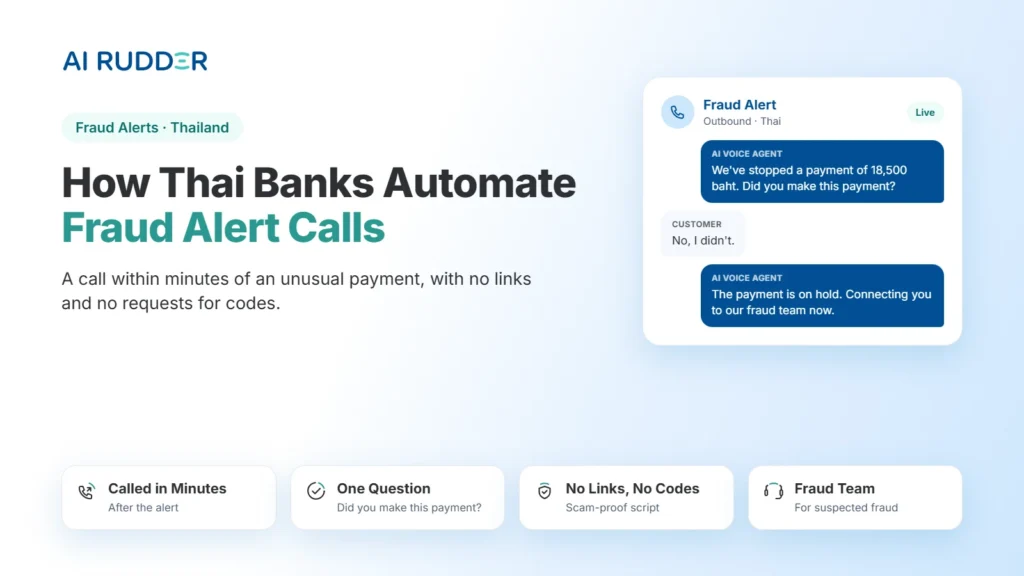
Banks in Thailand automate transaction verification by having an AI voice agent call the customer as soon as a payment looks unusual, confirm whether…
November 4, 2026
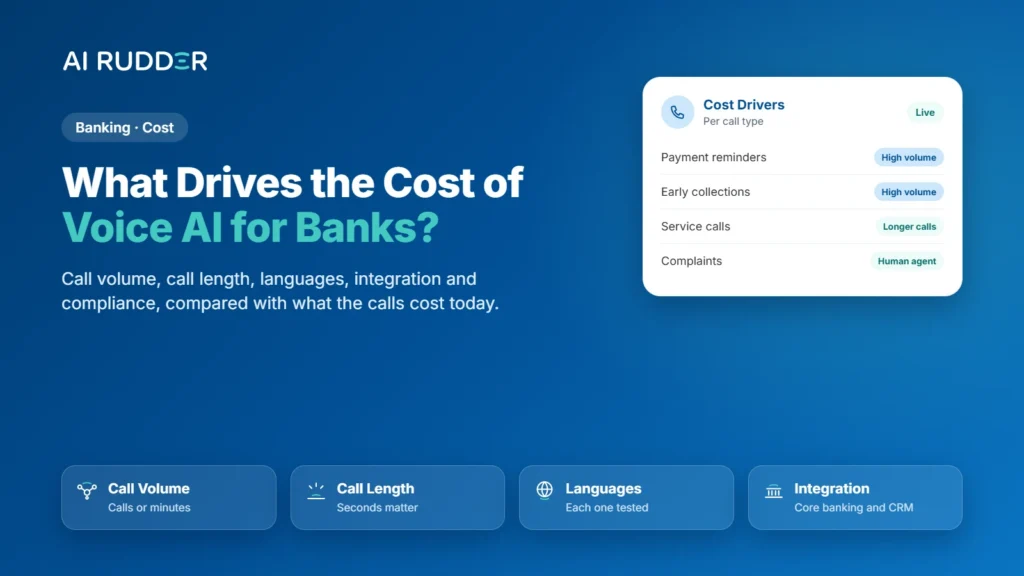
The cost of voice AI for a bank depends on five things: how many calls it makes or answers, how long those calls last,…
November 4, 2026