
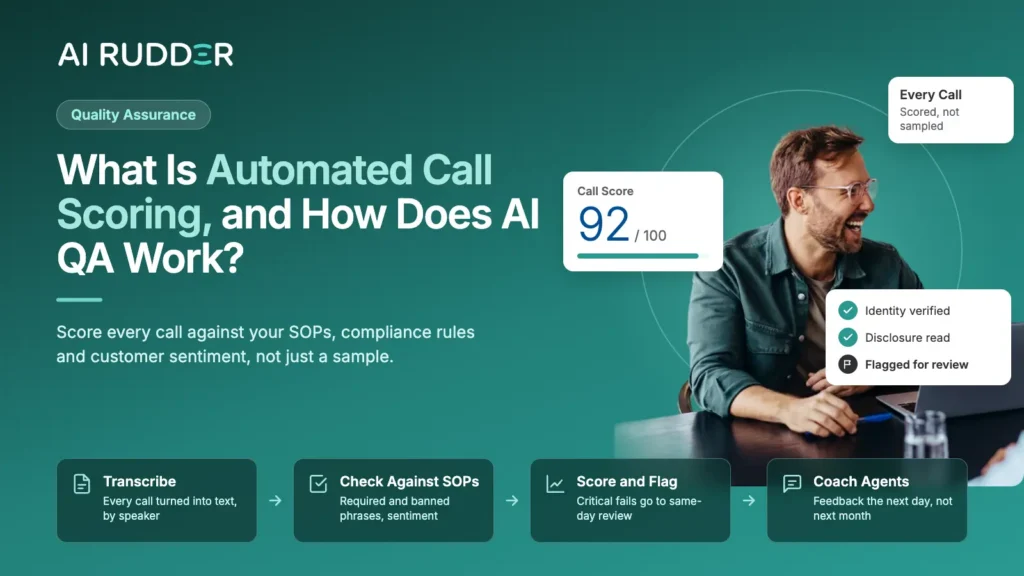
What Is Automated Call Scoring, and How Does AI QA Work?
Automated call scoring uses AI to transcribe every call and score it against your SOPs, compliance rules and customer sentiment, so quality assurance covers…
November 3, 2026
Nov 03, 2026 posted by Ming
The ROI of call center AI comes mainly from two lines you can calculate: agent hours you no longer spend on routine calls, and customers you reach who weren’t being reached before. A third line, better outcomes per conversation, is often the largest but the hardest to predict. Add the first two, subtract the monthly cost of the AI and the process change, and you have a conservative return built from your own numbers.
Most ROI claims you’ll see quote a single savings percentage. That number reflects someone else’s call mix. This guide gives you a way to work out your own, with a worked example, and shows what AI Rudder’s customers have published on its case-study page.
The first line is agent time on routine calls. Every reminder and status call an AI voice agent completes is one a person doesn’t make. This is the easiest return to measure and the one most vendors lead with.
The second line is reach. When call volume is limited by headcount, some customers simply don’t get called. An AI voice agent removes that cap. In collections, a customer reached in the first days after a missed payment is easier to recover than one reached in week four.
Better timing and faster follow-up can change how many calls end in a payment or a resolved question. This is the hardest to predict and often the largest.
You need six numbers from your own operation. The example values below are round, illustrative inputs to show the arithmetic. They aren’t benchmarks or AI Rudder results.
| Input | Where to find it | Example |
|---|---|---|
| A. Calls per month of the type you’d automate | Dialer or ACD reports | 200,000 |
| B. Share of those an AI voice agent can complete end to end | Pilot data, or a conservative estimate | 60% |
| C. Average agent minutes per call, including wrap-up | Workforce management data | 4 |
| D. Fully loaded cost per agent hour | Finance | 8 (in your currency) |
| E. Customers currently not reached each month | Unworked accounts or abandoned list segments | 30,000 |
| F. Average value of one successful outcome | Average amount recovered, or margin per sale | 50 |
Agent-time saving per month = A × B × C ÷ 60 × D
200,000 × 0.6 × 4 ÷ 60 × 8 = 64,000
Value of extra reach per month = E × (your success rate on reached customers) × F
At a 5% success rate: 30,000 × 0.05 × 50 = 75,000
Monthly return = agent-time saving + value of extra reach, minus the monthly cost of the AI and any process change.
Run it twice: once with your conservative estimates and once with your expected ones. If the conservative case doesn’t pay, the project needs a different first use case.
Quality and compliance gains don’t appear in the sum. Every AI call is recorded and transcribed, so Quality Assurance can check every call. That’s real value, but hard to price.
Two effects on your own team are also left out. Taking the most repetitive calls away changes the agent’s job, but we don’t have measured attrition data for it, so it isn’t in the sum. Implementation effort is the other: designing and testing call flows and integrating data takes your team’s time, so count it.
These are each customer’s own results, from their pages on AI Rudder’s website. They depend on each customer’s call mix and baseline, so treat them as examples.
| Customer | Market | Use | Reported result |
|---|---|---|---|
| NEOKARYA | Indonesia | Collections for Megafinance portfolios: AI voice agent, IVR reminders, human agents | 600,000 to 1 million customer records a month; average reach rate of 18.31% over three months |
| CBN | Indonesia | Payment reminder calls and customer satisfaction surveys | Average 27% connection rate; manual workloads and operational costs down 50–70%; productivity up 100–200% |
CBN’s page reports both the connection rate and the share of connected customers who complete the collection outcome (6–10%), alongside the cost reduction, which is why the reach and outcome lines matter.
Step 1: Pick one call type. Payment reminders or status calls are easiest to measure.
Step 2: Pull the six inputs from your dialer, workforce management and finance reports.
Step 3: Run the conservative case. Use a low completion share and a low success rate.
Step 4: Run a pilot beside a control group for four to eight weeks.
Step 5: Replace estimates with pilot data and rerun the sum.
Step 6: Decide where freed hours go. Savings only appear if time is redeployed or not rehired.
Assuming every call can be automated. Use a realistic completion share from a pilot.
Counting reach without outcomes. Extra contacts are only worth something if some of them pay or resolve.
Ignoring transfer costs. Calls the AI hands to people still cost agent time.
Forgetting implementation. Call design, testing and integration take your team’s time.
Comparing against a bad baseline. Measure your current numbers carefully before launch.
What’s a typical ROI for call center AI?
There isn’t a typical figure worth quoting, because call mix changes everything. Customers’ own published results, such as CBN’s 50–70% reduction in manual workloads and operational costs, are examples of what’s possible in a specific operation.
How quickly does it pay back?
It depends on volume and setup effort. High-volume, patterned calls pay back fastest. Use your conservative case to estimate the month the cumulative return passes the cost.
Do AI voice agents reduce operational costs?
CBN reports manual workloads and operational costs down by 50–70% on its case-study page. Your result depends on your calls.
How do you calculate voice AI cost savings?
Multiply the calls the AI completes by agent minutes per call and the cost per agent hour, then subtract the AI’s cost.
Pull the six numbers for one call type. Get a Demo and we’ll work through the calculation with you.
Automated call scoring uses AI to transcribe every call and score it against your SOPs, compliance rules and customer sentiment, so quality assurance covers…
November 3, 2026
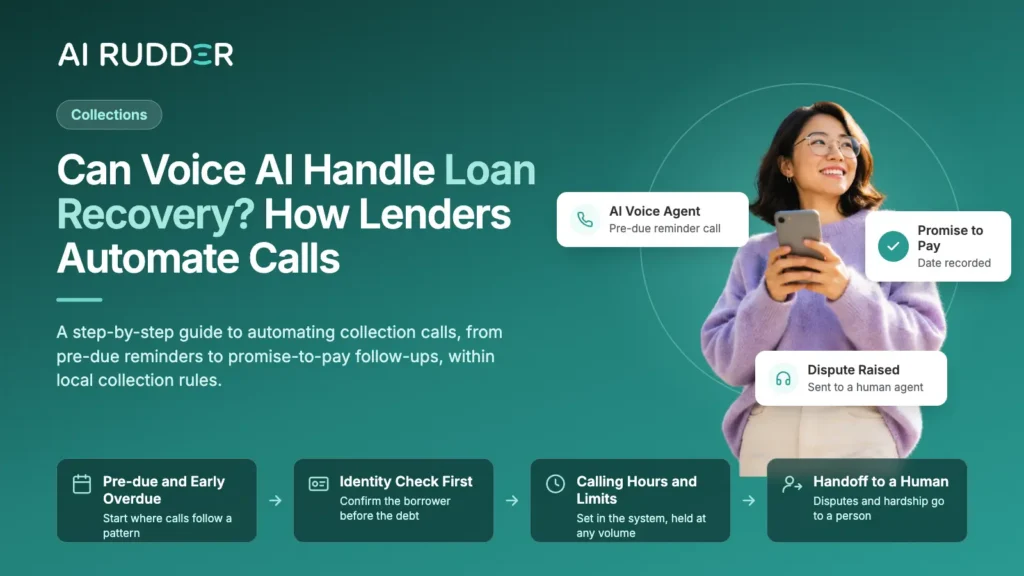
Voice AI can handle most loan recovery calls, with disputes, hardship and late-stage negotiations passed to human agents. Lenders automate collection calls by connecting…
November 3, 2026
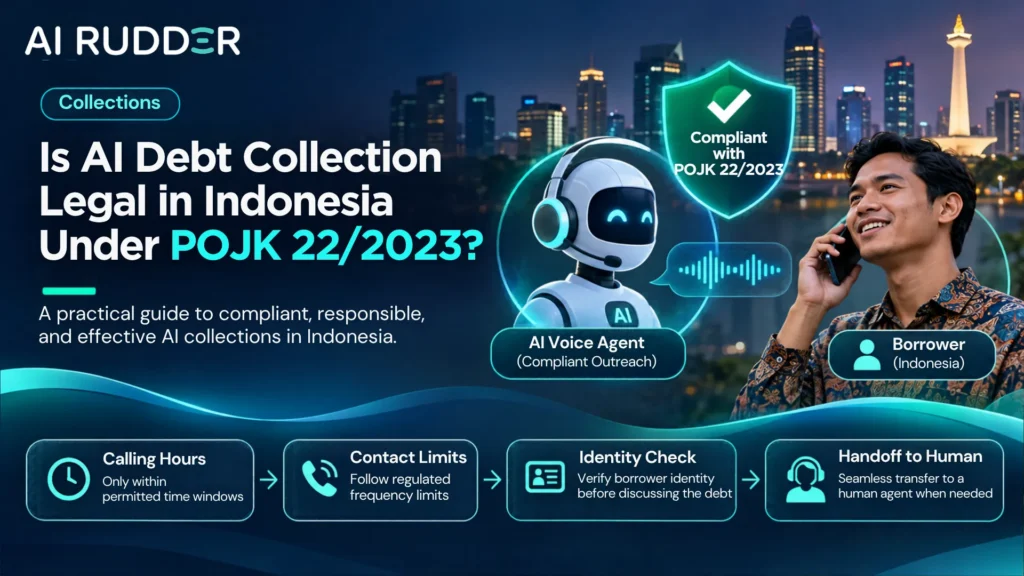
Yes, AI debt collection is legal in Indonesia, provided the calls follow the same rules as any other collection. Each POJK 22/2023 rule can…
November 3, 2026