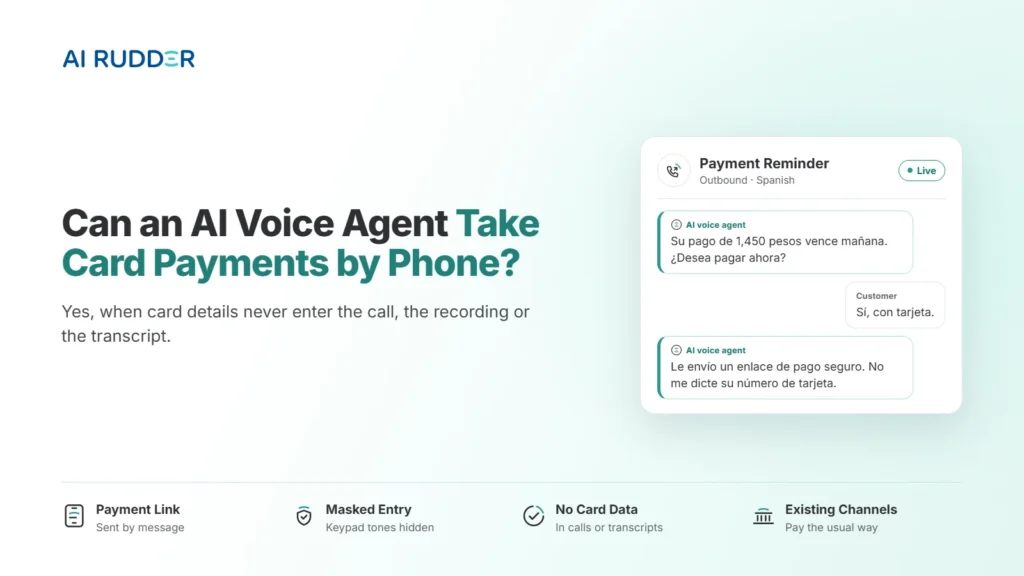
Can an AI Voice Agent Take Card Payments by Phone?
An AI voice agent can help a customer pay by phone, but the card details should never pass through the AI, the call recording…
November 9, 2026
Nov 09, 2026 posted by Ming
The best voice AI for debt collection is the one that follows your collection rules on every call, speaks your borrowers’ languages naturally, hands the right calls to people and proves all of it with a record of each conversation. Speech quality matters, but compliance, local language and the handoff to human agents decide whether a collections program works.
Most “best voice AI” lists rank vendors on features that matter for customer service. Collections is different. The calls are regulated, the customers are under pressure, and a single badly handled call can become a complaint to the regulator. This guide sets out the criteria that matter for collections in Indonesia, Malaysia and Mexico, and the types of vendor you will meet.
Collections buyers usually compare four types of provider:
AI Rudder sits in the last group, with collections as its lead use case since 2019.
Calling windows, daily contact caps, holiday blocks and identity-first scripts should be settings the system enforces. Ask the vendor to show you a campaign that stops itself at the limit.
Indonesia’s POJK 22/2023 allows collection 08:00 to 20:00, Monday to Saturday. Malaysia limits contact to 8:00 a.m. to 9:00 p.m. for buyers of impaired loans and holds lenders responsible for their collectors. Mexico’s CONDUSEF rules allow 7:00 to 22:00 and ban contact with non-guarantors. Most published guides only cover US rules such as the FDCPA, Regulation F and the FCC’s 2024 ruling that AI-generated voices fall under the TCPA. Make sure the vendor knows yours.
Malaysian borrowers switch between Malay and English mid-sentence. Indonesian borrowers speak with strong regional accents. Mexican borrowers expect Mexican Spanish. Ask for test calls with recordings of your own customers.
Pre-due reminders, early overdue calls and late-stage recovery need different scripts. The agent should confirm identity, state the amount, ask for a payment date, handle common objections and record the promise.
Disputes, hardship and distress need a person. The best setups run AI and human agents on one platform, so the transfer carries the conversation and the agent doesn’t ask the customer to start again.
Regulators in all three markets hold lenders responsible for what is said on their behalf. Every call should be recorded, transcribed and checked against your SOPs by automated Quality Assurance.
Customers who miss a call often answer a WhatsApp message. Check that voice and messaging share one contact count and one history.
Call data is personal data under Indonesia’s PDP Law, Malaysia’s PDPA and Mexico’s LFPDPPP. Ask where recordings are stored, for how long and who can access them.
Ask for published results from customers like you. NEOKARYA, a BPO company in Indonesia’s Mega Group, reports on its case-study page that its AI voice agent handles 600,000 to 1 million customer records a month, with an average reach rate of 18.31% over a recent three-month period.
A collections pilot should show results within a quarter, and the right vendor will agree the milestones with you before the first call.
Weeks 1 to 4: configure and test. The call flow, rules and handoffs are built from your collection policy. Compliance approves the scripts. Test calls run against recordings of your borrowers until recognition and responses are reliable in each language.
Weeks 5 to 8: go live on one segment. The agent runs one stage of one portfolio, such as pre-due reminders, with a human team running the same segment as a control. Every call is reviewed, and the scripts are tuned weekly from what borrowers actually say.
Weeks 9 to 12: compare and expand. Compare contact rate, promise-to-pay rate, kept promises, cost per contact and compliance flags against the control. If the numbers hold, add the next stage or the next market.
Two warning signs at this stage: a vendor that can’t show you individual calls behind its dashboard, and a vendor that needs your engineering team to change a script. Your collections team should be able to adjust campaigns themselves.
Buying on a demo voice. A polished demo in US English says little about a call in Javanese-accented Bahasa Indonesia.
Leaving compliance to the script. Rules that live only in a document will be broken at volume.
Separate systems for AI and people. Transfers without context frustrate customers and waste agent time.
No baseline. Without your current contact and payment rates, you can’t tell whether the AI improved anything.
What is the best voice AI for debt collection?
The one that enforces your rules, speaks your borrowers’ languages, hands off cleanly to people and lets you review every call. Test those four things with your own data before comparing price.
Is AI debt collection compliant?
It can be. Regulators apply the same rules to AI and human collectors, so the system must enforce hours, contact limits and third-party rules, and keep a record of each call.
Can voice AI handle collections in local languages?
Yes, if the speech models are trained for them. Ask for test calls in Bahasa Indonesia, Malay and English, or Mexican Spanish, with your own borrowers’ accents.
Do AI voice agents replace collectors?
They take the high-volume, rule-based calls. People keep disputes, hardship and complex cases. You set the rules. We run the agents and keep tuning them.
Get a Demo and we’ll run a test on one of your portfolios, in your borrowers’ language.
An AI voice agent can help a customer pay by phone, but the card details should never pass through the AI, the call recording…
November 9, 2026
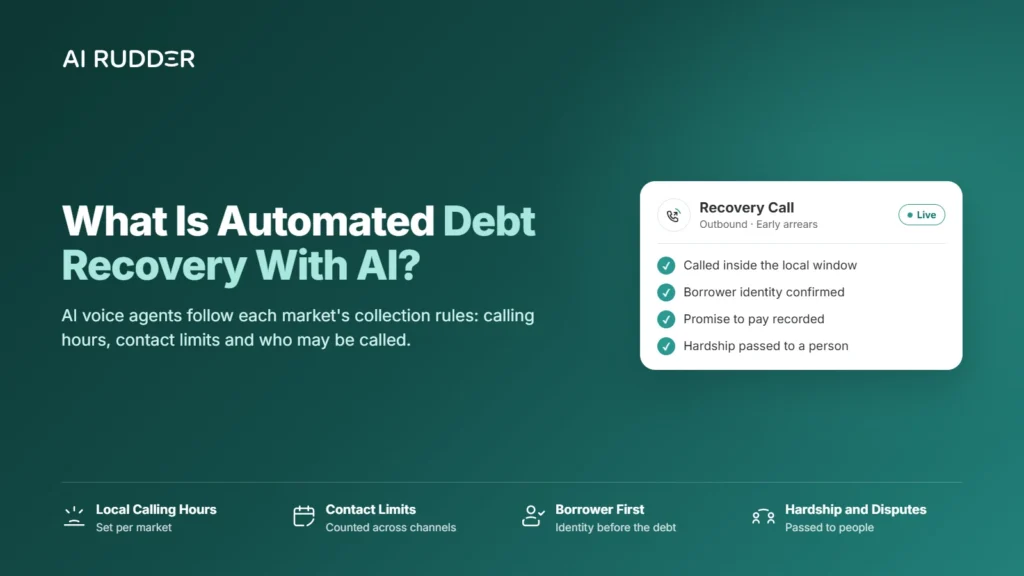
Automated debt recovery with AI is the use of AI voice agents and messaging to contact borrowers about overdue payments, agree a payment date…
November 9, 2026
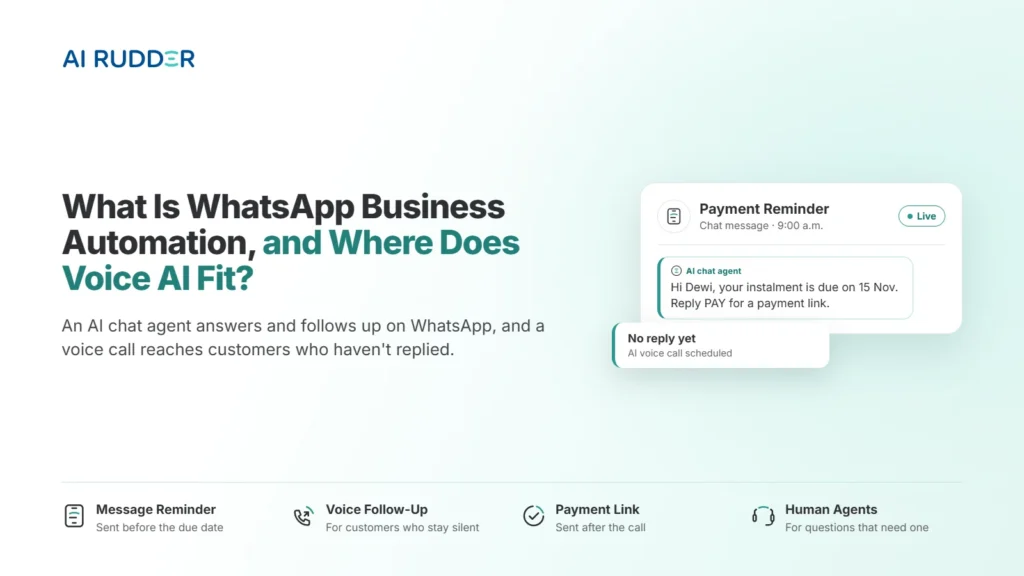
WhatsApp business automation is the use of software, usually an AI chat agent, to answer customers, send reminders and follow up on WhatsApp without…
November 9, 2026