
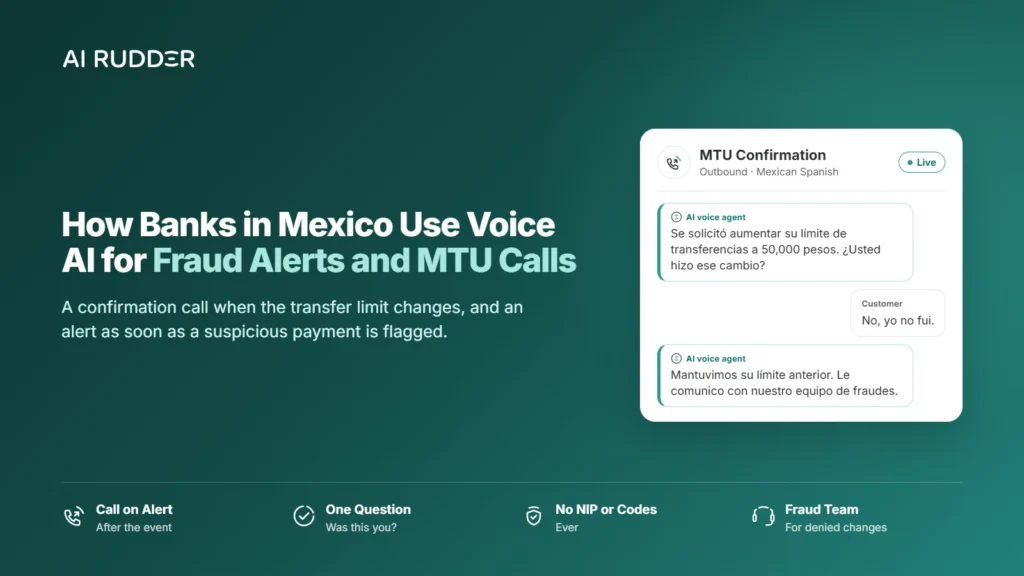
How Banks in Mexico Use Voice AI for Fraud Alerts and MTU Calls
Banks in Mexico use AI voice agents to call customers as soon as a suspicious card payment or transfer is flagged, and to confirm…
November 10, 2026
Nov 03, 2026 posted by Ming
Automated call scoring is the use of AI to transcribe every call and score it against your SOPs, compliance rules and customer sentiment. Each call gets a score and a list of what passed and failed, with flags for the calls a supervisor should review. Quality assurance then covers every call, and agents get feedback the next day.
Traditional QA relies on people listening to a few calls per agent per week. It is slow, expensive and leaves most calls unreviewed. AI QA changes the unit of work: supervisors review the calls the system flags.
Every call is recorded and turned into text, with each speaker identified. Speech recognition tuned to local languages and accents matters here: a poor transcript produces poor scores.
Each transcript is checked against your rules:
Each check carries a weight. The call gets an overall score, and any failure on a critical check, such as a missed identity step before discussing a debt, raises a flag for same-day review.
| Priority | Checks | Why |
|---|---|---|
| 1 | Compliance: identity, disclosures, banned phrases | Regulatory and reputational risk |
| 2 | Process: SOP steps in order | Consistency across agents |
| 3 | Outcome: promise, resolution, sale | Business results |
| 4 | Experience: sentiment, interruptions, hold time | Customer satisfaction |
Step 1: Write your checklist as rules. Each item becomes a check with a clear pass or fail.
Step 2: Weight the checks. Compliance items count most.
Step 3: Calibrate. Have your QA team score a set of calls by hand. Compare with the automated scores and adjust the rules until they agree on most calls.
Step 4: Set the flags. Critical failures go to same-day review; minor ones go to weekly coaching.
Step 5: Share results with agents. Agents see their own calls, scores and the reason behind each flag.
Step 6: Recalibrate monthly and whenever scripts or rules change.
Trust comes from calibration. Pick a set of calls each month, have two people score them by hand, and compare with the automated scores. Where they disagree, look at why: a rule written too narrowly, a phrase the customer said differently, a transcription error in a strong accent. Fix the rule, and the scores follow. Over time the disagreement rate is itself a measure of QA quality, and it should fall.
The overnight run has scored every call from the previous day. The supervisor opens a list of flagged calls, sorted by severity, each linked to the moment in the recording. They review the critical flags first, send coaching notes and notice that one script line is confusing customers across the team. That goes to the training lead the same morning.
Post-call scoring tells you what happened yesterday. Real-time monitoring tells you what is happening now. Supervisors can watch live voice and text conversations, see sentiment drop on a call in progress and step in before a complaint is made. The two work together: real-time monitoring catches the urgent cases, and automated scoring covers everything else the next morning.
Automated scoring isn’t only for human agents. Calls made by AI voice agents should be checked against the same SOPs: did the agent confirm identity before discussing the account, stay within the approved wording, transfer when the customer asked for a person? Scoring both on one standard makes it easy to compare AI and human performance on the same call type, and to find the calls where the AI should hand over sooner.
Scoring before calibrating. Agents won’t accept scores they don’t trust.
Too many checks at once. Start with compliance and process.
Weak transcription. Test speech recognition on your own calls, in your languages.
Scores without action. Full coverage only improves calls if someone coaches from it.
AI Rudder’s Quality Assurance checks conversations against SOPs the client defines, with sentiment analysis and multilingual support, plus real-time voice and text monitoring, scoring and dashboards. It works inside AI Rudder’s AI Contact Center or on its own, and covers calls made by both AI voice agents and human agents. AI Rudder is built to meet SOC 2 and ISO 27001, alongside GDPR and PDPA requirements.
What is automated call scoring with AI?
AI transcribes every call and scores it against your SOPs, compliance rules and sentiment, flagging calls for review.
How do you automate quality assurance in call centers?
Turn your QA checklist into rules, calibrate them against human scores and let the system score every call.
How do you automate call quality monitoring?
Add real-time monitoring alongside post-call scoring, so supervisors see live issues as well as daily reports.
Does AI QA replace the QA team?
No. The team’s time moves from listening to samples to reviewing flags, calibrating rules and coaching agents.
Share your current QA checklist. Get a Demo and we’ll show you how it would score every call.
Banks in Mexico use AI voice agents to call customers as soon as a suspicious card payment or transfer is flagged, and to confirm…
November 10, 2026
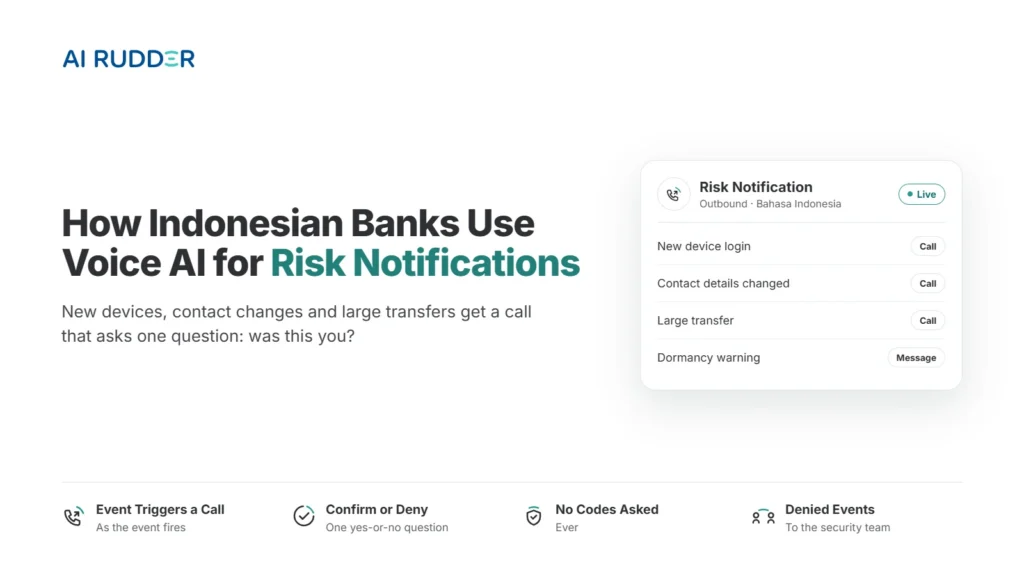
Banks in Indonesia use AI voice agents to call customers about account risks, such as a new device login or a large transfer. The…
November 10, 2026
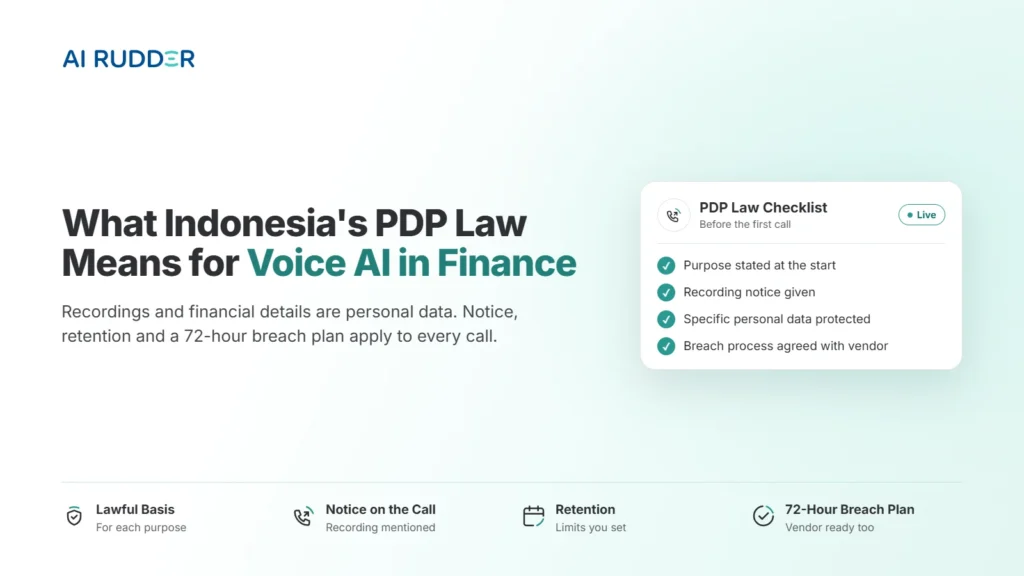
Indonesia's Personal Data Protection Law, Law No. 27 of 2022, applies to every call an AI voice agent makes or takes for banks and…
November 10, 2026